Spring AI in Practice: RAG, MCP, and Agents for Java Developers
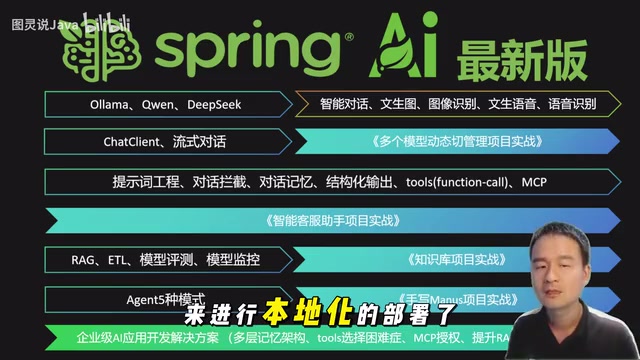
A complete Spring AI course for Java developers covering RAG, MCP, and Agents for enterprise AI development.
The release of Spring AI's stable version gives Java developers a familiar path into AI application development. This course by Bilibili creator Xu Shu systematically covers model integration, prompt engineering, Tools, MCP, RAG, and five Agent patterns, paired with three hands-on projects. The latter half addresses real enterprise challenges including multi-layer memory, tool selection, MCP authorization, and RAG retrieval accuracy — making it a strong resource for Java engineers transitioning into AI development.
Why Java Developers Should Pay Attention to Spring AI
With the release of Spring AI's stable version, Java developers can finally use their familiar tech stack to integrate large language models into AI applications — no longer forced into the Python ecosystem. This Spring AI course series, created by Bilibili content creator Xu Shu over nearly two months, is built around exactly this shift — taking developers from beginner to hands-on practitioner, then deeper into the underlying principles, covering the major enterprise AI deployment scenarios of today.
The course author's take is worth noting: as the performance and cost of open-source large models have reached a point where enterprises can realistically deploy them locally, a wave of businesses and individual entrepreneurs are set to enter AI application development. Rebuilding or augmenting traditional systems with AI is seen as the single most important growth opportunity in the IT industry going forward. For Java developers, Spring AI offers a low-barrier entry point into AI development.
Core Technical Modules Covered
The course follows a fairly complete technical arc, stretching from model integration all the way to agent development. A few key areas are worth highlighting.
Model Selection and Multi-Model Integration
The course opens with a look at how to choose the right large model, comparing different integration approaches — covering both locally deployed models and popular cloud-based options like Qianwen and DeepSeek. This section helps developers think through the trade-offs between cost, performance, and data security. Multi-modal use cases — including conversational AI, text-to-image, image recognition, text-to-speech, and speech recognition — are all demonstrated using ChatClient for streaming dialogue.
Prompt Engineering and Conversation Enhancement
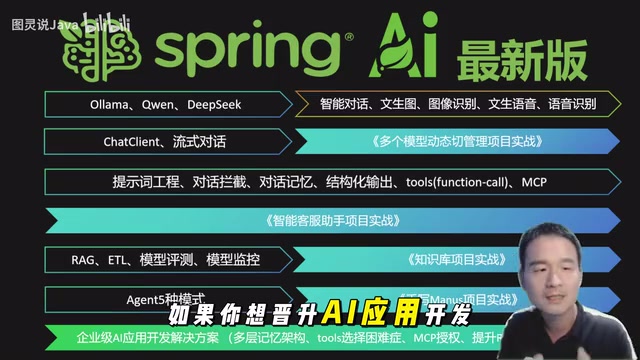
The advanced section zeroes in on Spring AI's core capabilities: prompt engineering, conversation interception, conversation memory, structured output, Tools function calling, and MCP (Model Context Protocol). These capabilities are what transform a large model from something that "can chat" into something that "can work" — and they form the foundation for building controllable AI applications.
MCP (Model Context Protocol) is an open standard proposed and championed by Anthropic in late 2024, designed to unify the interface between large models and external tools and data sources. Think of it as the "USB port" of the AI world — whether it's a database query, a file system, or a third-party API on the other end, any tool that follows the MCP protocol can be called by the model in a consistent way. Tools (Function Calling) is a capability that model providers introduced earlier, allowing models to proactively trigger predefined functions during a conversation and incorporate the results into their responses. MCP builds on Tools by further standardizing service discovery, permission declaration, and session management, enabling a tool ecosystem that can be reused across models and platforms. Spring AI has integrated support for MCP, which is the context behind the course's dedicated coverage of MCP authorization.
Three Hands-On Projects Connecting the Concepts
One of the course's strengths is that every module is immediately followed by a practical project, preventing the knowledge from staying purely theoretical.
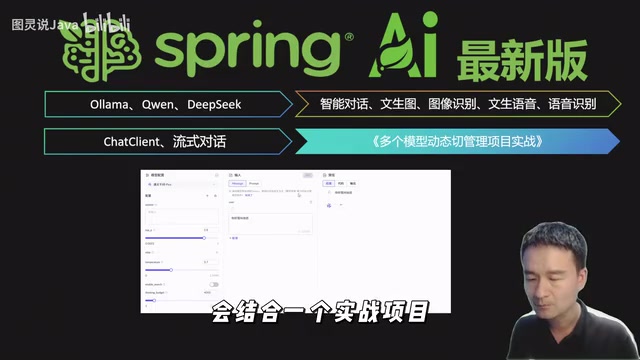
Multi-Model Dynamic Switching Management System
After covering model integration and streaming dialogue, the first hands-on project is a dynamic multi-model switching management system. In real-world applications, different tasks often require different models, and this kind of system addresses the engineering challenge of model orchestration and dynamic scheduling.
Intelligent Customer Service Assistant
Building on prompt engineering, conversation memory, Tools, and MCP, the course delivers an intelligent customer service assistant project. The author notes that this is one of the most typical and common real-world AI application scenarios right now, and offers strong reusability.
Knowledge Base System with RAG
After covering RAG, ETL, model evaluation, and model monitoring, the course wraps up with a knowledge base system as the final hands-on project. The knowledge base is treated as the most comprehensive application of RAG — covering the full pipeline from document processing and vector retrieval to retrieval accuracy optimization.
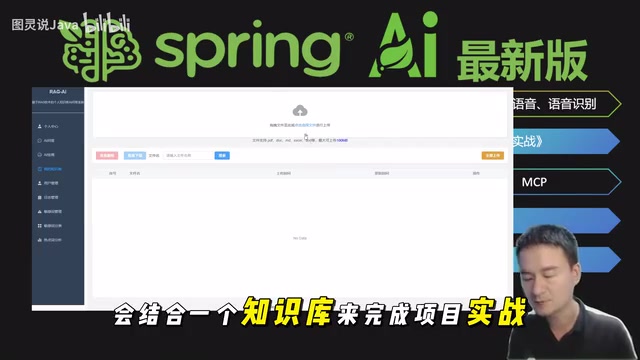
RAG (Retrieval-Augmented Generation) is one of the most important architectural patterns in enterprise AI applications today. The core idea is straightforward: before querying a large model, first retrieve relevant document chunks from an external knowledge base, then feed those chunks as context into the model alongside the question — enabling the model to answer questions about private or up-to-date knowledge that wasn't part of its training data. In the context of RAG, ETL (Extract-Transform-Load) refers to the document preprocessing pipeline — parsing raw files like PDFs, Word documents, and web pages, then chunking, vectorizing, and storing them in a vector database for later retrieval. The accuracy of vector retrieval directly determines the quality of the final answer; common optimization techniques include tuning chunking strategies, using a reranker model, and hybrid retrieval (combining keyword and semantic search). Spring AI provides complete abstraction support for the RAG pipeline, so developers don't need to build a retrieval system from scratch.
Five Agent Patterns and Enterprise-Level Challenges
The course also dedicates a section to the five patterns of intelligent agents (Agents), and guides students through building an Agent project by hand. The author believes that understanding these five patterns gives developers a completely new mental model of what agents can do.
The closing section focuses on real pain points in enterprise AI application development, offering solutions for several categories of problems:
- Multi-layer memory architecture: Handling long conversations and context management
- Tool selection difficulty: How to help the model accurately choose the right tool when many are available
- MCP authorization: Permission control under the Model Context Protocol
- RAG retrieval accuracy improvement: Engineering-level approaches to optimizing recall quality
These are exactly the hurdles that many AI applications hit when moving from demo to production — and they're also what distinguishes this course from a basic introductory tutorial.
Conclusion
For Java engineers looking to break into AI application development, this Spring AI course offers a fairly systematic learning path: from model integration and prompt engineering to RAG, MCP, and Agents, supported by three hands-on projects covering multi-model management, intelligent customer service, and a knowledge base system. Theory and engineering practice are tightly interwoven throughout. The curriculum reflects the mainstream technology stack for enterprise AI applications today, and serves as a useful reference for anyone assessing the entry barrier and practical priorities of this direction.
Related articles

LynnReal-Omni: 32B Unified Video Diffusion Model Goes Open Source with Multi-Task Coverage in Four Steps
LynnReal-Omni is a 32B unified video diffusion model on MiniMax H3, covering text-to-video, pose guidance, style transfer, restoration in 4 steps. Flash version generates 540p video in 377ms on one H100.

Anthropic Co-Founder: AI 'Kill Switch' May Need to Be Mandatory by Law
Anthropic's co-founder tells the BBC that AI 'kill switches' may need to be legally mandated. We analyze the industry logic, technical challenges, and the tension between regulation and innovation.

The AI Data Center Boom Is Colliding With Cities Scarred by Heavy Industry
The AI data center boom is clashing with post-industrial communities. Philadelphia's case reveals structural conflicts between AI growth, energy use, water, and environmental justice.