SpriteStage: Progressive Scene Programming for Long-Form Animation Generation

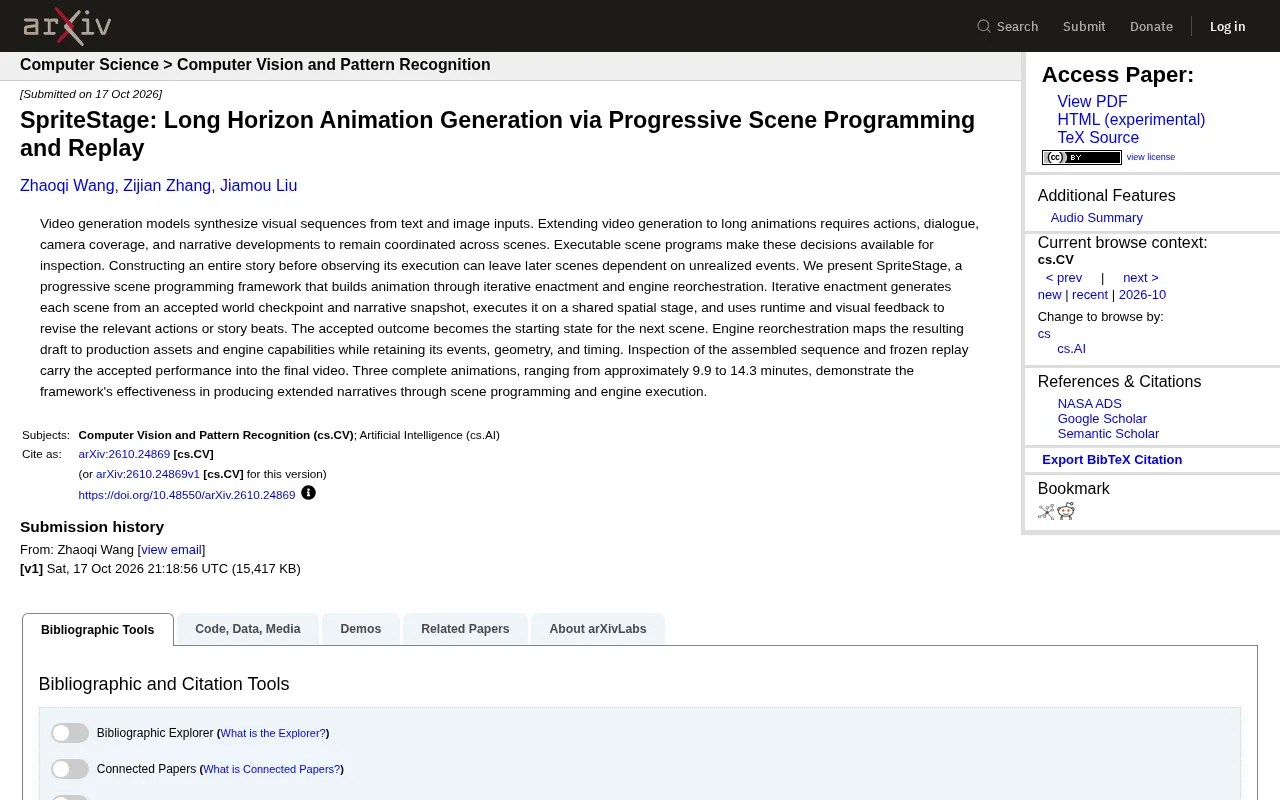
SpriteStage uses progressive scene programming and engine re-choreography to generate long-form animation, avoiding the rework risk of one-shot prediction.
To address the consistency challenges caused by 'unrealized dependencies' in long-form animation generation, SpriteStage breaks the process into iterative staging, engine re-choreography, and frozen replay. Iterative staging generates scenes based on accepted world checkpoints and narrative snapshots with feedback-driven revision; engine re-choreography maps drafts to production assets while preserving event, geometry, and timing information; frozen replay ensures output matches the confirmed version. Experiments produced three complete animations of about 9.9 to 14.3 minutes, validating the framework's ability to handle long-form narrative and offering a new direction for AI video tools to move from clip generation toward story orchestration.
Video generation models can already synthesize short clips from text or images, but extending videos into long-form animation requires coordinating motion, dialogue, camera coverage, and narrative development while ensuring cross-scene consistency. The traditional approach of "build the complete story first, then render" carries risks: later scenes depend on events that haven't happened yet, and once early decisions go wrong, the cost of reworking everything is enormous. A recent paper proposes SpriteStage, which uses progressive scene programming and engine re-choreography to break long-form animation generation into iterative, replayable stages, offering a new approach to long-form narrative animation.
Core Challenge: Global Consistency in Long-Form Animation
Long-form animation generation differs from short video synthesis: it requires character motion, dialogue, camera movement, and plot progression to remain coherent across dozens of scenes. With a one-shot generation approach, the model must plan every detail without observing any execution results, which easily leads to later scenes diverging from earlier setups. SpriteStage's starting point is precisely to solve this "unrealized dependency" problem—letting each scene be generated based on confirmed world states and narrative snapshots rather than predictions made from thin air.
Unrealized dependency is a concept from software engineering and planning that refers to a decision or build step depending on subsequent results that have not yet been produced or verified. In long-form animation generation, if all scenes are planned at once, the setups of later scenes (such as character positions, prop states, and plot twists) must be based on predictions about earlier scenes, and once predictions deviate, they cause cascading rework. SpriteStage cuts this dependency chain through "accepted world checkpoints," so that each scene depends only on confirmed past states, transforming a global consistency problem into a locally verifiable one.
SpriteStage's Three-Stage Workflow
SpriteStage divides animation construction into three stages—iterative staging, engine re-choreography, and frozen replay—forming a closed loop.
Iterative Staging: Scene-Level Execution and Feedback Revision
Starting from an accepted world checkpoint and narrative snapshot, the system generates an initial plan for the current scene and executes it on a shared spatial stage. During execution, runtime feedback and visual feedback are used to revise relevant actions or story nodes. Only accepted results become the starting state for the next scene, thereby avoiding error accumulation. This mechanism is similar to continuous integration in software development—each scene goes through a "build-test-fix" loop to ensure a solid foundation.
World checkpoints and narrative snapshots are two key state abstractions in SpriteStage. A world checkpoint records the spatial positions, attributes, and relationships of all entities in a scene at a given moment, equivalent to a save file in a game engine; a narrative snapshot records the events that have occurred, character goals, and plot state, equivalent to a story state machine. Together they constitute the starting conditions for the next scene, ensuring that the "world" and the "story" advance in sync during iteration. This separation means that action revisions do not accidentally change narrative logic, and vice versa.
Engine Re-choreography: From Draft to Production Assets
Once a draft scene is finalized, the engine re-choreography stage maps it onto actual production assets and engine capabilities while preserving the original event, geometry, and timing information. This means the animation's narrative logic is decoupled from final rendering: creators can first focus on story and action design, then let the engine produce high-quality output. This separation increases flexibility and reduces the cost of repeated revisions.
Engine re-choreography draws on the game development pipeline from "greybox testing" to "final assets": first validating motion and camera choreography with simple geometry or placeholders, then replacing them with high-precision models, materials, and lighting once confirmed. The key to this stage is preserving event, geometry, and timing information—that is, the narrative semantics remain unchanged while only the execution carrier migrates from the draft stage to the production engine. This decoupling lets creators iterate quickly on low-cost drafts while reserving expensive rendering compute for the final confirmed version, significantly reducing the iteration cost of long-form animation.
Frozen Replay: Assembly and Final Output
Once all scenes are ready, the system checks the assembled sequence and brings the accepted performances into the final video through frozen replay. The replay mechanism ensures the final output matches the version confirmed during iteration, avoiding unexpected deviations during rendering.
Experimental Validation: Three Complete Animations
The paper presents three complete animations ranging from about 9.9 minutes to 14.3 minutes in length. These works cover multiple elements required for extended narrative, validating the framework's feasibility for long-form animation generation. Although the paper does not disclose specific quantitative metrics, the durations alone show that SpriteStage can handle narrative lengths far beyond what traditional video generation models can achieve.
Implications for Animation and Video Generation
SpriteStage's value lies in transforming long-form animation generation from "one-shot prediction" into "progressive programming." Through executable scene programs, creative decisions become inspectable and replayable, giving animators an interactive experience similar to debugging code. For AI video generation, this approach may push tools to evolve from "generating clips" to "orchestrating stories." Of course, the framework currently relies on engine execution, and how to combine it with purely neural video generation models remains an open question.
Executable scene programs refer to describing scenes as sequences of instructions that can be interpreted and executed by an engine, rather than static pixels or implicit neural representations. Their advantage is that they are inspectable, replayable, and locally modifiable: animators can locate problematic scenes like debugging code, replay specific segments, or replace an action node without affecting the whole. This contrasts with current mainstream video generation models, whose outputs are uninterpretable pixel sequences. SpriteStage's limitation lies here as well—it relies on traditional engine execution, and how to give neural video generation models similar programmatic controllability is a key direction for future research.
Conclusion
Through progressive scene programming and engine re-choreography, SpriteStage provides a systematic solution to the consistency problem in long-form animation generation. Its combination of iterative staging, asset mapping, and frozen replay makes the construction of long-form narrative animation more controllable. As video generation models continue to develop, such programming-based frameworks may become an important bridge connecting creative storytelling and production rendering.
One-line Summary
SpriteStage uses progressive scene programming and engine re-choreography to generate long-form animation, avoiding the rework risk of one-shot prediction.
Paragraph Summary
To address the consistency challenges caused by "unrealized dependencies" in long-form animation generation, SpriteStage breaks the construction process into three stages: iterative staging, engine re-choreography, and frozen replay. Iterative staging generates scenes one by one based on accepted world checkpoints and narrative snapshots, using runtime and visual feedback to revise actions or story nodes; engine re-choreography maps drafts to production assets while preserving event, geometry, and timing information, decoupling narrative from rendering; frozen replay ensures the final output matches the confirmed version. Experiments generated three complete animations of about 9.9 to 14.3 minutes, validating the framework's ability to handle long-form narrative and offering a new direction for AI video tools to move from clip generation toward story orchestration.
Related articles

How Gen Turns Data into Decisions with ChatGPT Work
In an OpenAI user case, business leader Gen shares how ChatGPT Work turns data into decisions: within hours of launch, teams can judge whether integrations and onboarding flows work, shifting decision iteration from hundreds of trial-and-error attempts to a fast feedback loop.

ChatGPT vs. Claude In-Depth Comparison: Strong at Coding but Weak at Research — How to Bridge the Gap?
A user considers switching from ChatGPT to Claude, finding Claude stronger at coding but shallower at research. We analyze the differences and share tips to make Claude's research deeper.

Theranos Whistleblower Warns: The AI Boom Is "a Great Opportunity to Deceive"
Theranos whistleblower Tyler Shultz warns the AI boom is "a great opportunity to deceive" as never-profitable companies raise capital at trillion-dollar valuations. This article examines the real-world context, key differences between AI and Theranos, and practical criteria for investors and practitioners.