Sprout Pi Gives Old iPods a New Lease on Life: Bluetooth, Streaming, and USB-C All Included

Sprout Pi uses a full motherboard replacement to give old iPods Bluetooth, Wi-Fi, USB-C, and FLAC support in one go.
The article introduces Sprout Pi and Sprout Pico, two iPod motherboard replacement solutions. Rather than simple modular accessories, they integrate Bluetooth, Wi-Fi, USB-C, microSD, and FLAC playback onto a single board—users just open their iPod and swap the original motherboard for modern features. The article compares full motherboard replacement with traditional incremental mods, noting the former offers higher integration but a steeper learning curve, suited for users with some hands-on skills. It also places this solution in the broader context of iPod modding culture, arguing it reflects the community's passion for extending classic hardware's life after official discontinuation, and offers an attractive option for idle iPod owners—though pricing and detailed compatibility still need confirmation.
A New Path for Old iPods
Although the iPod was discontinued long ago, the modding ecosystem around it has remained quite active. From battery replacements and SSD swaps to Bluetooth module retrofits, all kinds of piecemeal modification solutions keep emerging. However, most of these mods require users to do their own soldering and case cutting, which sets the bar fairly high.
The arrival of Sprout Pi and Sprout Pico offers a more thorough solution—they're not simple modular accessories, but complete motherboard replacement solutions that integrate all the popular mod features—Bluetooth, Wi-Fi, USB-C, microSD card slot, FLAC playback—onto a single board.
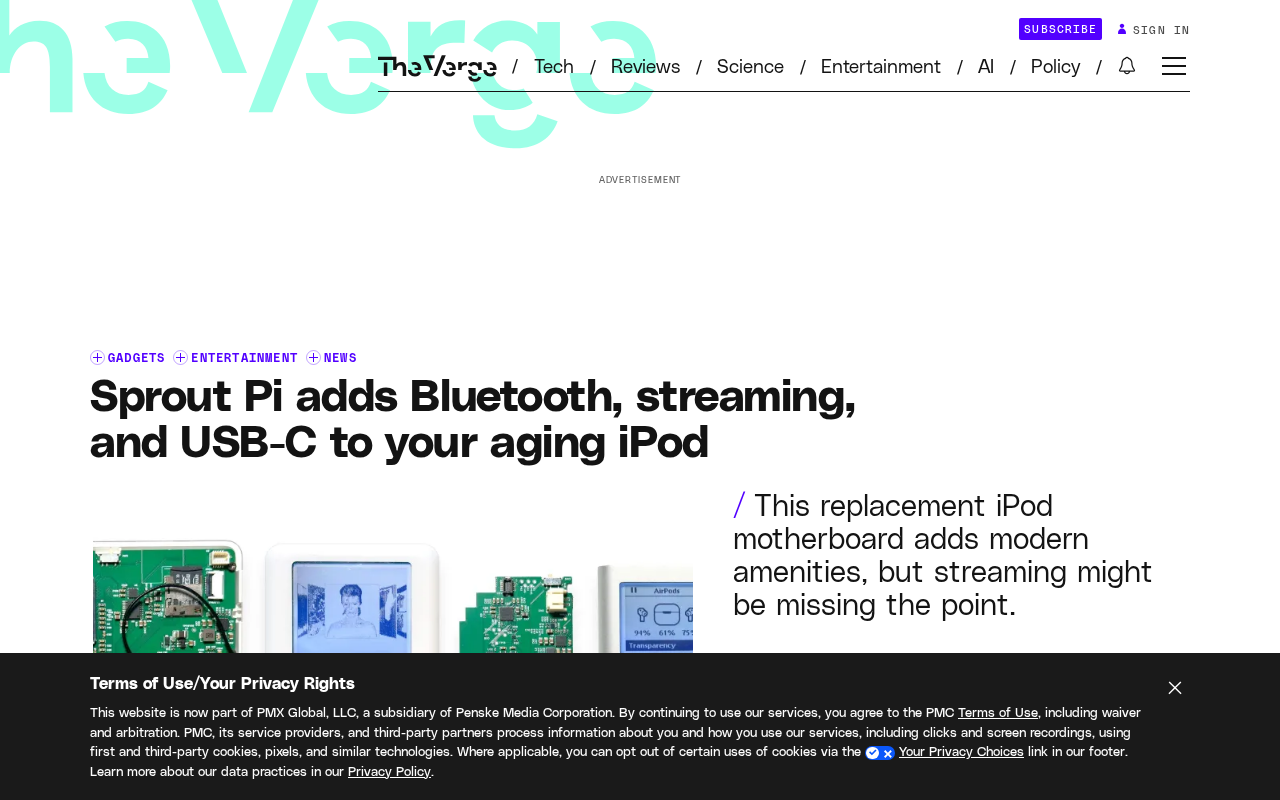
In other words, you no longer need to tinker with individual parts one by one. Open up your iPod, swap the original motherboard for a Sprout Pi, and you get almost every modern feature you could want in one go.
One Motherboard Solves All the Pain Points
The biggest problems with the original iPod are its closed nature and obsolescence. The 30-pin connector was phased out long ago and can't directly connect to modern devices; no Bluetooth means you're stuck with wired headphones; no streaming support means music must be synced in advance; and storage is fixed with no way to expand.
Sprout Pi's approach is straightforward: keep the iPod's classic look and feel while completely replacing the internal core.
Specifically, both versions support:
- Bluetooth audio: Pair with wireless headphones and speakers
- Wi-Fi connectivity: Network features enabled, paving the way for streaming
- USB-C port: Say goodbye to 30-pin and charge/transfer data with standard cables
- microSD card slot: Storage no longer limited by the original hard drive
- FLAC playback: Lossless audio format support for audiophiles
Together, these features essentially transform the iPod from an "offline music player" into a portable device that supports modern audio standards.
The 30-pin connector was a proprietary connection standard Apple used from 2003 to 2012, featuring 30 metal contacts and widely used for data transfer and charging on iPods, iPhones, and iPads. Its physical size was relatively large, and Apple strictly controlled the accessory ecosystem through its MFi certification program. After Apple introduced the Lightning connector in 2012, the 30-pin was gradually phased out, and today it's nearly impossible to find modern devices or cables with native support for it. For iPod users, this means the original connector can't directly connect to current computers, chargers, or car systems—you have to rely on adapters, which often don't support audio output or fast charging, greatly diminishing the experience. Sprout Pi replaces the 30-pin with USB-C precisely to solve this most fundamental compatibility bottleneck.
The Difference Between Sprout Pi and Sprout Pico
There are currently two versions available. According to the original source, Sprout Pi and Sprout Pico are highly consistent in functionality, both offering Bluetooth, Wi-Fi, USB-C, microSD, and FLAC support. The differences mainly come down to size and which iPod models they fit—the Pico version typically targets smaller form-factor models.
This "full motherboard replacement" approach isn't common in the iPod modding community. Most mod solutions are incremental: add a Bluetooth module, swap a battery, upgrade the storage. Sprout Pi's approach is more like "starting from scratch," replacing Apple's original design with a modern motherboard. The upside is high integration and complete functionality; the trade-off is that the modding difficulty may be greater than soldering a module yourself, since you need to disassemble the entire device and replace core components.
FLAC (Free Lossless Audio Codec) is a lossless audio compression format. Unlike lossy formats such as MP3 and AAC, it doesn't lose any audio information during compression and can fully restore the original PCM data upon decompression. FLAC files are typically 50%-60% the size of CD-quality audio, far smaller than uncompressed WAV, making them the preferred format for audiophiles and digital music archiving. However, the Apple ecosystem has long been dominated by ALAC (Apple Lossless) and AAC, and the original iPod doesn't natively support FLAC playback—users need third-party firmware (such as Rockbox) to achieve it. Sprout Pi's direct integration of FLAC support means it breaks free from Apple's format restrictions, letting users directly play lossless music downloaded from the internet or ripped from their own CDs. For iPod modding enthusiasts chasing sound quality, this is a key selling point.
A Microcosm of Modding Culture
iPod modding has already formed a small "cottage industry" ecosystem. From refurbished units on eBay to various custom cases and battery kits to motherboard-level solutions like Sprout Pi, users' enthusiasm for this discontinued product hasn't faded.
This actually reflects an interesting phenomenon: when the official manufacturer stops providing support, the community takes matters into its own hands to extend the product's life. What Sprout Pi does is essentially reinterpret a classic device with modern hardware—keeping its soul (the click wheel operation, portable form factor, music-focused philosophy) while swapping in a core that fits today's usage habits.
For those who still have an old iPod lying around and can't bring themselves to throw it away, this solution offers a pretty attractive option: get Bluetooth and USB-C without buying a new device.
Cottage industry ecosystem here refers to a production model led by small teams or individual developers, targeting specific niche needs. Unlike large-scale industrial production, this type of ecosystem typically relies on community forums, crowdfunding platforms, and word of mouth for distribution. Production runs are small and iteration is fast, but it often precisely meets needs that official manufacturers have already abandoned. In the iPod modding space, this ecosystem manifests as: refurbished unit sellers on eBay, custom battery and case kits on Taobao, open-source firmware projects on GitHub, and small-batch motherboard solutions like Sprout Pi. Its existence shows that when a product has a sufficiently large user base and strong emotional attachment, even after the official discontinuation, the community can spontaneously form a sustainable supply-and-demand chain, extending the product's practical lifespan.
Is It Worth Considering?
If you have an idle iPod and are willing to open it up, the Sprout Pi series is definitely a direction worth watching. It bundles multiple popular mod features together, saving you the hassle of tinkering with them one by one.
But there are trade-offs to weigh: full motherboard replacement means a higher modding barrier, suitable for users with some hands-on skills. Also, the original source doesn't mention specific pricing or a detailed compatibility list, so this information needs further confirmation before making a decision.
Either way, Sprout Pi's existence proves one thing: the vitality of classic hardware sometimes depends not just on the manufacturer, but also on a user community willing to tinker.
Related articles

Kimi K3.1 Hands-On Test: Open-Source Model Nears Opus, Video Generation Steals the Show
Kimi K3.1 completed motion graphics, 3D rendering, mini-games, and video generation in a live test. Analysis of its 2.8T MoE architecture, gap vs Opus/GPT, and hidden video generation.

Sam Altman: Why Life's Biggest Advice Should Still Come from Humans
OpenAI CEO Sam Altman on the limits of AI advice: AI can talk you out of an impulsive email, but life's biggest advice should still come from humans.

"Black October": Did AI Uncover 3% of All Critical Vulnerabilities Ever?
A Reddit post claims 3% of all critical software vulnerabilities ever were found in the past month, dubbed 'Black October.' We break down the statistical issues, how AI-assisted code auditing accelerates discovery, and how developers should respond.