SPW-Nav: A Deep Dive into the Language-Guided Streaming Panoramic World Model

SPW-Nav streams one-minute 2K 360° video from a single panoramic image via natural language instructions.
SPW-Nav is a language-guided streaming panoramic world model that interprets natural language movement instructions as camera displacement and rotation, generating up to one minute of 2K 360-degree video in real time from a single panoramic image — with support for on-the-fly instruction switching. Its three core innovations are: spherical rotation decoupling (applying rotations on the sphere to eliminate projection distortion), pose-aligned conditioning (bounding translation inputs to prevent long-sequence divergence), and a multi-term memory mechanism paired with a few-step generator for smooth instruction transitions. The team also released the SPW-NavSet dataset and demonstrated superior camera-following accuracy and video quality over existing panoramic generation methods.
A New Approach to Panoramic Video Generation
Language-guided panoramic video generation is emerging as a key technology bridging virtual and real worlds. Whether for interactive 3D scene exploration, VR experiences, or training embodied agents, there is a growing need for models that can generate high-quality panoramic frames in real time based on natural language instructions. Existing solutions, however, have clear limitations: traditional panoramic generators can only travel along predefined trajectories, while interactive world models are confined to perspective-view, low-level action control — making them ill-suited for free, continuous navigation.
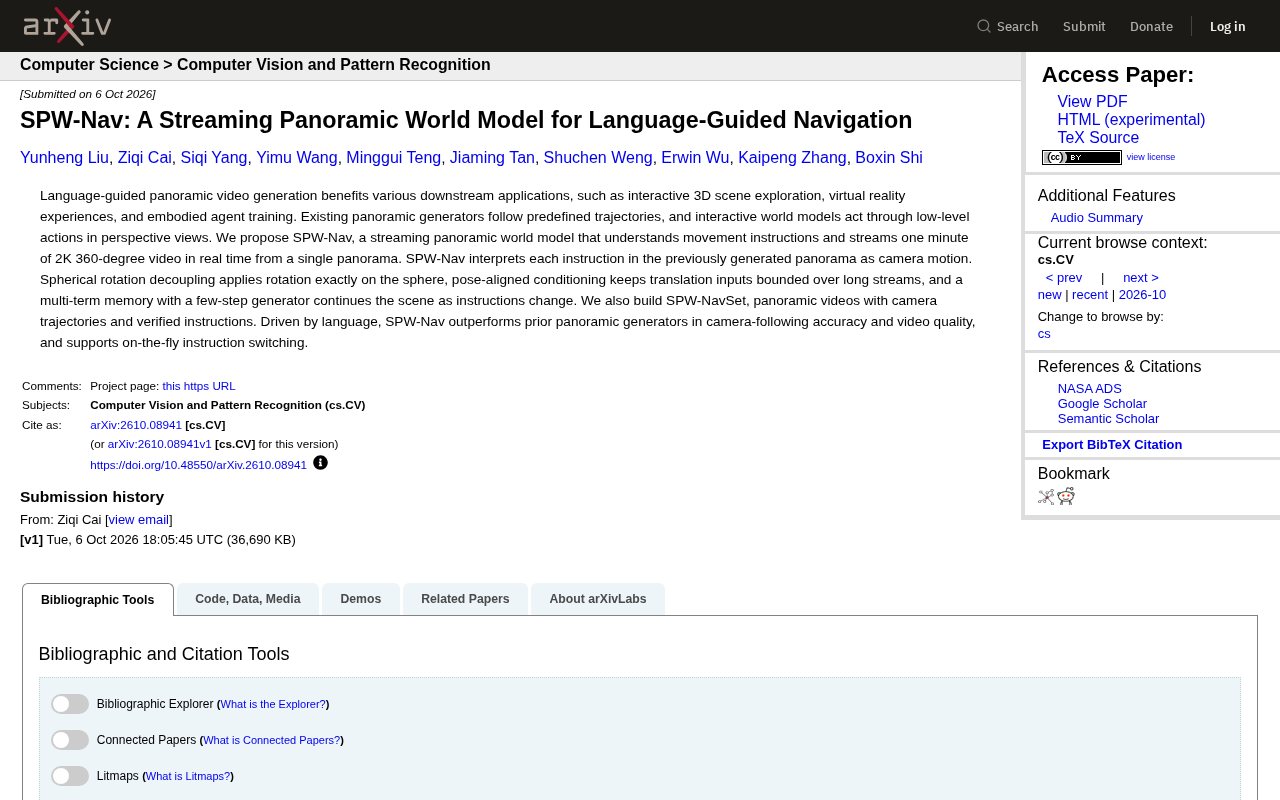
A paper on arXiv titled SPW-Nav: A Streaming Panoramic World Model for Language-Guided Navigation proposes a new solution — SPW-Nav, a world model capable of interpreting movement instructions and streaming a one-minute, 2K-resolution, 360-degree video in real time from a single panoramic image.
Core Mechanisms of SPW-Nav
The key insight behind SPW-Nav is the translation of language instructions into camera motion. For each instruction, the model interprets the previously generated panoramic frame and derives the corresponding camera displacement and rotation, driving continuous scene evolution. This design allows users to "navigate" a virtual scene using natural language, without having to manually tune low-level action parameters.
To address the challenges of long-duration, high-resolution streaming generation, the paper introduces three technical designs:
Spherical Rotation Decoupling
Panoramic video is inherently a spherical projection, and handling rotations directly in a flat plane readily introduces distortion. SPW-Nav applies rotation operations directly on the sphere, ensuring geometric consistency when the camera turns — a foundational element for improving camera-following accuracy.
Panoramic video typically uses Equirectangular Projection (ERP) to map spherical content onto a flat rectangular image, which is the dominant format for storing and transmitting 360-degree content. However, this projection causes severe stretching distortion near the poles, and performing rotation operations in planar coordinates breaks the spatial correspondence between pixels. The core idea behind spherical rotation decoupling is to maintain awareness of spherical geometry throughout the generation process — modeling rotation transforms directly as rigid-body motions on the sphere (i.e., operations in the SO(3) group) and then projecting back to the plane, rather than manipulating flat pixels directly. This ensures that rotations across all three degrees of freedom — pitch, yaw, and roll — introduce no additional distortion, and that the frames generated during camera turns remain geometrically consistent with the true spherical geometry. This is a critical design point that distinguishes panoramic generation from standard perspective video generation.
Pose-aligned Conditioning
Over the course of long streaming generation, translation inputs can accumulate errors or diverge. Through pose-aligned conditioning, the model constrains translation inputs within a bounded range, maintaining stability across long sequences and preventing them from "running away."
Multi-term Memory and Few-step Generator
SPW-Nav introduces a multi-term memory mechanism paired with a few-step generator, enabling smooth scene continuation rather than abrupt transitions when instructions change. This is the core capability enabling "on-the-fly instruction switching" — users can change direction or target at any point during generation, and the model will adjust subsequent frames accordingly.
The "memory mechanism" in streaming video generation addresses the problem of temporal consistency over long sequences. Autoregressive generation models can only condition on a limited context window at each step. If only the most recent frames are retained, distant scene details gradually drift or are forgotten over time; if all historical frames are retained, the computational overhead becomes prohibitive. Multi-term memory is typically designed to store key frames or features at different temporal scales in a hierarchical manner: short-term memory maintains local coherence, while long-term memory anchors the global scene structure — suppressing "scene forgetting" across generation sequences lasting up to one minute. The few-step generator corresponds to accelerated sampling strategies in diffusion models, such as Consistency Models or few-step distillation techniques, which compress the original tens of denoising iterations down to just a few steps to meet the strict latency requirements of real-time streaming output. Together, these two components allow the model to respond rapidly to on-the-fly instruction changes without losing memory of previously generated scenes.
Dataset and Experimental Results
To train and evaluate this type of model, the research team also constructed a dedicated dataset called SPW-NavSet. This dataset contains panoramic videos with camera trajectories and verified instructions, providing reliable supervision signals for language-guided panoramic generation. Data quality is often the bottleneck in such generative tasks, and paired data with trajectories and verified instructions can significantly improve the model's ability to understand and execute instructions.
Experimental results show that, under language-driven conditions, SPW-Nav outperforms prior panoramic generators on both camera-following accuracy and video quality, while also offering the flexibility to switch instructions mid-generation — a capability absent from existing methods.
Applications and Significance
The value of SPW-Nav lies not only in generating visually impressive panoramic videos, but more importantly in pushing "world models" toward an interactive, navigable paradigm. For embodied agent training, a world model that can evolve scenes in real time according to language instructions can serve as a low-cost, controllable simulation environment — allowing agents to repeatedly practice navigation strategies in virtual spaces. For VR and 3D content creators, being able to generate a minute-long, coherent walkthrough video from just a single panoramic image and a text instruction dramatically lowers the barrier to content production.
From a broader technical perspective, SPW-Nav represents a shift in panoramic generation from "fixed-trajectory playback" to "instruction-driven interaction." The combination of real-time performance, high resolution (2K), long duration (one minute), and switchable instructions gives it practical potential at the frontier of interactive world models. Of course, as a newly released preprint, its true generalization capability, stability in complex scenes, and computational cost still await further validation by the research community.
The field of Embodied AI has a particularly urgent need for interactive world models. Traditional simulation environments (such as Matterport3D and Habitat) rely on pre-modeled 3D assets, which limits scene diversity and incurs high production costs. The idea of replacing traditional simulators with world models — so-called "generative simulation" — has attracted widespread attention in recent years: rather than requiring an explicit 3D representation, the model directly predicts future frames from perceptual inputs, and agents can explore and learn policies within this implicit world. SPW-Nav extends this paradigm to panoramic vision and natural language instructions, meaning that agents can interact with environments using the directional descriptions that humans naturally use ("turn left," "go to the end of the hallway") rather than relying on discrete action encodings. This has direct implications for training robots or virtual assistants capable of understanding natural language navigation instructions, and aligns closely with the research direction of Vision-Language-Action (VLA) models.
One-line Summary
SPW-Nav streams one-minute 2K 360° video from a single panoramic image using natural language instructions, with support for on-the-fly instruction switching.
Related articles

Chain of Thought Isn't Just for AI: How Humans Can Use CoT to Improve Thinking Quality
Chain of Thought isn't just a prompt trick for large models. Starting from a Hacker News discussion, this article analyzes why CoT works for human thinking too, breaks down actionable ways to transfer it, and highlights the key differences between human CoT and machine CoT.
Cloudflare Teams Up with OpenAI: Closi…
Cloudflare Teams Up with OpenAI: Closing the Loop from Vulnerability Discovery to Defense with AI
Cloudflare uses OpenAI Daybreak to investigate security vulnerabilities and generate reviewable remediation plans, while developers use Codex to boost coding efficiency and quality.

Orca Multi-Agent Orchestration in Practice: A Guide to Parallel Collaboration with Claude and Codex
Orca is Stable AI's free open-source agent workbench supporting 34 agents like Claude Code and Codex in parallel. Learn its Git worktree isolation, multi-model orchestration, and mobile management.