Spymarks, Not Watermarks: The Covert New Frontier of Digital Content Tracking

Spymarks embed unique hidden identifiers per recipient to trace leaks, sparking privacy and surveillance debates.
The article introducing "Spymarks" on Hacker News contrasts them with visible watermarks: rather than declaring ownership publicly, Spymarks covertly embed unique identifiers for each recipient, enabling precise leak attribution. Built on steganography and digital fingerprinting, they're already used in film screeners, enterprise documents, and paid content. However, embedding tracking identifiers without recipients' knowledge raises significant privacy and informed-consent concerns, blurring the line between copyright protection and covert surveillance.
From Watermarks to "Spymarks"
As digital content distribution grows increasingly complex, tracking how content spreads and identifying the source of leaks has become a top concern for content platforms and creators alike. A recent article titled Spymarks, Not Watermarks sparked widespread discussion on Hacker News, earning 269 upvotes and 58 comments — a clear sign it struck a nerve.
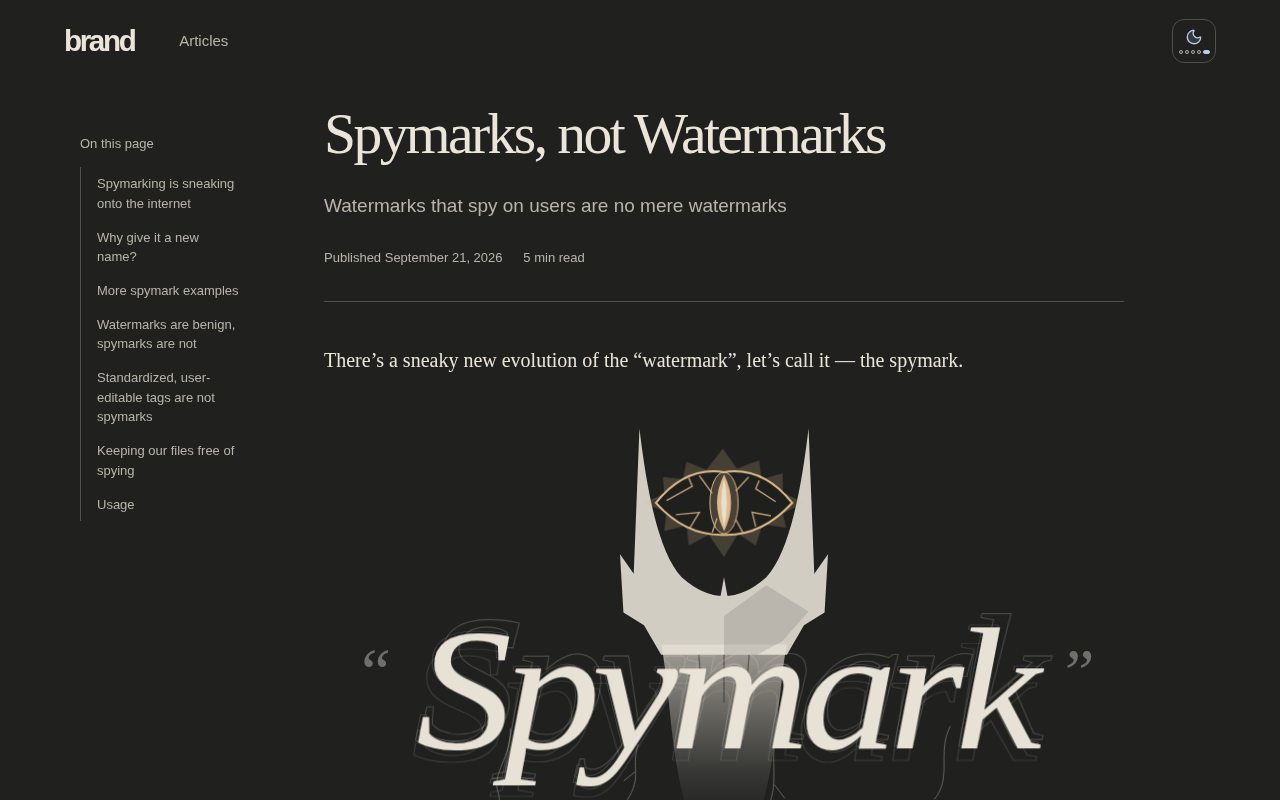
The article introduces a provocative concept: the "Spymark." Unlike the familiar "Watermark," a Spymark is something fundamentally different. Traditional watermarks are visible or semi-visible identifiers designed to assert copyright ownership. A Spymark, by contrast, is a covert tracking mechanism — its purpose isn't to "declare ownership" but to "track silently."
The Core Difference Between Watermarks and Spymarks
Understanding the distinction between these two concepts is key to grasping the article's central argument.
Watermarks: Public Copyright Declarations
Watermarks are designed to be seen. Whether it's a logo in the corner of an image or semi-transparent text overlaid on a document, a watermark is essentially a "public broadcast" — it tells everyone who views the content: "This belongs to someone." The value of a watermark lies in deterrence and attribution. Even if it's cropped or removed, its presence has already served its declarative purpose.
Spymarks: Covert Tracking Beacons
Spymarks go in the opposite direction. They are designed to be imperceptible, and critically, different recipients receive copies embedded with different hidden identifiers. This means that when the same piece of content is distributed to multiple channels or individuals, each copy carries a unique "fingerprint." If the content leaks into the public domain, the publisher can compare these hidden identifiers to precisely identify which channel or individual was responsible for the leak.
This approach has strong practical applications in enterprise document management, paid content distribution, and confidential information protection.
The Ethical Tension Behind the Technology
The reason Spymarks sparked such broad debate in the tech community is that they touch a sensitive ethical nerve.
The dual-edged nature of covert tracking is hard to ignore. From the content owner's perspective, it's an effective tool for protecting intellectual property and preventing unauthorized distribution. But from the recipient's perspective, having a personalized tracking identifier embedded in content you receive — without your knowledge — raises serious questions about privacy and the right to informed consent. Does every document you receive, every video you watch, quietly record who you are?
This technology echoes recent discussions around content provenance. As AI-generated content has exploded in volume, the demand for source verification and anti-counterfeiting traceability has grown urgent. Covert marking technologies like Spymarks may find even more applications in this wave — but they'll also need to strike a balance between transparency and privacy protection.
It's worth noting that the rise of AI-generated content (AIGC) is creating new momentum for covert tracking technologies. Major AI content platforms like OpenAI and Google are already exploring ways to embed invisible watermarks into AI-generated images and text. Google DeepMind's SynthID technology, for example, embeds imperceptible provenance markers at the pixel level of AI-generated images. In official narratives, these tools are framed as instruments of "content authenticity verification" and "deepfake prevention" — not user tracking. Critics, however, point out that the same technical architecture is inherently dual-use: it can mark "this is AI-generated content" just as easily as it can mark "this is the content a specific user generated or accessed." This ambiguity makes content provenance debates in the AI era far more complex, and the ethical controversies surrounding Spymarks extend well beyond traditional copyright protection.
Real-World Applications and Potential Risks
The technical thinking behind Spymarks is not entirely new. Similar steganography and digital fingerprinting techniques have long existed across multiple fields:
- Film and TV industry: To prevent pre-release leaks, distributors often embed invisible tracking codes in screener copies sent to different reviewers;
- Enterprise confidential document management: Sensitive documents are generated as unique copies with distinct identifiers for different employees, enabling accountability;
- Paid subscription content: Some platforms embed personalized markers in content downloaded by subscribers.
However, these technologies also carry risks of misuse. When tracking mechanisms exceed reasonable boundaries, they can evolve into tools for surveilling individuals. A seemingly ordinary PDF might expose your identity the moment you forward it. This is precisely why the topic ignited so much debate on Hacker News — the technology itself is neutral, but how it's applied determines whether it's a protective tool or an instrument of surveillance.
Steganography is one of the foundational principles underlying Spymark technology, with a history stretching back to ancient Greece. Unlike cryptography, which aims to make information difficult to decipher, steganography's core idea is to make the very existence of information difficult to detect. In the digital realm, steganography typically works by modifying imperceptible data bits within image, audio, or document files — for example, altering the least significant bits (LSB) of image pixels, or embedding identifiers in PDF metadata or character spacing. Digital fingerprinting is the specific application of this approach in content tracking: embedding a unique identifier in each copy of a distributed piece of content, making every copy a traceable "signed version." Together, these two techniques form the technical foundation of the Spymark concept, and are precisely what sets it apart from simple visible watermarks.
Implications for Content Creators
For content creators and distribution platforms, Spymarks offer a new lens through which to think about protecting digital assets. Compared to traditional watermarks that can easily be cropped or erased, covert marking is genuinely more effective as a leak deterrent.
But transparency is an unavoidable issue when adopting such technologies. Should recipients be informed that the content they've received contains tracking identifiers? How do you protect your own interests while respecting user privacy? These are questions that require careful consideration in practice. Technology can solve the problem of "tracking who leaked the content," but it cannot answer the ethical question of "whether it should be done" — that requires platforms, creators, and the broader industry to establish shared norms.
As the digital content ecosystem continues to evolve, covert tracking technologies like Spymarks may become increasingly common. But a truly healthy content ecosystem shouldn't be built on unilateral covert surveillance — it should find a sustainable balance between protection and transparency.
Related articles

Workbuddy for Absolute Beginners: How a Desktop AI Agent Fits Into Real Workflows
A beginner's guide to the Workbuddy desktop AI agent: installation, claiming credits, file management, and building automated workflows—compared with CodeX for fit and cost, helping professionals shift from AI question-askers to AI managers.

OpenAI's New Agent Stack: Computer Use, Decisions API, and Ultra-Fast Workflows
OpenAI Dev Day unveiled a new agent stack: Computer Use outperforms humans, Decisions API delivers ultra-low-latency classification via Luna, Agents API opens the same Computer Use capabilities, and GPT-6.1 Sol costs only one-seventh of Astra. Core updates, benchmark data, and developer insights.

Liang Wenfeng Open-Sources DeepInfo Inference Framework, Takes On U.S. Ban
DeepSeek open-sources its DeepInfo inference framework after its models, featuring GPU/CPU cross-pipelining, small-model prediction with large-model verification, and full Huawei Ascend and NVIDIA chip support—facing the U.S. federal ban head-on. This article analyzes its significance for AI deployment and open-source strategy.