SQL Server 2025 Deep Dive: AI-Native Integration and a Leap in Developer Experience

SQL Server 2025 embeds vector search, RAG, and AI inference natively in the engine while strengthening the core engine and developer experience.
SQL Server 2025, called Microsoft's "best developer release in a decade," embeds AI directly into the database engine: T-SQL model definitions generate embeddings stored in a native vector type, vector search combines with WHERE filters, and RAG runs in-engine with Ledger auditing and MCP Server exposure to AI Agents. The core engine adds Optimized Locking and TempDB governance among ~40 features. Native JSON, T-SQL regex, and Data API Builder cut glue code, while Azure Local and Foundry Local enable sovereign cloud deployments with smooth migration to public cloud.
SQL Server 2025 has officially been released, and Microsoft Principal Architect Bob Ward offered a detailed breakdown of the database product he calls "the best developer release in a decade" during SQL Modernization Day. From AI built into the engine to optimized locking, from a native JSON type to sovereign cloud deployment, SQL Server 2025 tries to answer one question: once the database natively supports vector search and RAG patterns, how much additional infrastructure do developers still need to build?
AI-Native: Bringing Vector Search and RAG into the Engine
The most fundamental change in SQL Server 2025 is embedding AI capabilities directly into the database engine rather than relying on external services. In his demo, Bob Ward walked through the complete vector search workflow: declaring a model definition via T-SQL that points to a local Ollama or cloud model endpoint, generating embeddings through secure REST HTTPS calls, and storing them in the new native vector data type column.
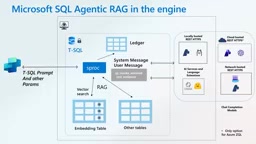
Compared with standalone vector databases, vector search inside the SQL engine supports combining with existing WHERE clauses for filtered search. This means developers don't need to stitch together multiple data sources at the application layer—semantic similarity queries can coexist with business filter conditions in a single SQL statement. Ward highlighted a healthcare scenario in particular: a patient's description of "blurred vision and severe migraines" may not literally match the terminology in professional documents, but vector embeddings can capture semantic similarity and return more relevant results.
Going further, the RAG pattern is also completed inside the engine. Through system stored procedures and model definitions, developers can build prompt programming inside SQL that includes system messages, user messages, and skills, and receive chat completion model responses in structured JSON format. Combined with Ledger tables, AI interactions can leave a tamper-proof audit trail. This pattern is exposed to the application layer through an MCP Server, making SQL Server the data and reasoning hub for AI Agent applications.
Embeddings are the process of mapping unstructured data such as text and images into high-dimensional numerical vectors, where semantically similar content is closer together in vector space. Traditionally, this required a standalone vector database (such as Pinecone or Milvus) or a dedicated extension (such as pgvector) to store and retrieve. SQL Server 2025 builds in the vector data type and approximate nearest neighbor (ANN) indexing, meaning developers can manage vector data with familiar T-SQL and leverage existing transactions, backups, and high availability mechanisms, reducing the complexity of syncing data between systems.
RAG (Retrieval-Augmented Generation) is a technique that lets a large language model retrieve relevant document fragments from an external knowledge base before generating an answer. The typical workflow is: convert the user's question into a vector, retrieve similar documents from the vector store, inject the documents as context into the prompt, and finally call the model to generate the answer. SQL Server 2025 encapsulates retrieval, prompt assembly, and model invocation inside the engine through system stored procedures and model definitions, so the RAG process can be completed entirely within database transaction boundaries, with audit tracking enabled through Ledger tables.
Core Engine: Optimized Locking and 40 New Features
Beyond AI, SQL Server 2025 introduces about 40 new features at the core engine level, covering security, performance, and availability. The one developers care about most is Optimized Locking. Ward used a live demo to illustrate the pain point: when a single statement updates 10,000 rows, lock escalation locks the entire table, blocking other queries that appear not to conflict. With Optimized Locking enabled, a versioned transaction lock mechanism allows the two operations not to block each other.
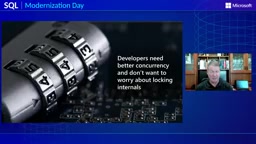
Combined with Accelerated Database Recovery (ADR) and Read Committed Snapshot Isolation (RCSI), Ward believes applications can look forward to running "lock-free," so developers no longer need to tune application logic around lock escalation and blocking issues. In addition, TempDB resource governance lets administrators control users' consumption of TempDB space; availability groups are further enhanced in failover speed and reliability; and all backup types can now be performed on replicas.
On the security side, SQL Server 2025 supports passwordless connections through Entra managed identities and retains Arc enablement, so on-premises instances can also get pay-as-you-go and cloud management experiences.
Lock escalation is an optimization mechanism in SQL Server: when the number of fine-grained locks (row locks or page locks) held by a single statement exceeds a threshold, the engine escalates them to a table-level lock to reduce lock management overhead. But this can also cause concurrency blocking—even queries accessing different rows are blocked by the table lock. Optimized Locking uses a versioned transaction lock mechanism to record lock information in the row version store, so update operations no longer trigger lock escalation, avoiding unnecessary blocking. This feature depends on Accelerated Database Recovery (ADR) and Read Committed Snapshot Isolation (RCSI), so these options must be enabled on the database before turning it on.
Developer Experience: Native JSON, Regular Expressions, and Data API Builder
For developers, several of the most requested features have finally landed. The native JSON data type stores data in binary format and supports very large documents, and with JSON indexes it can greatly speed up queries such as JSON_CONTAINS; T-SQL now directly supports regular expressions, including matching and replacement, eliminating the hassle of building complex pattern-matching logic yourself.
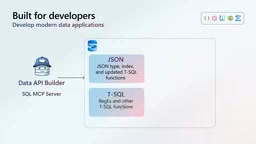
Data API Builder (DAB) further reduces the amount of plumbing code between applications and the database. It exposes tables, views, and stored procedures as REST or GraphQL endpoints through declarative configuration, with built-in security controls. Ward noted that DAB itself can be turned into an MCP Server through JSON configuration, letting Agent applications access the database directly through tool calls without an intermediate natural-language-to-SQL layer.
Change Event Streaming replaces the traditional polling model of CDC, allowing the engine to push changes directly to Azure Event Hub. And the generic REST invocation capability is not only for AI models—it can also connect to any REST service in the enterprise, collapsing the old "fetch data—call API—write back to the database" round trip into the engine itself.
Data API Builder (DAB) is Microsoft's open-source cross-platform tool that automatically exposes database objects (tables, views, stored procedures) as REST or GraphQL endpoints through a JSON configuration file, with built-in role-based access control, pagination, filtering, and caching policies. It supports multiple data sources including SQL Server, PostgreSQL, MySQL, and Azure SQL. DAB itself can run as an MCP (Model Context Protocol) server, which means AI Agents can directly query or operate the database through a standardized tool-calling protocol without generating SQL statements. This lowers the barrier to integrating Agent applications with databases while preserving fine-grained security controls.
Sovereign Cloud and the Edge: A Full AI Stack on Azure Local
Another major theme of SQL Server 2025 is deployment flexibility. In addition to Windows, Linux, containers, and Kubernetes, Microsoft announced that SQL Server can run on Azure Local, supporting connected or disconnected modes and managed through the Arc control plane. For customers with sovereign cloud compliance requirements, Foundry Local provides local model endpoints as a Kubernetes service, and SQL can directly call its embedding and chat completion capabilities without data leaving the country.
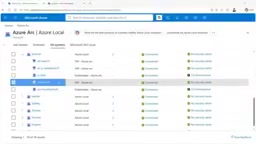
Ward demonstrated an end-to-end scenario with a patient transfer center application: a SQL Server 2025 virtual machine running on Azure Local, Foundry Local providing local model services, regular expressions extracting structured signals from medical record text, and skills stored as JSON in tables for the RAG process to call. When the customer decides to migrate to the public cloud, they only need to change the model endpoint—the same stored procedures and the same skill configuration can be reused, demonstrating the portability of SQL AI capabilities.
Azure Local is a hybrid cloud solution from Microsoft that allows Azure services (including virtual machines, AKS, and some data services) to run on customers' own hardware, managed uniformly through Azure Arc. It supports connected mode (maintaining a connection to the Azure control plane) and disconnected mode (running fully offline), suitable for edge computing, branch offices, or regulated industries. SQL Server 2025 can be deployed on Azure Local as a virtual machine or container, and combined with Foundry Local (a local model inference endpoint provided as a Kubernetes service), it forms a complete local AI stack from data storage and vector retrieval to model inference. This architecture meets data sovereignty and low-latency requirements while maintaining a development experience consistent with the public cloud.
Upgrade Path and Ecosystem Resources
In closing, Bob Ward reminded users still on older versions of SQL Server that they can view SQL Server 2025 as an innovation upgrade rather than a simple version iteration. His book "SQL Server 2025 Unveiled" covers topics such as vector search, embeddings, and chat completion, and according to his feedback, many readers have used the book's examples to pass the DP-800 certification. For teams preparing to upgrade, Microsoft provides supporting resources such as blogs, samples, demos, and slides.
From AI built into the engine to lock-free concurrency, from native JSON to sovereign cloud deployment, SQL Server 2025's positioning has gone beyond the scope of a traditional relational database—it looks more like a platform that brings data, AI inference, and application interfaces together into one layer. For developers, the real appeal may not lie in the length of the feature list, but in whether these capabilities can reduce glue code between systems—and from Ward's demo, that direction is clear.
Related articles

WorkBuddy Full Guide: How an AI Coworker Takes Over Workplace Automation
What is WorkBuddy? This article analyzes the core capabilities of this full-scenario AI agent: autonomous execution with deliverable results, local file processing, multi-agent parallelism, and workplace automation workflows, helping you judge its essential difference from ordinary AI chat tools.

The Truth About AI Agents: A Hundred Lines of Code + an LLM, Deconstructing the Agent's Underlying Logic
AI agents aren't a new AI species—just a language model plus tools, a loop, and a goal. Here's the underlying logic: how 100 lines of Python hit a 75% fix rate, why the harness beats the model, and Gartner's "agent washing."

AI Agent Deployment: Three Things Developers Should Do
AI Agent deployment doesn't require rushing into multi-agent systems. This article outlines an actionable deployment path and engineering acceptance thresholds for developers, covering human baselines, bounded single-agent scope, and a controlled code-modification loop.