SSU-LSF: A Machine Unlearning Framework for Geoscience State Space Models

SSU-LSF is the first machine unlearning framework for geoscience Mamba models, surgically removing confounding event bias from land surface forecasts.
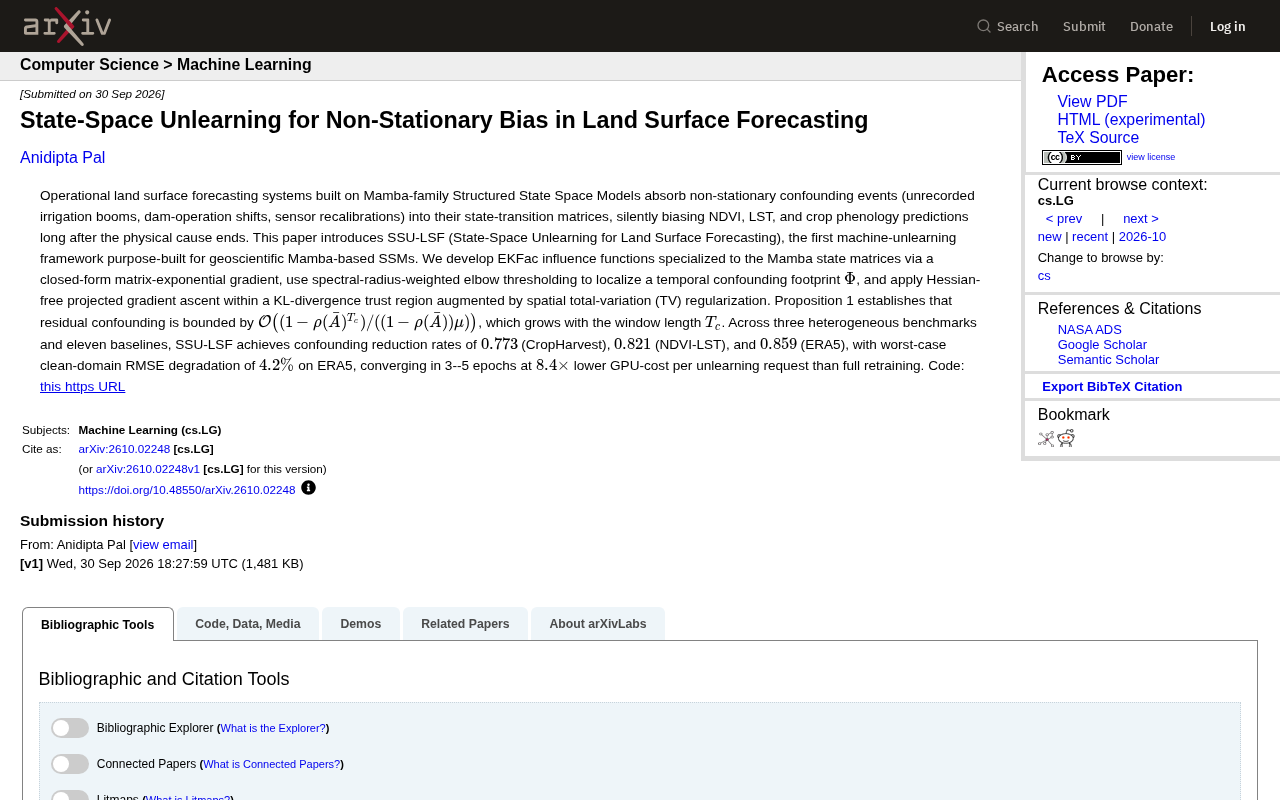
Mamba-based land surface forecasting systems silently encode non-stationary events — unrecorded irrigation surges, dam scheduling changes, sensor recalibrations — into their state transition matrices, persistently biasing NDVI, LST, and crop phenology predictions without triggering any alerts. SSU-LSF addresses this via dedicated EKFac influence functions, spectral-radius-weighted elbow thresholding, and Hessian-free projected gradient ascent, achieving confounding reduction rates of 0.773–0.859 across three benchmarks, worst-case RMSE degradation of only 4.2%, and 8.4× lower GPU cost than full retraining.
When Prediction Models "Remember" What They Shouldn't
Mamba-based Structured State Space Models (SSMs) are rapidly gaining adoption in weather forecasting and agricultural monitoring. But these models carry a subtle vulnerability: they silently absorb non-stationary confounding events into their state transition matrices.
Typical examples cited in the paper include unrecorded irrigation surges, changes in dam scheduling strategies, and sensor recalibrations. Although these events may have long since ended at the physical level, the model continues to be influenced by them for an extended period afterward — persistently producing biased predictions of NDVI (Normalized Difference Vegetation Index), LST (Land Surface Temperature), and crop phenology.
The key issue is the "silence" of this problem — the bias triggers no errors and is difficult to detect through routine evaluation. The model appears to be functioning normally, yet it has already been contaminated by historical anomalous events.
Mamba is a selective state space model (Selective SSM) introduced in late 2023. Its core innovation lies in an input-dependent selection mechanism that allows the model to dynamically decide which information should be retained in the state and which should be discarded — achieving both efficiency and expressiveness in long-sequence modeling. Unlike the global attention mechanism of Transformers, Mamba's computational complexity scales linearly with sequence length, giving it a distinct advantage when processing long-horizon land surface observation sequences at hourly or daily resolution. However, this "selective memory" mechanism is a double-edged sword: when non-stationary burst events (such as an unrecorded irrigation pulse) are mixed into the training data, the model's state transition matrix $\bar{A}$ encodes the anomalous signal as a "valuable pattern" and continues to retain it, influencing subsequent predictions even after the physical event has ended — without triggering any explicit alert.
SSU-LSF: The First Machine Unlearning Framework for Geoscience Mamba Models
The arXiv paper introduces SSU-LSF (State-Space Unlearning for Land Surface Forecasting), claimed to be the first machine unlearning framework specifically designed for geoscience Mamba-class SSMs. Machine unlearning refers to the targeted erasure of the influence of specific data or events on a model — without retraining from scratch.
Compared to discarding all training data and retraining from the ground up, the value of machine unlearning lies in efficiency: it attempts to surgically remove bias introduced by confounding factors while preserving the model's predictive capability on clean data. For operationally expensive land surface forecasting systems, this approach has real-world significance.
Core Technical Approach
SSU-LSF's method consists of several key components:
- Dedicated EKFac Influence Functions: Influence functions are constructed for Mamba state matrices using closed-form matrix-exponential gradients, quantifying the contribution of specific events to model parameters.
- Spectral-Radius-Weighted Elbow Thresholding: Spectral-radius-weighted elbow thresholding is used to locate the temporal "confounding footprint" $\Phi$ — determining precisely which time window has been contaminated.
- Hessian-Free Projected Gradient Ascent: The unlearning operation is performed within a KL-divergence trust region, supplemented by spatial total variation (TV) regularization to maintain spatial smoothness and physical plausibility in predictions.
The paper also provides a theoretical guarantee (Proposition 1), proving that residual confounding is bounded by a quantity related to window length $T_c$, on the order of $\mathcal{O}\big((1-\rho(\bar{A})^{T_c})/((1-\rho(\bar{A}))\mu)\big)$ — meaning that longer contamination windows yield larger upper bounds on potential residual bias.
Machine Unlearning originally emerged from the data privacy domain, with the goal of eliminating the influence of specific training samples on model parameters without retraining — to comply with regulations such as the "Right to be Forgotten." The core challenge is that neural network parameters are jointly optimized over all training data; mathematically isolating and removing the influence of a subset of data is equivalent to solving a reverse optimization problem with prohibitive computational cost. Existing approaches broadly fall into two categories: exact unlearning (which guarantees equivalence to retraining, e.g., through data sharding) and approximate unlearning (which approximates the removal of influence through gradient ascent, influence functions, etc.). SSU-LSF belongs to the latter, and customizes influence function computation to suit the special structure of SSM state matrices (matrix-exponential recurrences) — the core engineering challenge that must be solved when adapting machine unlearning to state space models.
EKFac (Extended Kronecker-Factored Approximate Curvature) is a method for approximating the Fisher information matrix of neural networks. It uses a Kronecker product decomposition to transform the otherwise intractable high-dimensional Hessian into a product of two smaller matrices, significantly reducing the computational overhead of second-order optimization. Influence functions leverage this approximate curvature to estimate "how model parameters would change if a particular training sample were removed" — forming the theoretical foundation of approximate unlearning methods. SSU-LSF extends EKFac to the Mamba state transition matrix setting; the key difficulty is that this matrix appears in matrix-exponential form ($\bar{A} = e^{\Delta A}$), and gradient computation requires the Fréchet derivative of the matrix exponential. The paper provides a closed-form solution to avoid error accumulation from numerical differentiation. The spectral radius $\rho(\bar{A})$ is the absolute value of the matrix's largest eigenvalue; it determines the rate at which state information decays over time — the closer the spectral radius is to 1, the longer historical information is retained, and the harder it becomes to erase the model's "memory" of confounding events.
Experimental Results: Performance Across Three Benchmarks
The authors evaluated the framework across three heterogeneous benchmark datasets against eleven baseline methods. Confounding reduction rates are as follows:
- CropHarvest: 0.773
- NDVI-LST: 0.821
- ERA5: 0.859
While reducing bias, performance degradation on clean data was kept in check — worst-case RMSE degradation on ERA5 was 4.2%. In other words, the unlearning operation did not come at the cost of significantly sacrificing normal prediction accuracy.
Efficiency Advantage
From an engineering perspective, the most compelling figure may be the efficiency gain: SSU-LSF converges within 3 to 5 epochs, with the GPU cost per unlearning request reduced by 8.4× compared to full retraining. For operational systems that must frequently respond to data contamination issues, this cost gap can determine whether a solution is practically deployable.
The paper's code has been open-sourced on GitHub (github.com/Anidipta/SSU-LSF).
Significance and Limitations
SSU-LSF transfers machine unlearning — a technique primarily discussed in recent years in the context of privacy compliance and copyright removal — into the relatively niche but high-value domain of geoscientific time-series forecasting, filling a gap in bias correction for Mamba-class SSMs.
That said, a clear-eyed assessment is warranted: this is still a preprint. Confounding reduction rates of 0.77–0.86 mean that a non-trivial proportion of confounding influence remains unresolved; the theoretical bounds also indicate that longer contamination windows are inherently harder to handle. The method's robustness in real-world operational environments, and its generalizability across different types of confounding events, remain to be further validated.
For researchers and engineers working in remote sensing, climate modeling, and state space models, this work offers a new direction worth following — how to make efficient sequence models not only learn fast, but also forget precisely.
Related articles

Differentially Private Sparse Reward Estimation: A New Breakthrough in RLHF Privacy Protection
New RLHF privacy research proposes a differentially private sparse reward estimation framework, achieving a better privacy-utility trade-off under sparsity assumptions, with theoretical error bounds significantly outperforming dense methods, validated on sentiment generation and safety alignment tasks.

AtomicRL: Atomic Reinforcement Learning Solves Long-Horizon Robotic Manipulation Challenges
AtomicRL introduces atomic reinforcement learning with Semantic-Aware Policy Optimization (SAPO) and Bottleneck-Adaptive Targeted Exploration (BATE) to solve credit assignment and subtask imbalance in VLA long-horizon robotic manipulation, outperforming PPO on LIBERO-LONG and CALVIN and improving real-world task performance by 21.3%.

Gaussian Mixture NPMLE Achieves Minimax Optimality: A New Breakthrough in Hellinger Distance
Recent research proves that the nonparametric maximum likelihood estimator (NPMLE) for Gaussian mixtures achieves the minimax optimal rate log(n)/n in squared Hellinger distance, with faster rates under compact support and empirical Bayes applications.