Stack Overflow Question Volume Plummets 99%: How AI Ended the Q&A Era

Stack Overflow questions fell 99% as AI tools like ChatGPT replaced traditional developer Q&A workflows.
Stack Overflow's monthly question volume has collapsed from 207,000 in 2014 to just 1,442 in July 2026—a 99% drop accelerated by ChatGPT's launch. As AI coding assistants offer instant, judgment-free, context-aware answers embedded directly in IDEs, developers have abandoned traditional Q&A platforms. This creates a paradox: AI trained on Stack Overflow's data is now killing the platform that fed it, potentially creating a knowledge gap crisis as new technical discussions move to private AI conversations.
The Twilight of an Era
According to data reported by PPC.land that sparked heated discussion on Reddit's tech communities, Stack Overflow's monthly question volume has plummeted from its peak of approximately 207,000 in March 2014 to just around 1,442 in July 2026—a staggering 99% decline.
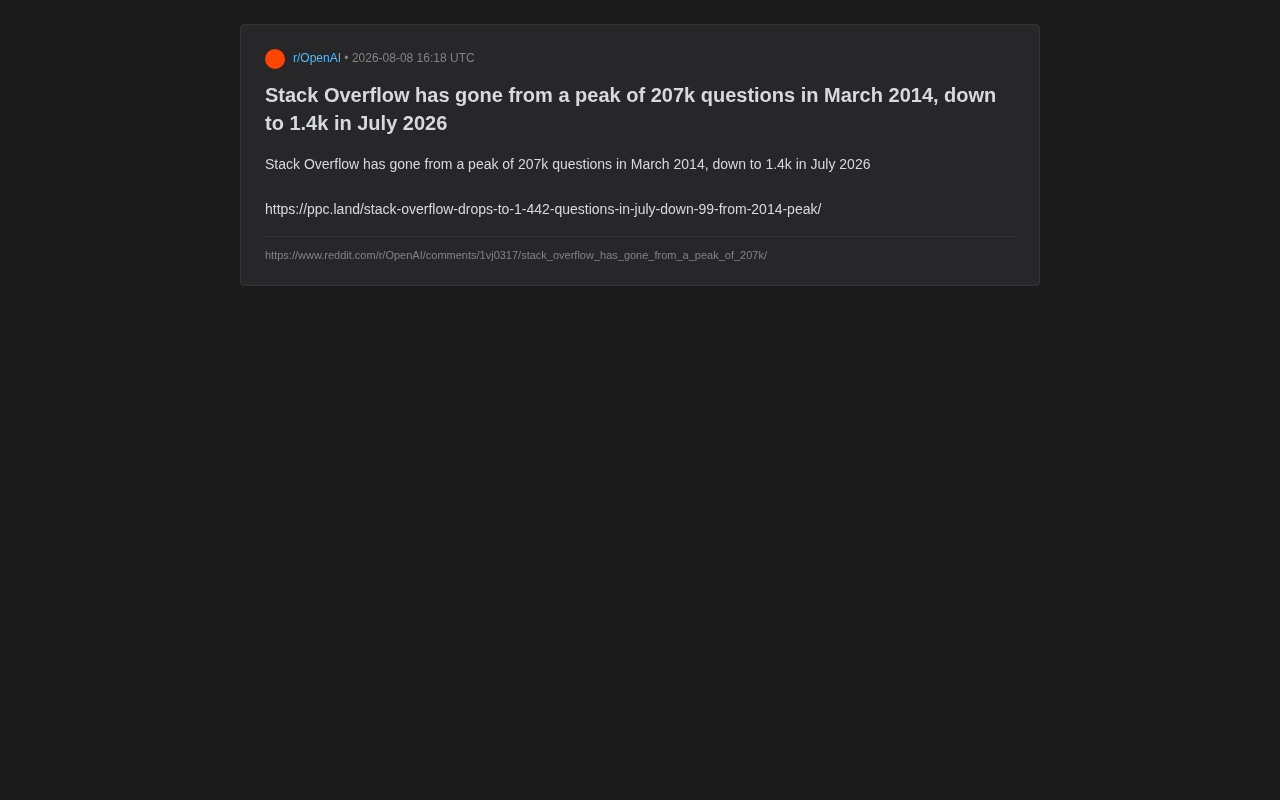
Behind these numbers lies a platform that once defined an entire generation of developers' workflows, now fading into silence. Stack Overflow was founded by Jeff Atwood and Joel Spolsky in 2008, and quickly became the world's largest programmer Q&A community thanks to its sophisticated reputation point system, community-driven vote sorting, and collaborative editing mechanisms. Its gamified incentive design—earning reputation by answering questions, pushing top-voted answers to the top, and questioners marking "accepted answers"—greatly facilitated the accumulation of high-quality knowledge in its early days. For many engineers with over a decade of experience, Stack Overflow was an indispensable part of the programming learning curve: encountering an error, copy-pasting it into a search box, and finding that answer upvoted by thousands had become muscle memory. Today, that entire workflow is being fundamentally reconstructed.
Behind the Data: Not Just a Decline, but a Collapse
Interestingly, Stack Overflow's decline didn't begin just in the past two years. In fact, after peaking in 2014, the platform's activity entered a long, gradual downward trajectory. Increasingly strict community rules, mass closures of duplicate questions, and higher barriers for new users had already drawn considerable criticism from developers frustrated with the platform's "gatekeeping" culture. As the community grew, the reputation mechanism that once incentivized contributions gave rise to an overly rigid content moderation culture—newcomers' questions were routinely flagged as "duplicates" and closed, slightly imprecise wording would attract downvotes, and many potential contributors were deterred.
However, the real inflection point that turned the curve from "gradual decline" to "cliff drop" came after ChatGPT's launch in late 2022. When large language models could instantly, patiently, and non-judgmentally answer virtually any programming question, Stack Overflow's core value proposition—"ask the community and wait for an answer"—instantly lost its competitive edge.
Large Language Models (LLMs) are deep learning models based on the Transformer architecture that learn language patterns and knowledge representations through pre-training on massive text datasets. Taking the GPT series as an example, these models use autoregressive methods to predict the next token word by word, with training data encompassing books, web pages, code repositories, and Q&A platform content. Stack Overflow's structured Q&A data—clear problem descriptions, multiple answers sorted by votes, and well-formatted code snippets—happened to be ideal material for training programming capabilities. Models are further aligned with human preferences through RLHF (Reinforcement Learning from Human Feedback), enabling them to provide targeted technical solutions in natural conversational form, rather than cold documentation search results.
Why Developers No Longer Ask Questions on Stack Overflow
From a user behavior perspective, this shift has its own internal logic:
- Immediacy: AI assistants respond in seconds, while posting a question on Stack Overflow might require waiting hours or receive no response at all.
- Zero social cost: No need to worry about being downvoted, closed, or mocked for asking a "too basic" question.
- Contextual customization: AI can provide tailored solutions for the specific code you paste, rather than a generic historical answer.
- Workflow integration: Tools like GitHub Copilot and Cursor embed directly into IDEs, solving problems right at the point of coding.
The last point deserves elaboration. GitHub Copilot, based on OpenAI's Codex model, provides real-time code completion and generation directly within mainstream IDEs like VS Code. Cursor takes a more radical approach, redesigning the entire IDE as an AI-native development environment with support for multi-file context understanding, cross-file code refactoring, and natural language-driven programming. Additionally, emerging AI coding assistants like Cline, Windsurf, and Augment have appeared in rapid succession. These tools share a common characteristic: they completely embed problem-solving at the point of coding—developers don't need to context-switch to a browser to search. Within the editor, they can complete the entire closed loop from discovering a problem, describing it, obtaining a solution, to applying code changes. This seamless experience delivers a devastating blow to the traditional "switch out to search" workflow.
The Ironic Cycle: AI Fed Its Own Gravedigger
There's a fascinating paradox here. The reason today's large language models can so proficiently answer programming questions is largely because they absorbed massive amounts of Stack Overflow's historical Q&A data during training. In other words, it was the high-quality content contributed by tens of millions of developers over more than a decade that trained the AI now replacing Stack Overflow.
This raises a deeper concern: If developers no longer contribute new questions and answers to public communities, where will future AI models learn the latest technical knowledge?
When a new framework, language feature, or bug emerges, it used to be discussed and answered on Stack Overflow first, forming public knowledge deposits that would then become training material for the next generation of models. Now, these exchanges increasingly occur in private conversations with AI, never entering the public knowledge pool.
From a technical standpoint, AI model training data has a knowledge cutoff—for example, a model might only be trained on public data up to 2024. For new framework versions, API changes, security vulnerabilities, or new programming paradigms that emerge afterward, models need technologies like continual learning or RAG (Retrieval-Augmented Generation) to update their knowledge. RAG works by retrieving external documents in real-time during inference to supplement the model's intrinsic knowledge, but its effective operation depends on the existence of high-quality, retrievable public knowledge sources. If new technical discussions primarily occur in private conversations between users and AI rather than being deposited on public platforms as indexable documents, then even RAG technology has nothing to retrieve. This is the technical essence of the "knowledge gap" risk—it's not that models lack capability, but that the fresh material available for learning is drying up.
Over time, this could create a vicious cycle: models develop lag or blind spots regarding emerging technologies, leading to decreased developer trust in AI responses, but developers have already lost the habit of contributing to public communities, and ultimately no one can access timely and accurate technical knowledge.
The Future of Public Knowledge Bases: Crisis and Solutions
Stack Overflow's predicament is essentially a microcosm of the challenge facing the entire internet's "public knowledge production" model. The core economics of user-generated content (UGC) work as follows: platforms provide free infrastructure and distribution channels, and users contribute content in exchange for reputation, social recognition, or altruistic satisfaction. When AI can replace the community in providing instant feedback, the incentive structure for contributors is fundamentally undermined—if no one is going to read my carefully crafted answer, why spend time writing it? This incentive collapse affects not only Stack Overflow but also threatens technical discussions in GitHub Issues, Reddit's tech subreddits, community maintenance of various open-source project documentation, and even the motivation to create technical blogs.
Similar trends may also ripple through tech blogs, forums, wikis, and other platforms that rely on user-generated content. When the entire internet's knowledge contribution incentive system simultaneously unravels, we face not merely one company's life-or-death struggle, but a systemic risk to the public knowledge infrastructure of the digital age.
Facing this crisis, Stack Overflow hasn't been sitting idle. The company previously launched AI-related products (such as OverflowAI) and reached data licensing agreements with companies like OpenAI, attempting to transform its massive historical content into sustainable commercial assets. But this looks more like monetizing existing value rather than rebuilding incremental vitality.
Several Possible Evolutionary Paths
- Transformation into a data supplier: Stack Overflow may pivot from a "human-facing Q&A community" to an "AI-facing knowledge licensing platform," surviving by selling high-quality structured data. The ceiling for this path is clear: as historical data loses timeliness, its licensing value will also diminish.
- New human-AI collaborative communities: Some platforms are experimenting with hybrid models where AI generates initial answers that human experts then review and correct, lowering the contribution threshold while maintaining content freshness. If this model can be paired with reasonable incentive design (such as financial compensation for reviewers), it might find a sustainable new paradigm for knowledge production.
- Return of expert value: As basic questions are absorbed by AI, truly complex, cutting-edge problems requiring deep experiential judgment may actually highlight the scarce value of human expert communities. Questions involving system architecture trade-offs, hands-on performance tuning experience, and technology selection for specific business scenarios remain areas where current AI struggles to provide reliable answers.
Conclusion: Not Disappearing, but a Restructuring of Knowledge Acquisition
Stack Overflow's 99% drop in question volume is less about one company's decline and more about a paradigm shift in how developers acquire knowledge. The era of search engines plus community Q&A is giving way to the era of conversational AI plus deep IDE integration.
For developers, this undoubtedly means greater efficiency. But for the broader technology ecosystem, how to maintain continuous production and updating of public knowledge in an AI-dominated era is a question urgently requiring an answer. After all, if everyone only asks AI questions and no longer contributes answers to the world, then the wellspring of AI's wisdom will eventually run dry. This isn't just a question for Stack Overflow alone to ponder—it's an epochal challenge that the entire tech industry—from AI companies to open-source communities to every individual developer—must collectively confront.
Related articles

JobRunner MCP Server: AI Agents Can Now Fix Failed Java Jobs
JobRunner launches an open-source MCP server enabling AI agents to view cluster status, diagnose failures, and recover Java jobs—incident response from any cloud coding environment or existing agent.

MLAI Digital Launches 9 Security Agents: MCP Server Safeguards the Full Lifecycle of Agentic AI
MLAI Digital launches Security MCP Server with nine built-in specialized security agents covering vulnerability discovery, attack simulation, prompt injection detection, API and infrastructure assessment, and accelerated remediation—embedding security validation across the full Agentic AI lifecycle from development to production.

Running Isaac Lab on H100 GPUs: Exploring Better Approaches
Exploring optimization methods for running Isaac Lab on NVIDIA H100 GPUs, including MIG configuration, mixed precision, TensorRT acceleration, and community experience to improve robotics simulation and reinforcement learning efficiency.