StaffDeck Open-Source Digital Employee Platform: Multi-Agent Teams Powered by DeepSeek Harness
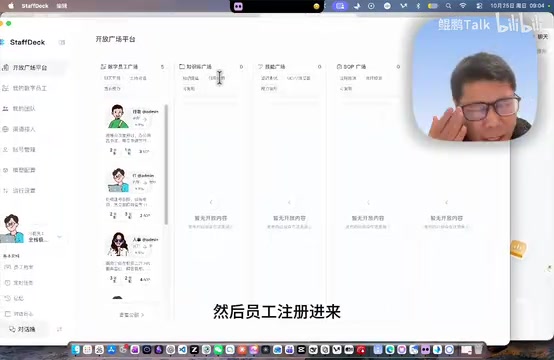
StaffDeck: an open-source digital employee platform driving multi-Agent teams with DeepSeek Harness.
StaffDeck is a GPL 3.0 open-source enterprise digital employee platform powered by DeepSeek Harness. It offers a digital employee plaza, knowledge bases, Skills, SOPs, and a tool plaza, integrates with Feishu, WeChat, WeCom, and DingTalk, supports mainstream model protocols like OpenAI, Claude, and Gemini, and ships Mac/Linux/Windows clients. Its core value is categorizing and accumulating Skills and SOPs by role to solve the "hundreds of skills but unusable" problem. Runtime round limits and context compression control costs, making it ideal for SMEs, startups, and heavy Agent users building one-person-company AI teams.
StaffDeck Open-Source Digital Employee Platform: Multi-Agent Teams Powered by DeepSeek Harness
When a single person has to handle development, operations, contract review, and customer replies all at once, the real bottleneck is often not model capability but the fact that tasks, skills, and memory are scattered across different conversations and never accumulate. StaffDeck, which recently drew attention on Bilibili, aims to solve this with an open-source enterprise-grade platform: powered underneath by DeepSeekAd Harness, it provides digital employee management, knowledge bases, Skills, SOPs, and Feishu/WeChat integration on top, expanding a single Agent into a collaborative AI team.
According to UP host "坤鹏talk", the project is fully open source under GPL 3.0, free for enterprises to use, and ships clients for Mac, Linux, and Windows, so even startups can deploy it directly.
From Admin Console to Digital Employee Plaza: A Complete Enterprise AI Foundation
The StaffDeck interface is divided into an admin console and a chat side. The admin console includes an open platform with a digital employee plaza, knowledge base plaza, skill plaza, SOP plaza, and tool plaza. Enterprises can centrally integrate knowledge bases, Skills, SOPs, and tools, and employees can use them right after registering.
The platform ships with basic digital employees for finance, legal, HR, IT, and administration, and also supports creating your own teams. The host demonstrated team configurations such as "R&D Division 1" and "Product Department," defining personas and responsibilities for each member; teams can receive messages and work collaboratively.
Channel integration is another key capability: WeChat customer service, WeChat, WeCom, Feishu, and DingTalk can all be connected. Account management supports creating multiple accounts and letting other employees log in and share them via API or web. Model configuration is compatible with mainstream protocols such as OpenAI, Claude, Gemini, and Anthropic, essentially covering all major model vendors on the market.
Knowledge Bases, Skills, and SOPs: Turning Personal Experience into Organizational Assets
The host summed up the real pain point of long-term single-Agent use bluntly: you install hundreds of skills, yet every invocation still relies on the model "guessing" for itself, and as a result more than 90% of Skills are never used beyond the first time. The human brain can't remember two or three hundred skills, and Agents face the same choice paralysis.
StaffDeck's solution is categorization and ownership: knowledge bases can be assigned to individuals or the company; Skills can be copied from the plaza and are compatible with mainstream ecosystems; SOPs codify processes such as contract review and seal approval, with different roles issuing approval opinions and revising documents at each stage. Tool invocation supports connecting to real enterprise APIs—for example, contract approval or meeting booking—so digital employees can actually operate business systems.
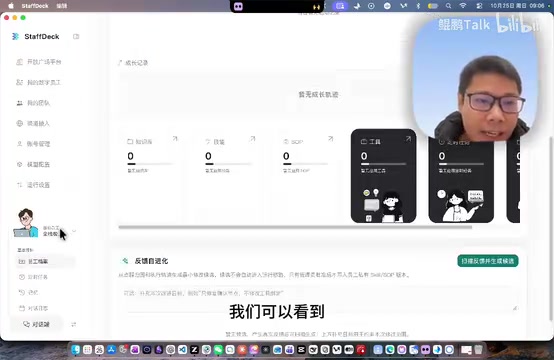
Each employee has independent work records, scheduled tasks, memory, and conversation logs. The host specifically highlighted the "accumulation" feature: experience gained during an employee's execution can be saved for self-iteration. This is closer to the definition of a "digital employee" than mere multi-turn conversation—capability grows with use.
SOP (Standard Operating Procedure) is a documented standard that codifies repetitive business processes into executable steps in an enterprise. In the digital employee context, an SOP is no longer just an operations manual for humans; it is broken down into roles, stages, approval conditions, and document flow rules, executed in sequence by multiple digital employees. For example, a contract review SOP specifies who does the initial review, who does the secondary review, and which roles must issue opinions before sealing, with the input and output of each step recorded. In this way, process knowledge is transformed from personal experience into a platform-callable asset. New employees or new Agents can collaborate directly per the SOP without relearning, significantly reducing dependence on "super individuals."
Runtime Control and Cost Constraints: A Management System on Top of Harness
The platform's runtime settings reveal its positioning as a "management system on top of Harness": you can toggle whether to show the thinking process, skill search, and tool calls, set a maximum number of rounds to constrain cost, and enable automatic context compression.
The host's assessment of the product architecture: StaffDeck is essentially a UI and management layer, with DeepSeek Harness underneath and DeepSeek as the primary model. This combination gives it a first-tier capability foundation among domestic products while also making it easy to use.
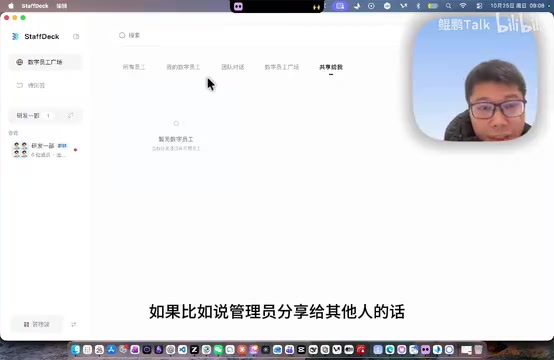
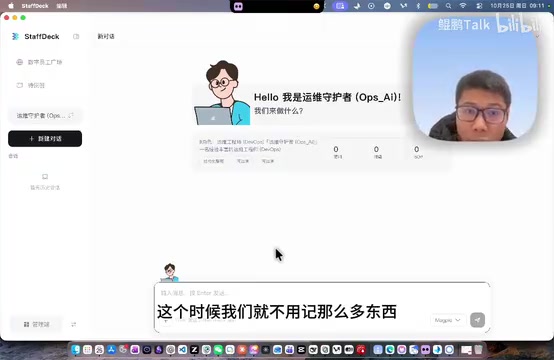
The chat side brings together all employees—digital employees and regular staff alike—and team conversations and the employee plaza support admin sharing, so others can also invoke them. When there are many tasks, the platform lists to-dos, analyzes them one by one, and drives them to completion. The host had a digital employee produce a competitive analysis report on the spot as a capability demo.
Automatic context compression is a key mechanism for long-conversation Agents to control token costs. As conversation rounds increase, historical messages quickly fill up the model's context window, driving up costs and potentially exceeding limits. Automatic compression typically uses summarization, truncation, or selective retention to condense earlier conversation into brief memory, keeping only information highly relevant to the current task. For multi-Agent collaboration platforms, the compression strategy directly affects task continuity and cost, so a balance must be struck between "remembering enough" and "spending little enough"—which is why StaffDeck makes compression a configurable runtime option.
Why a "Platform" Instead of a Single Agent
This is the most valuable insight in the video. The host compared it with the OPC workbench he had previously built and ultimately shut down his self-developed project because StaffDeck was clearly better in completeness. His core argument: after long-term Agent use, the efficiency bottleneck is not the model but how assets are organized.
Hand all operations-type Skills to the operations digital employee and transfer deployment directly after development is complete; put legal processes into SOPs with fixed roles approving them. After the three steps of categorization, ownership, and accumulation, Skills are actually put to use rather than piled up in a list. For developers who want to build a "one-person company," this means one front-end developer can have an entire development team, and one designer can add engineering capability.
The host also noted that current mainstream models and Agent capabilities are already very close; CodeX still performs best, but the gap is narrowing, and domestic solutions perform well. When capabilities converge, the selection criteria shift to experience and manageability—which is exactly where platforms like StaffDeck have their opportunity.
Who It's For, and What to Watch Out For
StaffDeck suits small and medium teams with clear process-accumulation needs, startups looking to build a digital employee system, and heavy Agent users who need to turn Skills into assets. GPL 3.0 open source means enterprises can use it for free, but you should also note the license's requirements for distribution.
There are risks to note as well: the platform is still iterating rapidly—the host himself only re-experienced it after waiting for fixes; multi-channel integration and enterprise API connections involve permissions and data boundaries, so a security assessment should be done before deployment. Current information comes mainly from a single host's hands-on demo, and the stability of actual multi-team collaboration still needs validation in more enterprise scenarios.
For developers troubled by "Skills installed but unused," StaffDeck offers a path worth trying: categorize your assets first, then talk about how strong the Agent is.
One-line Summary
StaffDeck is an open-source digital employee platform that uses DeepSeek Harness to drive multi-Agent team collaboration.
Paragraph Summary
StaffDeck is an enterprise-grade digital employee platform open-sourced under GPL 3.0, powered underneath by DeepSeek Harness and offering management modules on top such as the digital employee plaza, knowledge bases, Skills, SOPs, and the tool plaza. It supports integration with Feishu, WeChat, WeCom, and DingTalk, is compatible with mainstream model protocols including OpenAI, Claude, and Gemini, and provides Mac, Linux, and Windows clients. Its core value lies in categorizing and accumulating Skills and SOPs by role, solving the pain point of "hundreds of skills installed but unusable." Runtime supports round limits and context compression to control costs, making it suitable for small and medium teams, startups, and heavy Agent users building "one-person company"-style AI teams.
Related articles

GitHub Daily · October 30: Skills Ecosystem Explodes, Agents Start Provisioning Their Own Computers
GitHub Daily Oct 30: Skills ecosystem hits three layers (official, personal, vertical), agents get their own computers, and cross-session memory becomes essential.
AWS AgentCore Gateway: Connecting AI A…
AWS AgentCore Gateway: Connecting AI Agents to Enterprise Backends with MCP
How AWS AgentCore Gateway acts as a primary MCP server to aggregate REST APIs, Lambda, and existing MCP services? Analyzing its AST real-time mapping, zero cold start, semantic search for tool overload, session isolation, and key injection security design, plus the architectural approach to decoupling enterprise AI agents from backends.

One Link Gives Figma AI a New Skill: Hands-On with MCP Connectors
Paste one MCP server link and the AI Agent in Figma gains new tool capabilities. We break down the setup flow, 20+ one-click apps, read/write permissions and execution policies, and the public HTTPS requirement.