Stalwart Claims It Can Directly Replace Microsoft Exchange, Bringing a New Variable to Open-Source Email Services
Stalwart claims drop-in replacement for Exchange, community buzz but actual quality yet to be verified.
Open-source mail server Stalwart announced it is a "drop-in replacement" for Microsoft Exchange, gaining 246 points and 129 comments on Hacker News. "Drop-in replacement" means replacing without modifying configurations or clients, shifting competitive focus from feature lists to migration experience. Exchange's high stickiness stems from deep integration with Outlook, calendars, contacts, and enterprise directory services, which is also the main source of migration costs. The comment count near half the upvotes indicates controversy or dense experience sharing. The article notes that the announcement title has limited information value, and edge cases like shared mailboxes, resource calendars, permission groups, and compliance archiving are where migration truly gets stuck; technical teams should conduct small-scale parallel validation before deciding.
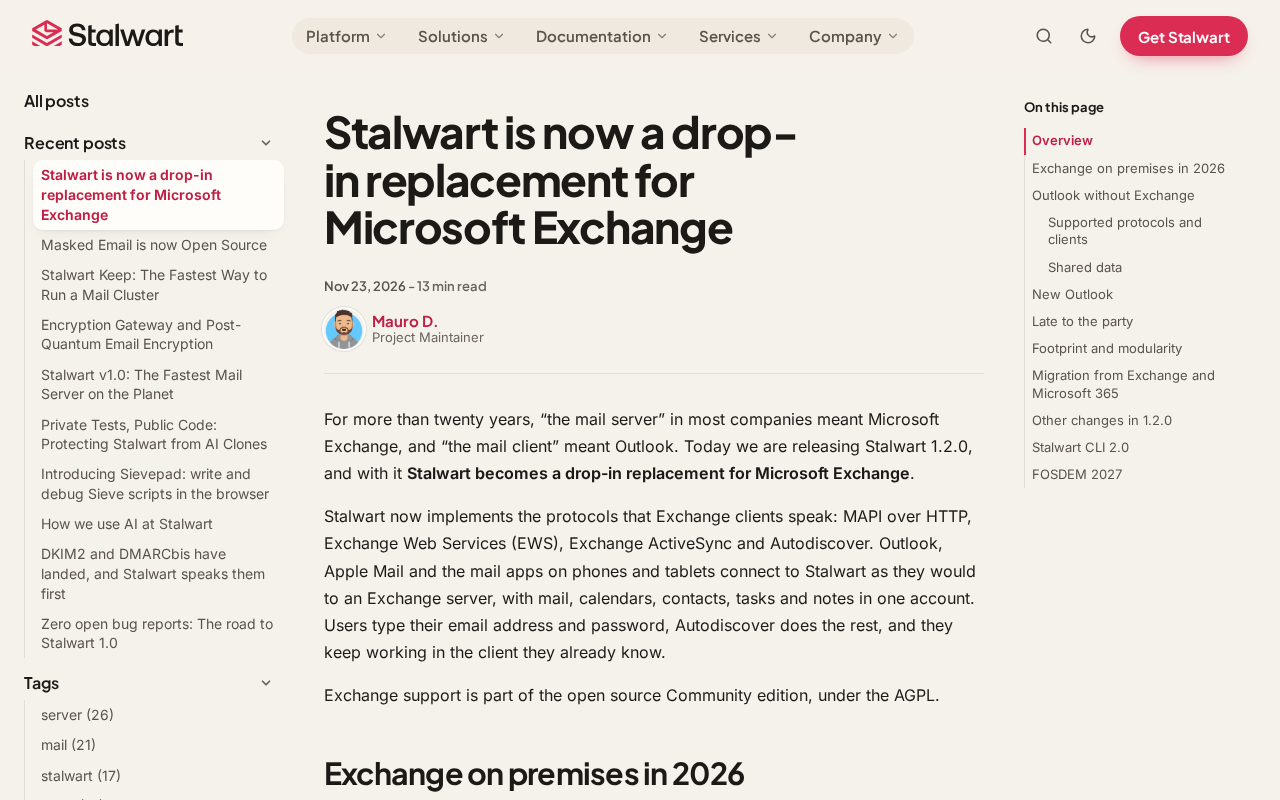
The open-source mail server project Stalwart has announced that it is now a "drop-in replacement" for Microsoft Exchange. The news sparked discussion on Hacker News, garnering 246 points and 129 comments, reflecting the developer community's continued interest in open-source alternatives for email infrastructure.
What "Drop-in Replacement" Means
"Drop-in replacement" has a clear meaning in software: a new component can directly replace the old one without modifying existing configurations, clients, or usage habits. In the context of mail servers, this means Stalwart aims to seamlessly take over Exchange's typical use cases.
Exchange has long dominated the enterprise email and collaboration market, fostering a vast ecosystem of clients and operational habits around it. Any solution claiming to replace Exchange must address protocol compatibility, client interoperability, and management interface migration. Stalwart's positioning is precisely aimed at reducing migration friction.
In enterprise email scenarios, protocol compatibility mainly involves standard protocols like IMAP, POP3, and SMTP, as well as the MAPI/EWS (Exchange Web Services) interfaces widely used in the Exchange ecosystem. Clients like Outlook do not rely solely on standard protocols when connecting to Exchange; many calendar, shared mailbox, and global address list features depend on EWS or MAPI over HTTP. Therefore, to truly be a "drop-in replacement," a solution often needs to implement both standard protocols and a compatibility layer for Exchange's proprietary interfaces—the latter being a long-standing gap for open-source mail servers. If Stalwart claims direct Outlook support, its technical complexity lies primarily in this compatibility layer, not in basic SMTP/IMAP sending and receiving.
Why Exchange Alternatives Matter
Enterprise email services are typical "high-stickiness" infrastructure. Exchange's value lies not only in sending and receiving emails but also in its deep integration with Outlook clients, calendars, contacts, and enterprise directory services. This integration is both a moat and a major source of migration costs.
For small and medium-sized organizations and self-hosted users, Exchange's licensing and operational costs have long been a burden. Open-source solutions have a natural cost advantage, but historically they often stumble on "features look sufficient, but migration is too painful." By positioning "drop-in replacement" as a selling point, Stalwart shifts the competitive focus from feature lists to migration experience.
Enterprise directory services typically refer to Active Directory (AD) or LDAP. Exchange's integration with AD is a key source of its high stickiness: user accounts, groups, permissions, and contacts are all managed centrally in the directory, with the email system being just a consumer of this identity system. When migrating to open-source solutions, organizations often need to retain existing AD/LDAP as the identity source, requiring the alternative to support directory synchronization, SASL/LDAP authentication binding, and directory group-based permission mapping. Whether it can smoothly integrate with existing directories directly affects whether migration means "switching email services" or "rebuilding the entire identity system"—an aspect often underestimated when evaluating Exchange alternatives.
Signals from Community Reactions
The Hacker News discussion, with 246 points and 129 comments, shows this is not a message easily overlooked. A comment count close to half the upvotes usually indicates controversy or dense experience sharing—and email server migration is exactly the kind of topic that triggers "war stories."
The热度 of discussions around self-hosted email solutions in technical communities often correlates positively with the cost and lock-in of mainstream commercial services. The attention Stalwart's news received itself indicates market expectations for viable alternatives. But there is a gap between expectation and validation; actual migration cases beyond the announcement are the true benchmark.
What to View with Caution
The announcement's title is more persuasive than its content. The specific scope of "drop-in replacement"—whether it covers all Exchange feature modules or just the core email sending and receiving chain—requires scrutiny of project documentation. The complexity of enterprise environments lies in edge cases: shared mailboxes, resource calendars, complex permission groups, and compliance archiving—these are often where migration truly gets stuck.
For technical teams considering evaluation, a more pragmatic approach is to conduct small-scale parallel validation first rather than making decisions based on announcement titles. Assessing the maturity of open-source email solutions should revolve around protocol compatibility testing, client compatibility checklists, and rollback plans.
Shared mailboxes, resource calendars, and complex permission groups are part of Exchange's unique collaboration data model. Shared mailboxes allow multiple users to access the same mailbox while maintaining individual read states; resource calendars are used for booking and conflict detection for meeting rooms, equipment, and other resources; permission groups grant fine-grained access to mailboxes and calendar folders via directory groups. These features have no equivalent semantics in standard IMAP/SMTP protocols and require the server to implement its own access control and delegation model. Compliance archiving involves email retention policies, legal holds, and audit logs. When evaluating open-source alternatives, each of these edge cases should be confirmed for equivalent implementation rather than just checking if email sending and receiving works.
Conclusion
Stalwart's announcement brings the替代 relationship between open-source mail servers and Exchange into the spotlight, and the Hacker News discussion热度 proves there is real demand behind this issue. For self-hosted and enterprise IT teams, this is a new option worth adding to the evaluation list, but the true quality of "drop-in replacement" will ultimately be determined by migration practice, not announcement wording.
One-line Summary
Stalwart claims to be a drop-in replacement for Exchange, sparking community discussion but with actual quality yet to be verified.
Paragraph Summary
The open-source mail server Stalwart announced it is now a "drop-in replacement" for Microsoft Exchange, garnering 246 points and 129 comments on Hacker News. "Drop-in replacement" means replacing without modifying existing configurations or clients, shifting the competitive focus from feature lists to migration experience. Exchange's high stickiness comes from deep integration with Outlook, calendars, contacts, and enterprise directory services, which is also the main source of migration costs. The comment count being nearly half the upvotes suggests controversy or dense experience sharing. The article cautions that the announcement title has limited information value, and edge cases like shared mailboxes, resource calendars, permission groups, and compliance archiving are where migration truly gets stuck; technical teams should conduct small-scale parallel validation before deciding.
Related articles

Prospero: A Lightweight Native AI Coding Tool Built with ImGui
Prospero is a bloat-free native AI coding tool built with ImGui, emphasizing lightweight design, high performance, and low dependencies. This article analyzes its design philosophy, technical choices, and the divergence between platformization and toolization in AI coding tools.

WebRTC Abused: New Variant of Credit Card Skimming Scripts on Shopping Sites
Security researchers found skimming scripts on popular shopping sites using WebRTC data channels to exfiltrate credit card data. This article analyzes the technical原理, differences from traditional Magecart attacks, and defense strategies for e-commerce platforms in third-party script governance and CSP policies.

Single GB10 Card Hits 101 tok/s: Inkling 2 Mini Performance Tested on vLLM
A developer shared on Hacker News running Inkling 2 Mini with vLLM on a single GB10 at 101 tok/s. This article analyzes the technical context, the significance of vLLM with small models on single cards, and caveats for interpreting tok/s metrics.