Stanford CS224r vs Berkeley CS285: How to Choose Between Deep Reinforcement Learning Courses

A practical guide to choosing and combining Stanford CS224r and Berkeley CS285 for deep RL self-study.
This article compares Stanford's CS224r and Berkeley's CS285 deep reinforcement learning courses, analyzing their differences in rigor, content freshness, and focus areas. It recommends using CS285 as the theoretical backbone for its mathematical depth, while supplementing with CS224r for frontier topics like RLHF and LLM alignment, offering a balanced mixed learning path for self-learners.
The Dilemma Between Two Top Deep Reinforcement Learning Courses
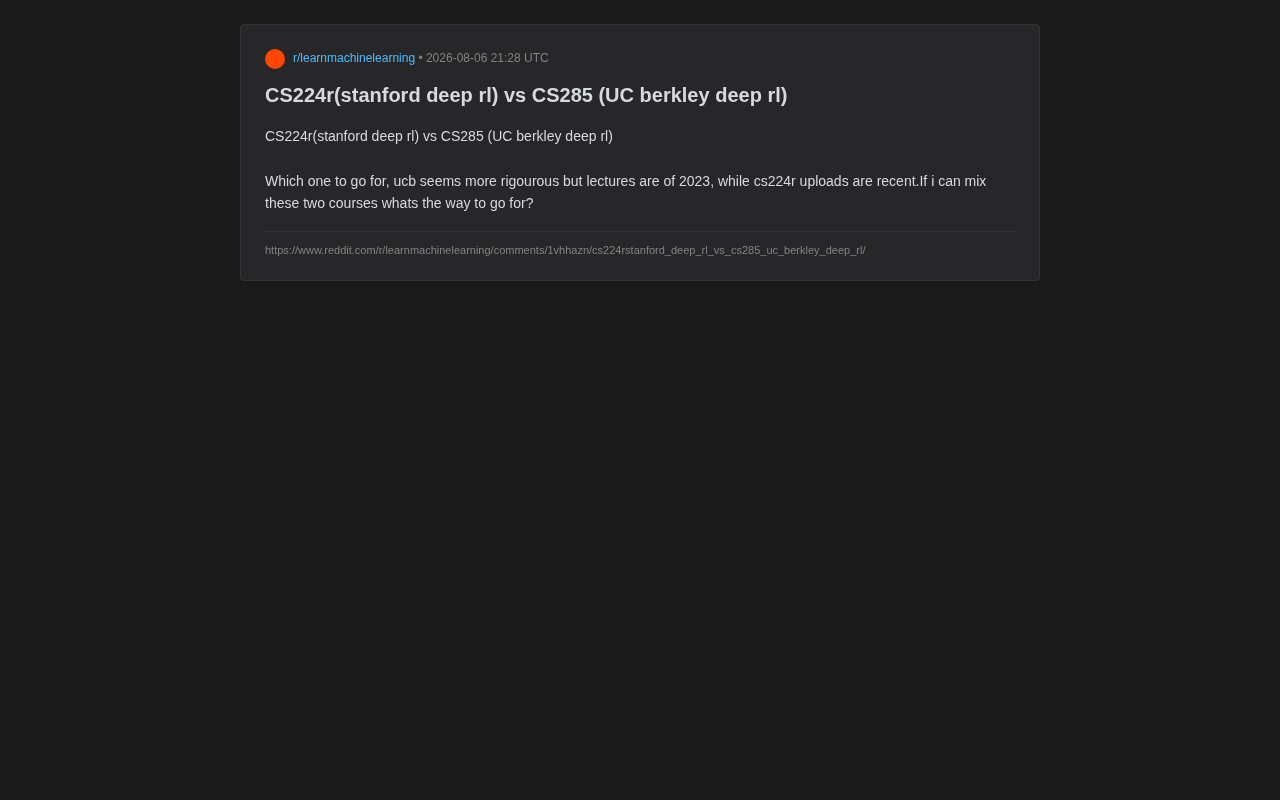
On the path to learning Deep Reinforcement Learning (Deep RL), Stanford's CS224r and UC Berkeley's CS285 are widely recognized as two pinnacle courses. Recently, a learner posed a highly representative question on Reddit: which of these two courses should you take?
The core dilemma was this: UC Berkeley's CS285 appears more rigorous, but its publicly available lecture recordings are from 2023; meanwhile, Stanford's CS224r has more recently uploaded content. If one could combine both courses, what would the optimal learning path look like?
This question may seem simple, but it touches on a common challenge faced by self-learners in reinforcement learning: how to find the right balance between mathematical rigor, content freshness, and learning efficiency. This article combines the distinct positioning of both courses to offer an actionable learning strategy.
CS285: Berkeley's Hardcore Deep Reinforcement Learning Course
Course Positioning and Characteristics
UC Berkeley's CS285 (Deep Reinforcement Learning) is taught by Professor Sergey Levine and has long been regarded as one of the most systematic and rigorous public courses in the deep reinforcement learning field. Sergey Levine is an Associate Professor in Berkeley's EECS department and a core member of the Berkeley Artificial Intelligence Research (BAIR) Lab. His research spans deep reinforcement learning, robot learning, and decision-making, with groundbreaking contributions in end-to-end learning for robotic manipulation, offline reinforcement learning theory, and model-based RL—his team has published widely influential papers including Conservative Q-Learning (CQL) and Decision Transformer. Because Levine himself is at the forefront of RL research, CS285 not only reflects textbook-level rigor but also incorporates extensive insights from cutting-edge research.
Its reputation for being "rigorous" is well-earned:
-
Complete mathematical derivations: From Policy Gradient to Actor-Critic, to Model-based RL and Offline RL, CS285 provides thorough theoretical derivations for every category of algorithm. Policy gradients are a class of reinforcement learning methods that directly parameterize the policy function and optimize expected returns via gradient ascent. The core idea originates from the REINFORCE algorithm (Williams, 1992), which computes policy parameter gradients through Monte Carlo estimates of trajectory returns. However, pure policy gradient methods suffer from high variance and slow convergence. The Actor-Critic architecture was proposed precisely to address this: the Actor outputs the action policy while the Critic estimates the value function as a baseline, significantly reducing gradient estimation variance. This framework later evolved into a series of modern deep RL algorithms including A2C, A3C, PPO, and SAC, forming the theoretical foundation for understanding contemporary RL systems.
-
Broad and deep coverage: The course covers advanced topics including imitation learning, exploration strategies, and inverse reinforcement learning, constructing a near-complete knowledge map of deep RL. Among these, Model-based RL and Model-free RL constitute the two major paradigms of RL. The former learns the environment's dynamics model (i.e., state transition function and reward function) and plans within simulated environments, dramatically improving sample efficiency. Representative methods include Dreamer and MBPO. Offline RL is a recent research hotspot that requires agents to learn policies solely from pre-collected static datasets without interacting with the environment—particularly important in scenarios like medical decision-making and autonomous driving where trial-and-error is impractical. Its core challenge lies in distribution shift: state-action pairs not covered in the data may lead to severe overestimation of value functions. Algorithms like CQL and IQL address this through conservative estimation or implicit constraints.
-
Challenging assignments: The programming assignments require learners to implement core algorithms from scratch, serving as a dual test of both coding ability and theoretical understanding.
Does the 2023 Recording Date Affect Learning?
The original poster was concerned that CS285's public recordings are from 2023. But it's worth noting that the core theoretical framework of reinforcement learning is relatively stable—foundational content like policy gradients, TD learning, and Bellman equations doesn't become outdated in a year or two.
Temporal Difference Learning (TD Learning) is one of the most fundamental ideas in reinforcement learning, systematically articulated by Richard Sutton in 1988. It combines the model-free nature of Monte Carlo methods with the bootstrapping property of dynamic programming, updating value functions through current estimates without waiting for complete episodes to finish. The Bellman equation is the mathematical foundation of all reinforcement learning theory, recursively defining optimal value functions: the value of a current state equals the immediate reward plus the discounted expected value of the next state. Classic algorithms like Q-learning and DQN are essentially iteratively solving the Bellman optimality equation. These concepts, first proposed by Richard Bellman in the mid-20th century, have never changed in their core form—which is why 2023 course recordings remain entirely applicable for these fundamental theories.
The 2023 version already covers the vast majority of foundational knowledge needed in both industry and academia today. What's truly iterating rapidly are frontier directions like RLHF (Reinforcement Learning from Human Feedback) that combine RL with large language models. And this is precisely where CS224r may have an advantage.
CS224r: Stanford's More Frontier-Adjacent Reinforcement Learning Course
Faster Content Updates, Covering LLM Alignment
Stanford's CS224r has more recently uploaded content, meaning it's more likely to incorporate the past two years' hottest topics in reinforcement learning, especially technologies related to large language model alignment, such as RLHF and DPO (Direct Preference Optimization).
RLHF (Reinforcement Learning from Human Feedback) is the key technology for applying reinforcement learning to LLM alignment, practiced at scale by OpenAI in InstructGPT (2022). The process has three steps: first, train a base model with Supervised Fine-Tuning (SFT); then train a Reward Model to fit human preference rankings; finally, use the PPO algorithm to optimize the language model's policy to maximize the reward model's scores. However, RLHF's pipeline is complex and training is unstable. In 2023, a Stanford team proposed DPO (Direct Preference Optimization), which bypasses explicit reward model training by reformulating the preference optimization problem as a simple classification loss function, directly optimizing the policy from preference data pairs. DPO and its variants (such as IPO and KTO) quickly became mainstream methods in LLM post-training, significantly lowering the engineering barrier for alignment training.
For learners aiming to enter the LLM post-training direction, the timeliness of such content is extremely valuable. LLM training is typically divided into two phases: Pre-training and Post-training. Pre-training acquires general language capabilities through self-supervised learning on massive text corpora, while post-training shapes the model into a helpful, honest, and harmless assistant through steps like SFT, preference optimization (RLHF/DPO), and safety alignment. In recent years, post-training has become one of the most active R&D directions in the AI industry—leading labs like OpenAI, Anthropic, and Google DeepMind are actively hiring researchers with RL and alignment expertise. Mastering the application of reinforcement learning in LLM alignment has become a core competitive advantage for joining these top teams.
Differences in Course Style
Compared to CS285's hardcore "build from scratch" approach, CS224r tends to emphasize connections to practical applications in its pacing and content organization. This doesn't mean it's less rigorous—rather, the focus is different. It's more like a window into cutting-edge practice.
How to Choose? The Optimal Mixed Learning Path
Clarify Your Learning Goals
Which course to choose ultimately depends on your objectives:
- If you want to build a solid theoretical foundation, or plan to pursue research in reinforcement learning, CS285 should be your main course. Its depth and rigor will help you develop a thorough understanding of algorithmic principles.
- If you're more interested in frontier applications like LLM alignment and RLHF, CS224r's newer content will better match your needs.
Recommended Mixed Learning Plan
Addressing the original poster's question about combining both courses, here's a practical path:
- Use CS285 as the backbone: Systematically complete Berkeley's core lectures and assignments to build a complete knowledge system from fundamentals to advanced topics. The depth of your theoretical foundation determines how far you can go.
- Supplement with CS224r for frontier topics: After mastering the basics, focus on CS224r's content covering RLHF, preference optimization, LLM integration, and other chapters that CS285 covers less or has older material on, bridging the timeliness gap.
- Prioritize hands-on practice: Regardless of which course, the biggest mistake in learning reinforcement learning is "watching without doing." Make sure to complete programming assignments and implement algorithms yourself—that's the only way to truly understand those abstract formulas.
Avoid the "Course Collecting" Trap
It's worth noting that many self-learners fall into the trap of "collecting courses"—starting multiple courses simultaneously only to finish none of them. A wiser approach is to go deep with one primary course and use the other for targeted supplementation, rather than pushing forward on two heavy courses in parallel.
Conclusion
CS285 and CS224r aren't an either-or choice but rather two complementary puzzle pieces. Berkeley's rigor lays your foundation; Stanford's freshness adds the frontier. For most learners, "building your base with CS285 and staying current with CS224r" is a reliable path that balances depth and timeliness. At the end of the day, courses are just tools—true growth comes from the understanding you gain through hands-on algorithm implementation.
Related articles

Python 3.15 New Feature: Is the sentinel Type Better Than None?
Python 3.15 adds the sentinel type, using named unique sentinel objects to replace None and bare object(), resolving confusion among missing values, explicit emptiness, and invalid input while avoiding type hint failures.

Deep Learning's Three Architectures and the Universal Approximation Theorem: A Complete Guide to MLPs, CNNs, and Transformers
Explaining the inductive bias differences among MLP, CNN, and Transformer, the existence meaning of the Universal Approximation Theorem (UAT), and the role of Taylor expansion in approximation analysis, while clearing up common misconceptions.

GitLab Emergency Patch Release: Analysis of Critical Security Fixes
GitLab releases critical patch 19.5.1, sparking 355 points of discussion on Hacker News. This article analyzes the background, upgrade steps for self-hosted instances, and verification points to help DevOps teams respond quickly to security updates.