Stanza: Turn Natural Language into Stateful Mock APIs in Seconds

Stanza turns natural language into stateful, CRUD-capable mock REST APIs using open-weight models.
Stanza is an open-source developer tool that instantly converts a natural language description into a callable mock REST API endpoint, supporting full GET, POST, PUT, and DELETE operations with data state persisting across requests. Aimed at frontend developers and indie hackers whose real backend isn't ready, it lets them simulate latency and custom status codes via query parameters for testing loading, timeouts, and error handling. Technically, Stanza calls open-weight models via Groq and extracts data structures using enforced JSON mode, populates nested data locally with @faker-js/faker and a recursive generator, then stores it in MongoDB Atlas with TTL indexes for automatic expiration and cleanup—achieving zero vendor lock-in and local fallback robustness while controlling costs. The project is open-sourced under AGPL-3.0 and already deployed online.
What Is Stanza
Stanza is a production-ready open-source developer tool that instantly turns natural language descriptions into usable, stateful mock REST API endpoints. You simply type something like "Generate 20 online users with id, name, avatar, and last active time," and Stanza parses the prompt, generates a customized data structure blueprint, and dynamically serves a live, callable endpoint.
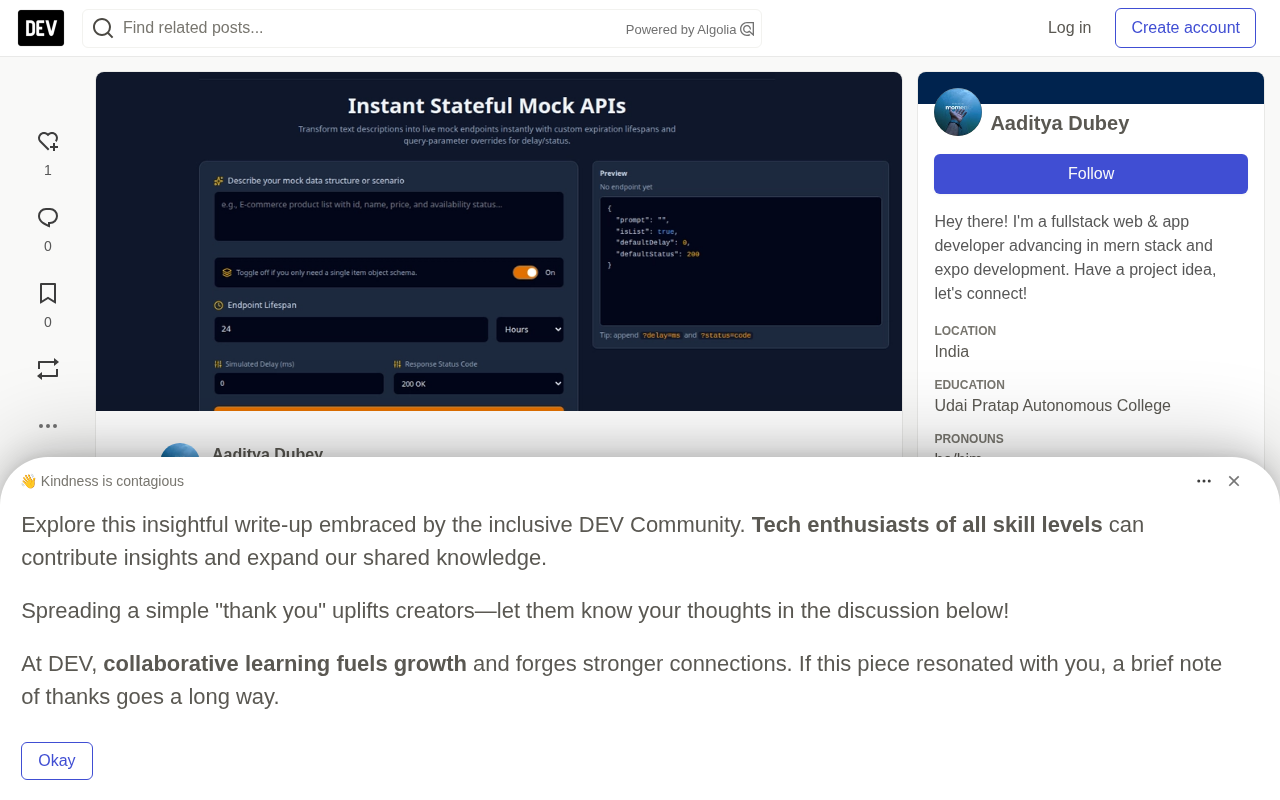
This tool is aimed at frontend developers and indie hackers, helping them rapidly prototype applications before a real backend is ready. According to its author, Stanza supports full CRUD operations (GET, POST, PUT, DELETE) and allows you to simulate artificial latency via query parameters (e.g., ?delay=5000) and custom status codes (e.g., ?status=500), making frontend development more closely resemble a real environment.
Core Features: More Than Just Static Mocks
Stanza positions itself as a "stateful" mock service, meaning the data it generates is not a one-time snapshot but something you can continually interact with. You can perform create, read, update, and delete operations on the generated resources, and the data changes accordingly. This is especially useful for frontend projects that need to demo multi-step flows, test pagination logic, or verify error handling.
Its built-in data mocking capability is also worth noting. According to the project documentation, Stanza combines @faker-js/faker with a recursive schema generator, capable of populating deeply nested JSON structures, sub-objects, and arrays without relying on token quotas from closed APIs. This means developers can generate complex, interrelated datasets in one go—for example, user profiles with nested chat histories and participant arrays.
Stateful vs. Stateless Mocks: Stateless mocks return the same or randomly generated data on every request. They're fine for verifying UI rendering but cannot simulate real business flows like "you can query a record after creating it" or "the ID becomes invalid after deletion." A stateful mock maintains a mutable data collection in memory or a database: records added via POST are read by subsequent GETs, and PUT changes are persistently reflected in responses. Stanza stores generated data in a MongoDB collection, so state is consistent across requests. This makes it suitable for testing logic that depends on before-and-after state sequences—pagination cursor advancement, optimistic update rollback, idempotency—tests that otherwise require waiting for a real backend or building a full mock server.
@faker-js/faker is a pure JavaScript/TypeScript fake data generation library and the community-maintained fork of the classic faker.js. It provides dozens of generators for names, addresses, emails, URLs, UUIDs, company names, dates, and more, with multilingual locale support and reproducible random seeds. Compared with calling external data APIs, faker generates locally and synchronously—no network round trips or quota limits—making it suitable for bulk-populating thousands of records in a single request. When combined with a recursive schema generator, it can generate objects and arrays layer by layer according to a JSON Schema hierarchy, constructing deeply nested structures.
Technical Architecture Analysis
Stanza's tech stack is designed around performance and zero-cost scaling, with several key decisions reflecting the author's engineering trade-offs.
AI Blueprint Engine
Stanza uses open-weight models (such as qwen/qwen3.8-27b) for inference via Groq, enforcing JSON output mode to extract precise schema structures and record counts from natural language prompts. This design ensures high-frequency, low-latency JSON extraction while avoiding dependence on a single closed-source API. The author emphasizes in the original post that open-weight models provide full architectural control, zero vendor lock-in, and the ability to build a local fallback heuristic layer, ensuring the application doesn't crash when external AI nodes experience rate limiting or cold starts.
Open-weight models are not exactly the same as open-source models: Open-weight means the model parameters can be publicly downloaded and self-deployed, but the training data, training code, or license may not be fully open. For developer tools, the key benefit is that inference can be migrated between self-hosted and third-party hosting providers, without being locked into a single API vendor. The article mentions inference via Groq, a service provider offering extremely low-latency inference on LPU hardware. Its advantages lie in first-token latency and output tokens per second—exactly suited to high-frequency calls with short input and short output, like quickly converting a sentence of natural language into a JSON schema.
Enforced JSON output mode (Structured Output / JSON Mode) is a mechanism that guarantees the model returns valid JSON, typically implemented via constrained decoding: at each sampling step, tokens that would break JSON syntax are masked out. Compared to writing "please return only JSON" in the prompt and parsing afterward, constrained decoding avoids parsing failures caused by the model outputting explanatory text or extra commas—crucial for pipelines that need to programmatically consume model output. This is also the prerequisite for Stanza to reliably map natural language to field structures.
Fallback heuristic layer refers to using rule-based local logic as a fallback when the primary AI call fails, is rate-limited, or times out—for example, matching common field names (id, name, avatar) based on keywords or applying default templates to generate schemas. It sacrifices some semantic understanding capability in exchange for availability, preventing the entire tool from becoming unusable due to external dependency fluctuations.
Local Data Population and Database Layer
Data population is handled by local libraries rather than calling external APIs, significantly reducing usage costs. The database layer uses MongoDB Atlas with a single-document collection strategy and TTL indexes (expiresAt) for automatic expiration and cleanup of temporary mock endpoints. Each mock endpoint can have a lifespan ranging from a few minutes to 48 hours, which both avoids the collection count limits of the free tier and keeps resource usage clean.
MongoDB TTL indexes are special indexes that allow a background thread to automatically delete a document once a specified date field reaches a certain time. To create one, you build a TTL index on the expiresAt field with expireAfterSeconds: 0, and documents are cleaned up after that point in time. Note that the TTL background task typically runs about every 60 seconds, so deletion is not precise to the second—but that's sufficient for temporary mock endpoints. Compared to writing your own scheduled job to scan and delete, TTL indexes delegate cleanup responsibility to the database, reducing application-side state management.
Single-collection strategy means not creating a new collection for each mock endpoint, but instead storing records for all endpoints in the same collection, distinguished by a field like endpointId. The benefit is bypassing MongoDB Atlas free tier's collection count limits while avoiding the metadata overhead of many small collections; the cost is that queries must always include the endpoint identifier, and composite indexes need to be created for commonly filtered fields. Combined with TTL indexes cleaning up by expiresAt, the entire lifecycle of temporary data forms a closed loop.
Simulated Infrastructure Middleware
Built-in middleware handlers are responsible for response delay clamping and dynamic HTTP status code overriding. These two features seem simple but allow frontend developers to easily test loading states, timeout handling, and error boundaries—scenarios that are often difficult to quickly reproduce in real backend development.
Why Open Models Are Key
Stanza's author specifically discusses the significance of open innovation to the project. Building a prompt-to-schema translation engine requires high-frequency, low-latency JSON extraction, and open-weight models give the team full control over the details of the parsing pipeline. Using a closed-source API would not only impose customization limits but also bring heavy recurring costs for a developer tool like this.
This reflects a broader trend: AI-native tools are beginning to adopt open models as the default choice, especially in cost-sensitive developer tool domains that require many repeated calls. Stanza further enhances robustness with a local fallback heuristic layer—this "open model + local fallback" architecture pattern may become a common paradigm for small AI tools.
Use Cases and How to Get It
Stanza is suitable for the following scenarios: frontend prototyping, API contract testing, demo environment setup, and creating teaching examples. The project is deployed on Vercel, and the code is open-sourced under the AGPL-3.0 license.
A quick test example: generate a mock endpoint for "20 online users with id, name, avatar, and last active time," then call it with ?delay=2000&status=200 to observe the simulated delay and status code. Developers can visit the GitHub repository for the full code or try the online demo directly.
One-line Summary
Stanza uses open-weight models to turn natural language into stateful, CRUD-capable mock REST APIs.
Paragraph Summary
Stanza is an open-source developer tool that instantly converts a natural language description into a callable mock REST API endpoint, supporting full GET, POST, PUT, and DELETE operations with data state persisting across requests. It's aimed at frontend developers and indie hackers whose real backend isn't ready yet, allowing them to simulate latency and custom status codes via query parameters for testing loading, timeouts, and error handling. Technically, Stanza calls open-weight models via Groq and extracts data structures using enforced JSON mode, populates nested data locally with @faker-js/faker and a recursive generator, then stores it in MongoDB Atlas with TTL indexes for automatic expiration and cleanup—achieving zero vendor lock-in and local fallback robustness while controlling costs. The project is open-sourced under AGPL-3.0 and already deployed online.
Related articles

Chain of Thought Isn't Just for AI: How Humans Can Use CoT to Improve Thinking Quality
Chain of Thought isn't just a prompt trick for large models. Starting from a Hacker News discussion, this article analyzes why CoT works for human thinking too, breaks down actionable ways to transfer it, and highlights the key differences between human CoT and machine CoT.
Cloudflare Teams Up with OpenAI: Closi…
Cloudflare Teams Up with OpenAI: Closing the Loop from Vulnerability Discovery to Defense with AI
Cloudflare uses OpenAI Daybreak to investigate security vulnerabilities and generate reviewable remediation plans, while developers use Codex to boost coding efficiency and quality.

Orca Multi-Agent Orchestration in Practice: A Guide to Parallel Collaboration with Claude and Codex
Orca is Stable AI's free open-source agent workbench supporting 34 agents like Claude Code and Codex in parallel. Learn its Git worktree isolation, multi-model orchestration, and mobile management.