Starlink Suddenly Restricts Ukraine Military Service: Musk-Zelensky Rift Spills Over into Battlefield Communications

Ukraine accuses Starlink of unannounced service restrictions disrupting drone operations, following Musk's criticism of Zelensky.
Ukrainian officials accuse SpaceX's Starlink of imposing new restrictions on Ukrainian military services in specific areas without warning, directly disrupting satellite-dependent drone operations and military missions. The incident occurred days after Musk publicly said Zelensky 'has gone too far,' making the timing highly sensitive. Starlink terminals have become critical infrastructure for Ukrainian reconnaissance, positioning, and frontline command due to their rapid deployment, high bandwidth, and strong anti-jamming capabilities. The restrictions expose a structural risk: when military capabilities are built on third-party commercial services, the provider's decisions can instantly alter the battlefield situation. SpaceX has not yet given a complete response, and the outcome depends on whether both sides can reach a new consensus on service terms and communication mechanisms.
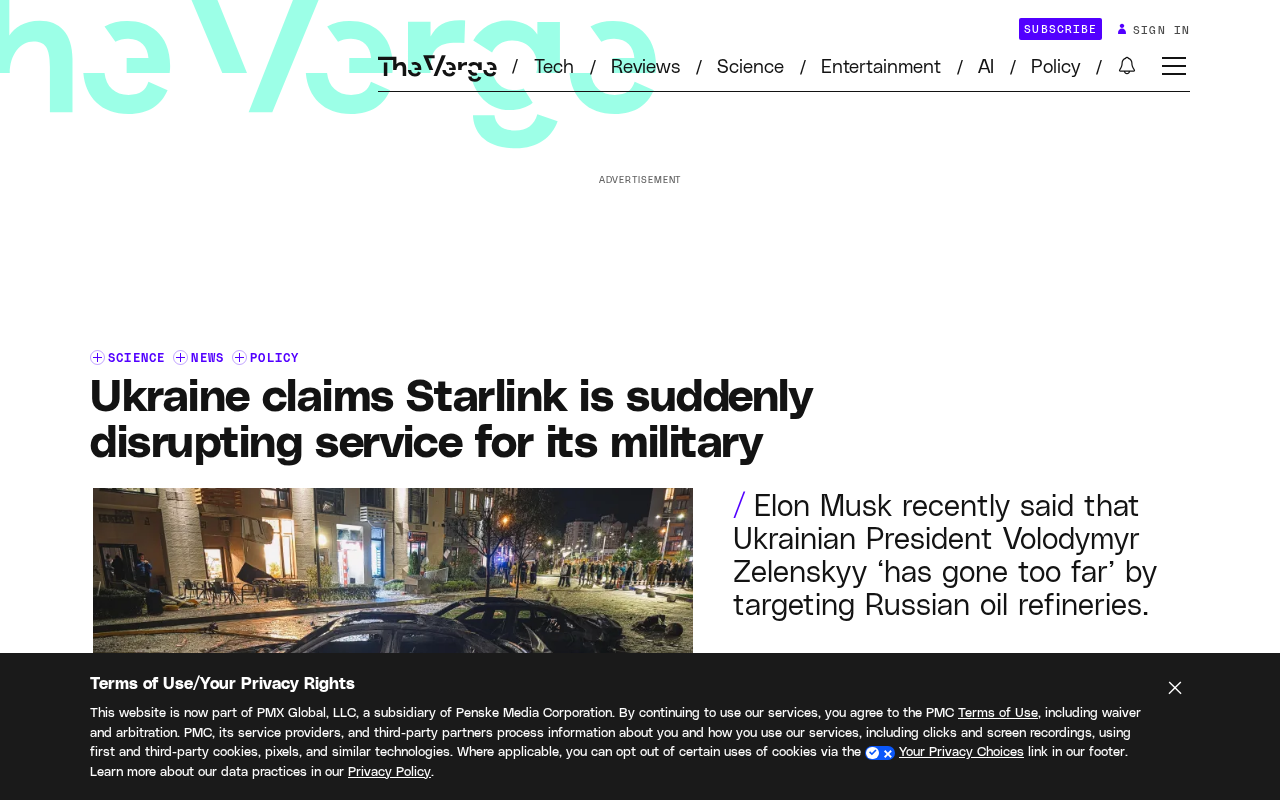
According to Reuters and the Financial Times, Ukrainian officials recently accused SpaceX's Starlink of imposing new restrictions on Ukrainian military services in specific areas without any warning, disrupting drone operations and some military missions. The timing of this incident is extremely sensitive—just days earlier, Musk publicly stated on X that Ukrainian President Zelensky "has gone too far."
Why Starlink Became Critical Infrastructure on Ukraine's Battlefield
Since the outbreak of the conflict, Starlink terminals have been a vital pillar of the Ukrainian military's communications system. Compared to traditional military communication equipment, Starlink terminals deploy quickly, offer high bandwidth, and have strong anti-jamming capabilities, playing an irreplaceable role in drone reconnaissance, target positioning, and frontline command.
The core of the allegation lies in its "suddenness"—Ukrainian officials say the service restrictions took effect without any notification, directly impacting drone operations that depend on satellite networks. For units executing missions, a communications outage doesn't just mean mission failure—it can also put personnel at risk of casualties.
SpaceX has not yet provided detailed explanations regarding the specific restrictions, but this incident has once again thrust the role of commercial satellite services in warfare into the spotlight of public debate.
Starlink's Technical Principles and Military Suitability
Starlink is a low Earth orbit (LEO) satellite internet constellation operated by SpaceX, with satellites at an orbital altitude of approximately 550 kilometers—far below the 35,786 kilometers of traditional geostationary satellites. The direct advantage of low orbit is significantly reduced communication latency (typical round-trip latency of about 20–40 milliseconds), sufficient to support latency-sensitive applications like real-time video transmission and remote control. Each satellite covers a small area, requiring a constellation of thousands of satellites for continuous coverage—which also means service can be precisely degraded or cut off in specific geographic areas. The user terminal is a phased-array antenna that automatically aligns with satellites overhead, requiring no specialized infrastructure for deployment and capable of connecting within minutes of being powered on—this is precisely why Ukrainian forces could rapidly roll out the system on the front lines. By comparison, traditional military satellite communication terminals are bulky, expensive, and have long procurement cycles, making it difficult to support the dispersed, mobile combat style of Ukrainian forces.
The Public Rift Between Musk and Zelensky
Before news of the service restrictions emerged, Musk posted on X that Zelensky "has gone too far." While the causal relationship between the specific context of this post and Starlink policy has not been independently confirmed, the close timing makes it difficult for observers to dismiss as coincidence.
Musk has repeatedly made controversial statements about the Ukraine conflict, including suggesting Ukraine trade territory for peace. The tension between these positions and the Ukrainian government's expectations has been steadily accumulating, and whether Starlink's service strategy—as a commercial asset personally controlled by Musk—is influenced by his personal political views has been a persistent focus of scrutiny.
From a technology governance perspective, the fact that a private business owner holds the switch to critical wartime communications infrastructure has itself sparked widespread discussion at the level of international law and business ethics.
Drone Warfare's Deep Dependence on Satellite Communications
Ukraine has extensively used drones for reconnaissance and strike missions in the conflict, with these drones' real-time video transmission, remote control, and target correction heavily dependent on stable satellite links. Once Starlink degrades or interrupts service in a specific area, drone combat effectiveness drops sharply.
Ukrainian officials revealed that the restrictions directly "disrupted" drone operations and military missions. This means the impact is not theoretical—it has already occurred in actual combat scenarios.
This also exposes a structural risk: when military capabilities are built on third-party commercial services, the service provider's business decisions or political judgments can change the battlefield situation in an instant.
Composition of Military Drone Communication Links
Ukrainian drones fall roughly into two categories: one is consumer-grade or lightly modified models that rely on direct radio connections, with operational ranges typically only a few kilometers to a few dozen kilometers; the other is medium-to-long-range fixed-wing drones that require beyond-line-of-sight communication links, for which Starlink is the lowest-cost, fastest-to-deploy option. Satellite links primarily serve three functions: real-time video relay (for operators and command posts to assess targets), flight control command transmission, and backup positioning correction when GPS is jammed. When the link is degraded, operators may lose their visual feed and can only rely on pre-set waypoints, significantly reducing target identification and strike accuracy. Russian electronic warfare primarily targets radio and GPS frequencies, and jamming Ku/Ka-band satellite links is more difficult—which is one reason Starlink has particular value on the battlefield.
The Wartime Governance Dilemma of Commercial Satellite Services
This is not the first time Starlink has been embroiled in policy controversies related to the Ukraine conflict. There have already been multiple rounds of discussion regarding service area restrictions, cost bearing, and the boundaries of military use. Each controversy asks the same question: what responsibility should commercial infrastructure bear in wartime?
From SpaceX's standpoint, the company needs to balance commercial contracts, U.S. export control regulations, and its own risk tolerance. But from Ukraine's standpoint, a communications outage on the battlefield is equivalent to a existential threat, and any "unannounced" service change is unacceptable.
Currently both sides maintain their own positions. Reuters and the Financial Times reports are primarily based on Ukrainian officials' statements, and SpaceX's full response has not yet been adequately presented. How this incident develops will depend on whether both sides can reach a new understanding on service terms and communication mechanisms.
For other users and partners relying on Starlink, this incident also serves as a wake-up call: the reliability and predictability of critical communications infrastructure should not hinge solely on the decisions of a single commercial entity.
ITAR and Export Controls' Constraints on SpaceX
As a U.S. company, SpaceX's satellite communication services and related technologies are subject to the International Traffic in Arms Regulations (ITAR) and U.S. export control laws. Providing or restricting communication services to a conflict zone involves judgments about whether it constitutes military assistance, whether it violates sanctions provisions, and whether compliance controls are needed for specific geographic areas. SpaceX has previously stated that some service area adjustments were related to sanctions and export control compliance, rather than purely commercial decisions. This means that even if SpaceX were willing to continue providing services, it might be compelled to take certain measures due to legal restrictions. This background makes attributing responsibility more complex: it is not just a question of the business owner's personal choices, but also a question of how a commercial entity fulfills compliance obligations within the framework of national security regulations—and current international law lacks clear, actionable rules for such situations.
One-line Summary
Ukraine accuses Starlink of restricting service without warning, disrupting drone operations, shortly after Musk criticized Zelensky.
Paragraph Summary
Ukrainian officials accuse SpaceX's Starlink of imposing new restrictions on Ukrainian military services in specific areas without warning, directly disrupting satellite-dependent drone operations and military missions. The incident occurred days after Musk publicly said Zelensky "has gone too far," making the timing highly sensitive. Starlink terminals have become critical infrastructure for Ukrainian reconnaissance, positioning, and frontline command due to their rapid deployment, high bandwidth, and strong anti-jamming capabilities. The restrictions expose a structural risk: when military capabilities are built on third-party commercial services, the provider's business decisions or political judgments can instantly alter the battlefield situation. SpaceX has not yet given a complete response, and the incident's outcome depends on whether both sides can reach a new consensus on service terms and communication mechanisms.
Related articles

Workbuddy for Absolute Beginners: How a Desktop AI Agent Fits Into Real Workflows
A beginner's guide to the Workbuddy desktop AI agent: installation, claiming credits, file management, and building automated workflows—compared with CodeX for fit and cost, helping professionals shift from AI question-askers to AI managers.

OpenAI's New Agent Stack: Computer Use, Decisions API, and Ultra-Fast Workflows
OpenAI Dev Day unveiled a new agent stack: Computer Use outperforms humans, Decisions API delivers ultra-low-latency classification via Luna, Agents API opens the same Computer Use capabilities, and GPT-6.1 Sol costs only one-seventh of Astra. Core updates, benchmark data, and developer insights.

Liang Wenfeng Open-Sources DeepInfo Inference Framework, Takes On U.S. Ban
DeepSeek open-sources its DeepInfo inference framework after its models, featuring GPU/CPU cross-pipelining, small-model prediction with large-model verification, and full Huawei Ascend and NVIDIA chip support—facing the U.S. federal ban head-on. This article analyzes its significance for AI deployment and open-source strategy.