StateCraft: Enhancing Video World Models with Abstract State Reasoning

StateCraft decouples abstract state from visual state, enabling video world models to track changes in invisible regions during long-horizon interactions.
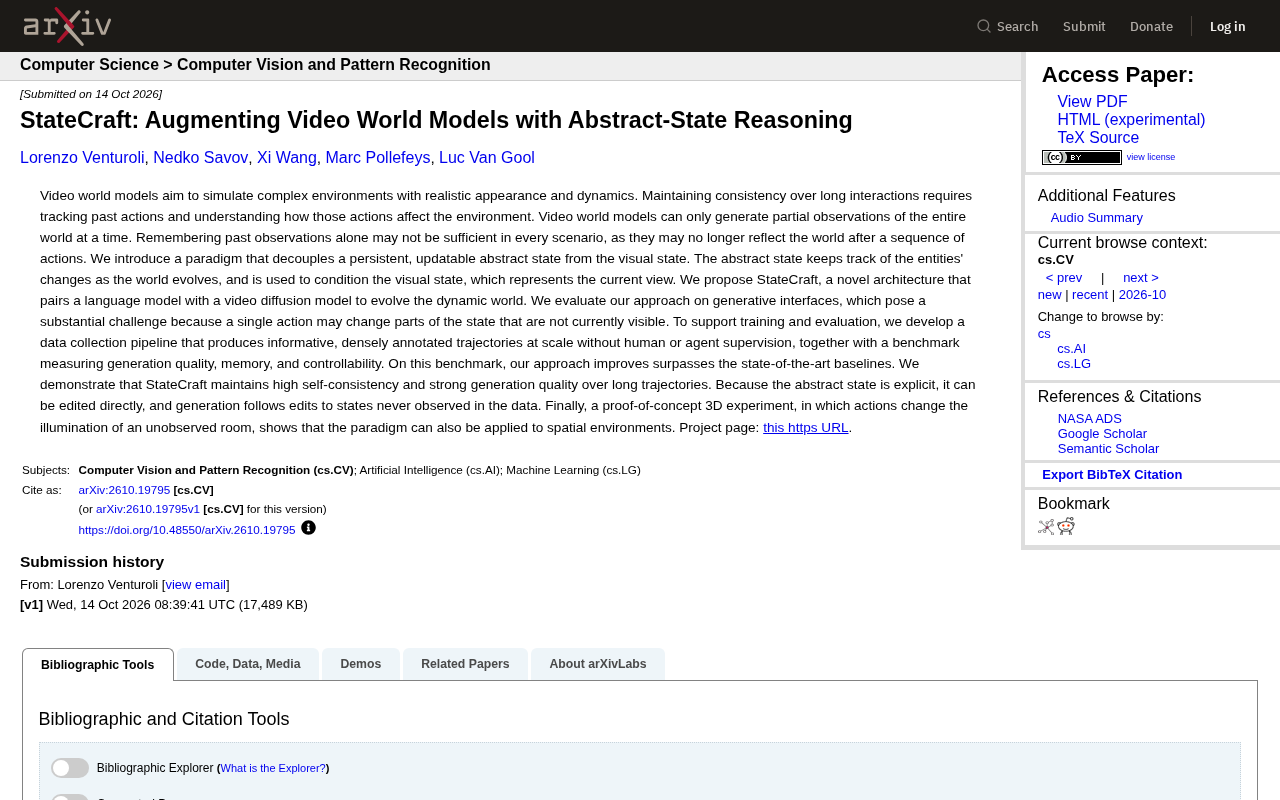
StateCraft addresses the issue that video world models relying solely on visual memory cannot track changes in invisible regions during long-horizon interactions by decoupling a persistently updatable abstract state from the visual state. The abstract state is maintained by a language model and records viewpoint-independent entity attributes and changes; the visual state is generated by a video diffusion model conditioned on the abstract state to render the current viewpoint. In the challenging test scenario of generative interfaces, the method comprehensively surpasses existing baselines across generation quality, memory retention, and controllability, and supports direct editing of the abstract state to guide generation. The team also developed an unsupervised large-scale data collection pipeline and evaluation benchmark, while a 3D proof-of-concept shows the paradigm can extend to spatial environments.
Video world models are becoming core infrastructure for embodied intelligence and interactive content generation. But a fundamental contradiction persists: the model can only observe a local part of the world at each step, yet must maintain global consistency across long-horizon interactions. When action sequences alter regions that are currently invisible, simply "remembering the frames you've seen" is no longer enough.
Researchers from insait-institute propose StateCraft, which offers a new solution to this challenge by decoupling a persistently updatable abstract state from the visual state. According to its project homepage, the method surpasses existing baselines across three dimensions: generation quality, memory retention, and controllability.
Why "Remembering Frames" Isn't Enough
The traditional approach to video world models is straightforward: use historical frames as context to predict the next frame. This paradigm performs well on short video clips, but reveals structural flaws when facing long-horizon interactions.
The core issue is that the world model only generates partial observations of the overall environment. When you rotate the camera in your hand, open a door, or move an object, the altered state is likely outside the current field of view. If the model relies solely on visual memory, it has no way of knowing about those parts that are "unseen but changed."
This is similar to a person who can only observe a room through a keyhole but needs to remember the entire room's layout—and after each peek, the room may also have changed due to previous actions. StateCraft's approach is: in addition to recording "what was seen," it also maintains a "current world state" that is independent of viewpoint.
Decoupled Architecture: Language Model + Video Diffusion Model
StateCraft's core design splits world modeling into two cooperating components:
Abstract state is responsible for tracking entity attributes and changes. It does not depend on any particular viewpoint; it records "what the world is like now," not "what it looks like from a certain angle." This state is an explicit representation that is readable, writable, and editable.
Visual state represents the image from the current viewpoint, generated by a video diffusion model. The key is that the generation of the visual state is conditioned on the abstract state—that is, the image is not "continued" from memory, but "rendered" according to the current world state.
The two are bridged by a language model: the language model maintains and updates the abstract state, while the video diffusion model converts the abstract state into visual output. This division of labor allows the system to handle complex semantic changes while maintaining high-quality image generation.
Video diffusion model refers to a class of models that apply the diffusion generation process to sequences of video frames. The core idea of diffusion models is to first gradually add noise to data, then train a network to reverse this process, progressively denoising from pure noise to generate samples; when applied to video, the model must also maintain frame-to-frame coherence along the temporal dimension. Compared with earlier video generation methods, diffusion models are usually better in image detail and motion naturalness, but they are computationally expensive and prone to drift or forgetting when generating long sequences. StateCraft conditions video diffusion model generation on the abstract state, essentially delegating the decision of "what content to generate" to the state maintained by the language model, while the diffusion model is only responsible for "how to render it," thereby alleviating long-horizon inconsistency under purely visual conditions.
Generative Interfaces: The Most Challenging Test Scenario
The research team chose "generative interfaces" as the primary evaluation scenario, and this choice is well considered.
In a generative interface, a single user action may change the state of regions that are currently invisible. For example, adjusting a parameter may affect content in another tab or collapsed section. This places extremely high demands on the world model: you must not only generate the current view, but also correctly infer and record those parts that were changed but not observed.
StateCraft performs excellently in such scenarios. Because the abstract state it maintains is viewpoint-independent, even if some changes have never been observed in the training data, the model can respond correctly by editing the abstract state. This means the system possesses a certain degree of generalization ability—it is not just "generate what has been seen," but "change the state and generate."
Generative interface can be understood as dynamically producing user interface images with generative models, rather than statically rendering them from front-end code. For example, when a user modifies a slider or clicks a tab, the system does not hard-code every interface state in advance; instead, the model "paints" the next screen based on the current state. The fundamental difference from traditional UI is that interface elements and their changes are inferred by the model rather than specified by explicit code. Therefore, the model must maintain state consistency across views and interaction steps; otherwise, after one action, the screen may show missing elements or corrupted values. Generative interfaces inherently require long-horizon memory and viewpoint-independent state representation, which is also why they make an ideal evaluation scenario for StateCraft.
Data Pipeline and Evaluation Benchmark
Supporting this method is an automated data collection pipeline. It can generate information-dense, richly annotated trajectory data at scale, without human or agent supervision. This solves the scarcity of high-quality long-horizon data in world model training.
The accompanying evaluation benchmark measures model performance along three dimensions: generation quality, memory capability, and controllability. On this benchmark, StateCraft comprehensively surpasses existing state-of-the-art methods and maintains high self-consistency and stable image quality in long-trajectory generation.
Notably, the abstract state is editable. Since the state is explicit, users can directly modify it, and the generated results will follow these edits—even if the edited state has never appeared in the training data. This opens new possibilities for interactive applications: you do not need to retrain the model, only to change the state description.
Trajectory data in world model training usually refers to a sequence of (action, observation) pairs: an agent or user performs an action, the environment returns one or more observation frames, and arranging them in chronological order forms a trajectory. Long-horizon trajectories can cover the process of state changing cumulatively over time, which is crucial for training memory capability. But such data is difficult to collect: real interaction is costly, and annotation further requires human judgment of whether the state has been changed. An automated pipeline can generate scenarios programmatically, execute actions, and record before-and-after states, producing information-dense, richly annotated trajectories in batches without relying on human supervision, thereby alleviating the constraints of scarce high-quality long-horizon data on world model training.
From Screen to Space: 3D Proof of Concept
The research team also demonstrated a 3D proof-of-concept experiment: an action changes the lighting conditions of an unobserved room, and the model needs to correctly infer this change and reflect it in subsequent generation.
The significance of this experiment is to show that the paradigm is not limited to 2D interfaces and can also be applied to spatial environments. Although it is currently only a proof of concept, it points to a more general world modeling paradigm—abstract state as the "skeleton" of world evolution, and visual generation as its "projection" from a specific viewpoint.
From a broader perspective, StateCraft represents a shift in thinking: rather than having the model implicitly remember everything, give it an explicit, structured state representation. This decoupling not only improves performance and controllability, but also makes the internal workings of the world model more transparent and intervenable.
For researchers and developers focused on video generation, embodied intelligence, and interactive AI, StateCraft's architecture design is worth in-depth study. The project page provides more technical details and demonstrations.
One-line Summary
StateCraft decouples abstract state from visual state, enabling video world models to track changes in invisible regions during long-horizon interactions.
Paragraph Summary
To address the problem that video world models relying solely on visual memory cannot track changes in invisible regions during long-horizon interactions, StateCraft proposes decoupling a persistently updatable abstract state from the visual state. The abstract state is maintained by a language model and records viewpoint-independent entity attributes and changes; the visual state is generated by a video diffusion model conditioned on the abstract state to produce the current viewpoint image. In the highly challenging test scenario of generative interfaces, the method comprehensively surpasses existing baselines across generation quality, memory retention, and controllability, and supports directly editing the abstract state to guide generation. The research team also developed a large-scale data collection pipeline that requires no human supervision and an accompanying evaluation benchmark, and a 3D proof-of-concept experiment further shows that the paradigm can extend to spatial environments.
Related articles

Chain of Thought Isn't Just for AI: How Humans Can Use CoT to Improve Thinking Quality
Chain of Thought isn't just a prompt trick for large models. Starting from a Hacker News discussion, this article analyzes why CoT works for human thinking too, breaks down actionable ways to transfer it, and highlights the key differences between human CoT and machine CoT.
Cloudflare Teams Up with OpenAI: Closi…
Cloudflare Teams Up with OpenAI: Closing the Loop from Vulnerability Discovery to Defense with AI
Cloudflare uses OpenAI Daybreak to investigate security vulnerabilities and generate reviewable remediation plans, while developers use Codex to boost coding efficiency and quality.

Orca Multi-Agent Orchestration in Practice: A Guide to Parallel Collaboration with Claude and Codex
Orca is Stable AI's free open-source agent workbench supporting 34 agents like Claude Code and Codex in parallel. Learn its Git worktree isolation, multi-model orchestration, and mobile management.