Statement Normalization: A Cost-Effective Approach to Large-Scale Conversation Analysis

Statement Normalization preprocesses conversations once so small models can handle million-scale dialogue analysis cheaply.
This arXiv paper introduces a "Clarify, Then Focus" principle, converting raw customer service dialogues into speaker-attributed, semantically tagged normalized statements as a one-time preprocessing step. Experiments on an offer-suppression task show normalization benefits supervised classifiers on its own, while weaker prompted readers also need evidence selection. Crucially, the entire pipeline runs on small models and lightweight encoders, with normalization outputs reusable across countless queries — dramatically cutting enterprise costs at million-conversation scale.
The Core Challenge of Enterprise Conversation Analysis
When enterprises need to extract insights from millions of customer interactions, they repeatedly fall into the same cost trap: every analytical question requires re-interpreting what the speakers actually meant, then sifting through lengthy transcripts for relevant information. This interpretive work gets executed over and over on the same transcripts, driving up massive computational and time costs.
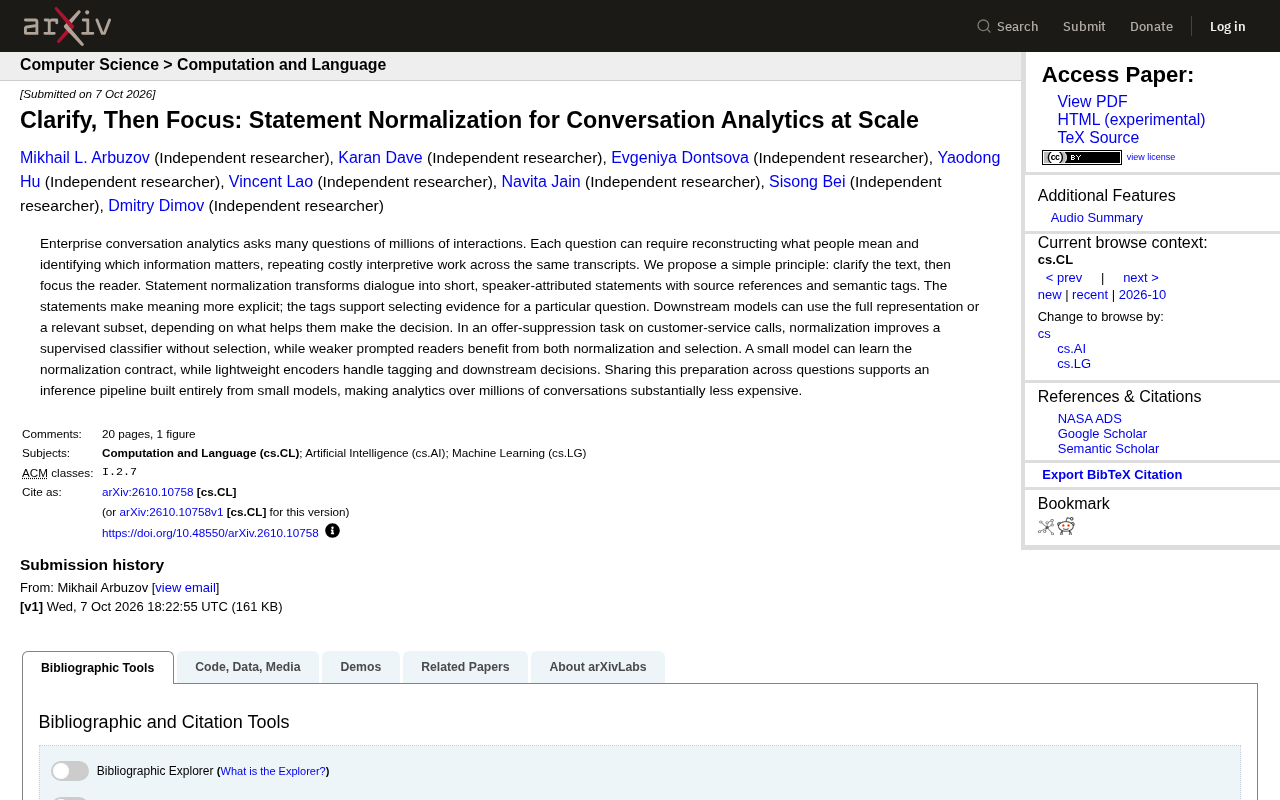
A newly published paper on arXiv (arXiv:2610.10758v1) proposes a refreshingly simple yet practical guiding principle: Clarify, Then Focus. The idea is to front-load the semantic understanding work — which would otherwise be repeated for each specific task — into a one-time preprocessing step, so the results can be shared across many downstream queries.
What Is Statement Normalization
The paper's core method is called Statement Normalization. It transforms raw conversations into a series of concise, speaker-attributed statements that include source citations and semantic tags.
This transformation accomplishes two things:
- Making meaning explicit: The heavy reliance on context, ellipsis, and colloquial expression in raw dialogue is rewritten into structurally clear, self-contained statements with unambiguous meaning. Readers — human or model — no longer need to repeatedly infer "what does this line actually mean?"
- Enabling evidence selection: Each statement carries semantic tags that allow the system to quickly identify and retrieve relevant evidence snippets for any given question.
In short, normalization both improves readability and provides an index structure for "on-demand retrieval." Downstream models can choose to use the full normalized representation or only a relevant subset, depending on the task at hand.
Semantic tags serve as lightweight indexes here — similar to attaching keywords or category labels to each statement, such as "customer complaint," "offer presented," or "customer declined." When a downstream system needs to answer a specific question, it doesn't need to scan all normalized statements; it simply filters by tag to retrieve the relevant subset. This mechanism has deep roots in information retrieval — it essentially converts unstructured natural language into structured records with metadata, enabling precise lookup. Compared to embedding-based retrieval, tag-based retrieval is computationally cheaper and typically accurate enough for enterprise scenarios with well-defined domains and limited category sets.
Experimental Validation: The Offer-Suppression Task
The research team validated this approach on an "offer-suppression" task in a customer service call setting. The results revealed an interesting stratified effect:
- For supervised classifiers, normalization alone — without evidence selection — was sufficient to improve performance. This suggests that structured, explicit text inherently provides a cleaner input signal for trained models.
- For weaker prompted readers, both normalization and evidence selection contributed meaningfully. Less capable models benefit more from having key information surfaced directly in front of them.
This contrast highlights the method's adaptability: downstream models of varying capability can each benefit from different stages of the normalization pipeline.
"Offer suppression" is a compliance detection task in customer service quality management: a service representative was expected to offer a qualifying customer a specific incentive (such as a discount or retention package) during a call, but failed to do so or actively avoided it. Automatically identifying such behavior has direct commercial value for call center quality assurance and training. At the same time, it's a demanding text-understanding classification task because it requires comprehending the context of a lengthy conversation and the agent's actual intent — making it an ideal testbed for validating whether normalization truly works. Prompted readers typically refer to language models driven directly by prompts without task-specific fine-tuning; their performance ceiling is constrained by the model's in-context reasoning ability, making them especially sensitive to input text quality.
Building an Inference Pipeline with Small Models
The paper's most practically valuable finding concerns a shift in cost structure. The research shows that:
- A small model can learn the "normalization contract" — that is, how to transform conversation transcripts into normalized statements;
- Lightweight encoders are sufficient for tag annotation and downstream decision tasks.
This means the entire inference pipeline can be built entirely from small models, with no need for expensive large models. More importantly, once the normalization preprocessing is complete, its output can be shared across thousands of different analytical questions — the understanding work is done once, but the benefits extend to all subsequent queries.
For enterprises running analysis at the scale of millions of conversations, this architecture can significantly reduce overall costs.
The "normalization contract" is a key concept in the paper, referring to an explicit set of specifications that the normalization transformation must follow: what format requirements the output statements should meet, how speaker attribution should be marked, what information must be explicitly preserved, and how semantic tags should be assigned. Once this specification is clearly defined, a small model can be trained via supervised learning to execute the transformation reliably, without relying on the generalized reasoning capabilities of a large model. This approach aligns with the philosophy of "distillation" or "task specialization": decompose a complex task into well-defined subtasks, then replace a generalist large model with lightweight models specialized in those subtasks — thereby drastically reducing inference costs while maintaining quality.
Implications for the Industry
This research reflects an emerging trend in large-scale LLM deployment: rather than having a large model bear the full burden of understanding on every query, redistribute the computational cost through structured preprocessing combined with small-model specialization.
The "Clarify, Then Focus" principle is essentially about abstracting the general-purpose component of language understanding into a reusable intermediate representation. This is broadly relevant to any scenario that requires repeatedly querying over large volumes of unstructured text — customer service quality assurance, compliance auditing, user research, and beyond. That said, the method has been validated primarily in the specific domain of customer service calls, and its generalization to more open-ended or complex conversational settings remains to be further explored.
Related articles

Chain of Thought Isn't Just for AI: How Humans Can Use CoT to Improve Thinking Quality
Chain of Thought isn't just a prompt trick for large models. Starting from a Hacker News discussion, this article analyzes why CoT works for human thinking too, breaks down actionable ways to transfer it, and highlights the key differences between human CoT and machine CoT.
Cloudflare Teams Up with OpenAI: Closi…
Cloudflare Teams Up with OpenAI: Closing the Loop from Vulnerability Discovery to Defense with AI
Cloudflare uses OpenAI Daybreak to investigate security vulnerabilities and generate reviewable remediation plans, while developers use Codex to boost coding efficiency and quality.

Orca Multi-Agent Orchestration in Practice: A Guide to Parallel Collaboration with Claude and Codex
Orca is Stable AI's free open-source agent workbench supporting 34 agents like Claude Code and Codex in parallel. Learn its Git worktree isolation, multi-model orchestration, and mobile management.