Stealing Reasoning Traces: A New Knowledge Distillation Attack on Closed-Source LLM APIs

New research exposes how reasoning traces from closed-source LLM APIs can be systematically distilled to train competing models.
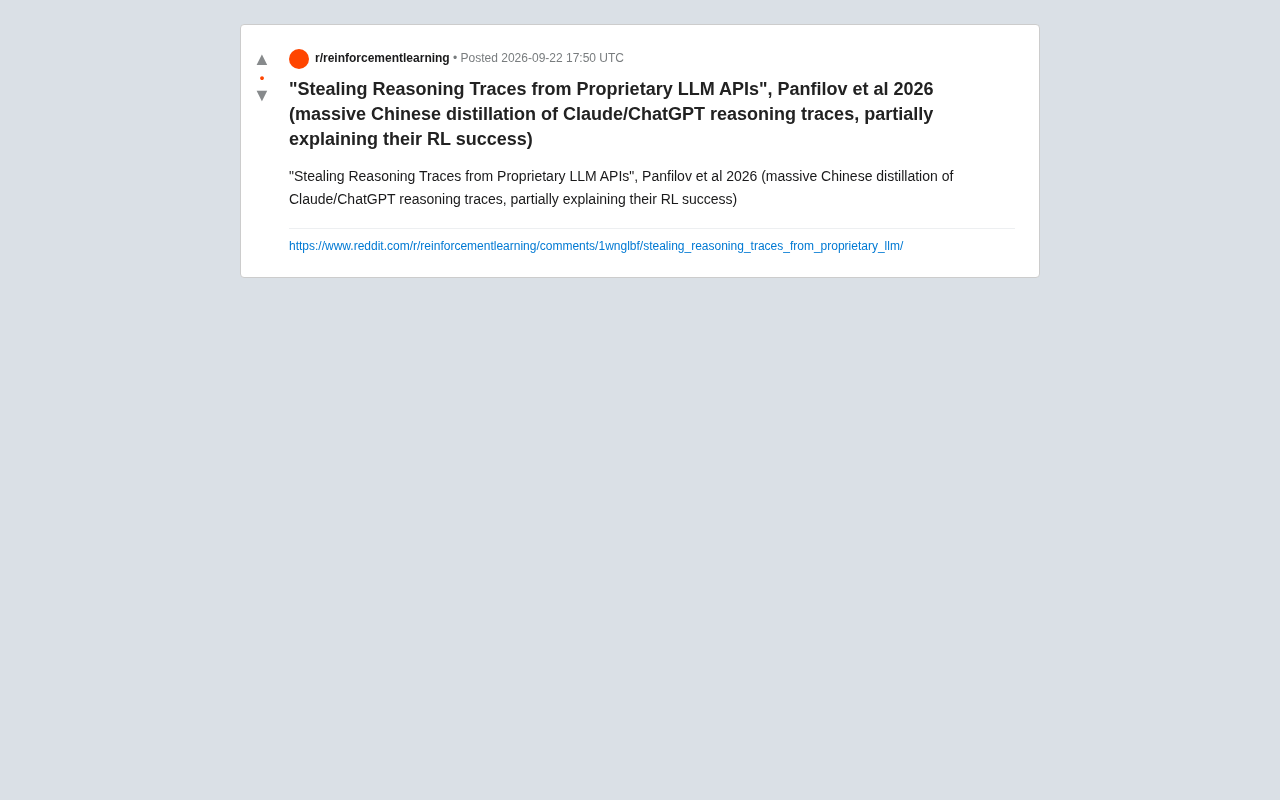
A paper titled *Stealing Reasoning Traces from Proprietary LLM APIs* has sparked debate in technical communities. It focuses on a widely practiced but under-studied technique: calling closed-source model APIs like Claude or ChatGPT to extract step-by-step reasoning traces at scale and use them to train in-house models. Since high-quality reasoning trajectories are scarce and costly to produce, distilling them from strong model APIs carries significant economic incentive. Some in the community suggest this may partly explain certain models' rapid gains in reasoning — though the paper stops short of definitive causal claims. Its core value is bringing this open secret into systematic academic analysis while exposing the structural vulnerability of closed-source API business models.
A Paper That Sparked Debate
A paper titled Stealing Reasoning Traces from Proprietary LLM APIs (Panfilov et al.) has recently sparked heated discussion in technical communities such as Reddit. The paper centers on a phenomenon that, while not entirely new to the industry, has largely lacked systematic study: systematically extracting and distilling reasoning traces from closed-source LLM APIs (such as Claude and ChatGPT) at scale, and using this data to fuel reinforcement learning (RL) training for in-house models.
One particularly controversial claim raised in the discussion is that this kind of large-scale reasoning trace distillation may partly explain why certain models have rapidly closed the gap in reasoning capabilities. While provocative, this assertion touches on a genuinely murky gray area in today's LLM competition.
What Is Reasoning Trace Distillation?
To appreciate the significance of this paper, it helps to clarify a few key concepts. Traditional model distillation refers to training a smaller or less capable "student model" using outputs generated by a more powerful "teacher model" — a well-established technique in deep learning.
"Reasoning traces" refer to the intermediate thinking steps a model produces when solving complex problems — what we commonly call Chain-of-Thought (CoT). Compared to the final answer alone, these intermediate reasoning steps contain far richer information: how to decompose a problem, how to verify intermediate results, and how to self-correct errors.
The attack described in the paper essentially involves systematically collecting these high-value reasoning traces by calling closed-source model APIs — either through legitimate or quasi-legitimate means — and then using them to train proprietary models. This has drawn attention because it strikes at the most valuable asset of closed-source providers: not just the model weights, but the "way of thinking" that the model exhibits during inference.
From a technical standpoint, reasoning trace distillation differs meaningfully from traditional distillation. Traditional distillation typically uses only the teacher model's final outputs (such as logits or answer probability distributions) to guide student training. Reasoning trace distillation goes further, using the teacher model's complete thought process as a supervisory signal. In practice, this usually involves sending carefully crafted math, coding, or logic problems to a target API in bulk, collecting the step-by-step reasoning text it returns, and then using those traces as "gold-standard" trajectories for supervised fine-tuning (SFT) or RL training of an in-house model. Since reasoning chains from models like o1 or Claude 3.7 often include complex behavioral patterns — such as iterative attempts and self-correction — their information density far exceeds what human-written examples can offer, significantly accelerating the student model's acquisition of higher-order reasoning strategies.
Why Reasoning Traces Are So Valuable
Reinforcement learning is one of the key technical approaches for improving model reasoning capabilities today. Whether it's OpenAI's o-series or other frontier models, high-quality reasoning data is the scarce fuel powering RL training. Producing this data from scratch requires enormous investment in human annotation and compute.
If you can directly "extract" tens of thousands of verified reasoning trajectories from an existing strong model's API, you essentially bypass the most expensive step in data construction. This is why the paper uses the charged word "stealing" in its title — it implies that this practice, while providing a competitive edge, carries clear ethical and compliance concerns.
Notably, many closed-source providers are already aware of this risk and explicitly prohibit using API outputs to train competing models in their terms of service. Some have even begun hiding or compressing raw reasoning processes, showing users only summarized thinking steps — precisely to guard against this type of distillation attack.
The typical RL paradigm for training reasoning in large models involves methods such as RLHF (Reinforcement Learning from Human Feedback) or more recently GRPO and RLVR. These approaches require large amounts of process-level annotated data — meaning annotations that assess not just whether the final answer is correct, but also the quality of the reasoning path, or that provide correct reasoning demonstrations. In mathematical reasoning, for instance, constructing a single high-quality human-annotated reasoning trace requires a domain expert to write out the solution step by step — time-consuming and impossible to scale. By contrast, a single API call to a strong model might cost just a few cents, yet yields a reasoning chain validated by the model's internal process. This cost asymmetry is the fundamental economic driver behind distillation attacks, and it explains why the paper uses "stealing" rather than a neutral phrase like "learning from" — it explicitly points to an unequal transfer of value.
Technical Competition in a Gray Area
The Reddit discussion suggests that large-scale distillation "partially explains" the RL training success of certain models. This claim deserves caution — it reflects community speculation based on observation, not a definitive causal conclusion drawn by the paper.
Objectively speaking, improvements in model capability result from a combination of factors: algorithmic innovation, data engineering, compute scale, and training techniques all play important roles. Attributing the catching-up entirely to distillation both underestimates the value of independent R&D and may oversimplify a complex technical picture. What is certain, however, is that reasoning trace distillation — as a low-cost, high-return technique — is widely used across the industry, even if rarely discussed openly.
The paper's real value lies in bringing this "open secret" into the open for systematic study, allowing the field to honestly examine its technical mechanisms, scope of impact, and potential defenses.
Implications for the Industry
From a broader perspective, this type of research reveals a structural dilemma facing closed-source models: as long as a model is made available externally through an API, its outputs cannot be fully protected from reverse distillation. What providers can do is raise the barriers and costs of distillation — for example, by limiting output detail, detecting anomalous call patterns, or imposing legal constraints through terms of service.
For the open-source community and late-entering vendors, this research offers a reference perspective on paths to improving model reasoning capabilities, while also reminding relevant parties to be mindful of compliance risks.
It should be emphasized that, since the available information at this time mainly comes from community summaries and brief descriptions, the specific experimental methods, distillation scale, and defense proposals detailed in the paper still need to be verified by reading the original work. The analysis in this article is based on existing discussion, and readers interested in this area are encouraged to consult the original paper for complete conclusions.
Defending against reasoning trace distillation faces fundamental technical challenges. On one hand, excessively compressing or hiding the reasoning process directly undermines the model's interpretability and debugging value for users — running counter to the industry trend toward "transparent AI." On the other hand, anomaly detection based on call frequency or question patterns can easily be circumvented by attackers through distributing requests or blending them into normal business traffic. Defense approaches currently being explored by researchers include embedding watermarks in reasoning traces to trace distillation sources, and using adversarial perturbations to make output reasoning chains human-readable but "poisonous" for model training. All of these methods are in early research stages, with no mature industrial-grade solutions yet deployed. This is also one reason the paper has attracted wide attention — it is not only offensive research, but also implicitly calls for a systematic mapping of the defensive landscape.
Conclusion
Reasoning trace distillation sits at the intersection of technical efficiency and intellectual property — a microcosm of LLM competition entering its most intense phase. It reflects both the industry's urgent demand for high-quality reasoning data and the inherent vulnerability of the closed-source API business model. As more research of this kind becomes public, finding the right balance between open services and knowledge protection will be a challenge the entire industry must continually confront.
Related articles

Python 3.15 New Feature: Is the sentinel Type Better Than None?
Python 3.15 adds the sentinel type, using named unique sentinel objects to replace None and bare object(), resolving confusion among missing values, explicit emptiness, and invalid input while avoiding type hint failures.

Deep Learning's Three Architectures and the Universal Approximation Theorem: A Complete Guide to MLPs, CNNs, and Transformers
Explaining the inductive bias differences among MLP, CNN, and Transformer, the existence meaning of the Universal Approximation Theorem (UAT), and the role of Taylor expansion in approximation analysis, while clearing up common misconceptions.

GitLab Emergency Patch Release: Analysis of Critical Security Fixes
GitLab releases critical patch 19.5.1, sparking 355 points of discussion on Hacker News. This article analyzes the background, upgrade steps for self-hosted instances, and verification points to help DevOps teams respond quickly to security updates.