StemDeck: A Detailed Look at the Free, Open-Source, Local AI Stem Separation Tool

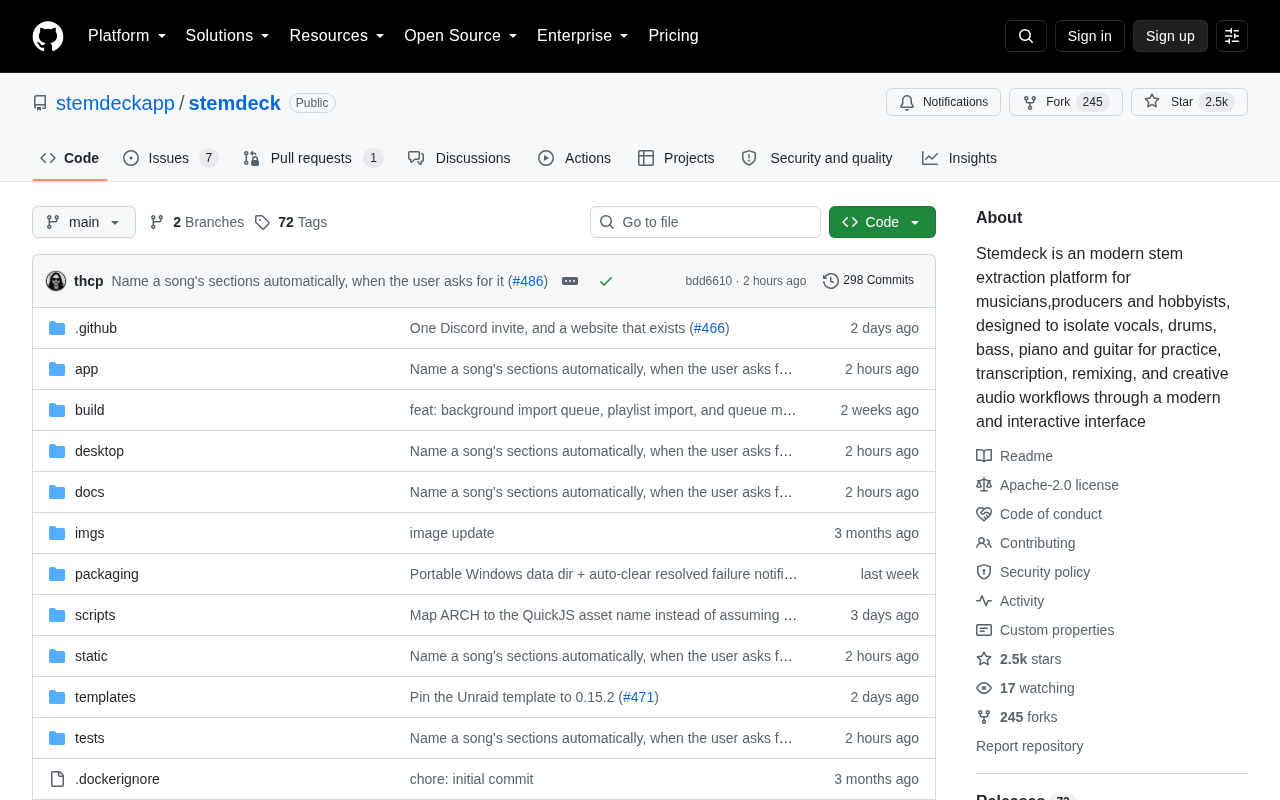
StemDeck is a free, open-source AI stem separator that runs entirely on your local machine.
StemDeck is a free, open-source AI tool that separates mixed audio into individual stems (vocals, drums, bass, etc.) entirely on your local device. Built on models like Demucs, it addresses key pain points of cloud-based alternatives: cost, privacy, and internet dependency. The article explores its core features, technical underpinnings, practical use cases for musicians and creators, current limitations like audio artifacts, and why local AI tools represent a growing trend.
What Is Stem Separation?
In the world of music production, cover creation, and remixing, stem separation has always been an extremely valuable yet highly challenging task. Simply put, stem separation means breaking down a fully mixed song back into individual components—vocals, drums, bass, accompaniment, and so on—each as a separate audio file. In the past, this was virtually impossible without access to the original multi-track project files from the recording studio, putting it far out of reach for ordinary users.
To appreciate this difficulty, it helps to understand the basic workflow of modern music production. A song is typically recorded in a studio as multiple tracks (multi-track)—vocals, guitar, drums, bass, and other parts each occupy their own independent track. Engineers and mixers can individually adjust the volume, EQ, effects, and spatial positioning of each track. Once all parts are finalized, they undergo a "mixdown," merging dozens or even hundreds of tracks into a single stereo file (the finished music we listen to every day). This process is essentially irreversible—much like mixing multiple paint colors together and trying to separate them back out precisely. The original multi-track project files (typically from DAWs like Pro Tools, Logic Pro, or Ableton Live) are generally held only by the record label and the original production team and are never made public. For this reason, "reverse-engineering" individual stems from a finished mix has long been considered one of the great challenges in audio processing.
As deep learning technology has matured, AI-based stem separation has gradually become a reality. Open-source models like Demucs and Spleeter can now "reverse-extract" individual components from a single mixed audio file.
The technical evolution of these models is worth a brief overview. Spleeter was open-sourced in 2019 by French music streaming platform Deezer and was one of the first AI stem separation tools to gain widespread attention. It's based on the U-Net architecture (an encoder-decoder convolutional neural network originally designed for medical image segmentation) and operates in the spectrogram domain—converting audio via Short-Time Fourier Transform (STFT) into a time-frequency representation, then predicting a "spectral mask" for each stem, and multiplying that mask with the original spectrum to isolate the target component. Demucs, developed by Meta (Facebook)'s research team, has gone through several major version iterations. Early versions operated directly in the time domain (waveform), while subsequent versions—Hybrid Demucs (v3) and HTDemucs (v4)—adopted a "hybrid domain" strategy, processing audio signals simultaneously in both time and frequency domain branches before fusing the results. This hybrid approach significantly improved separation quality, particularly in preserving transient details (like the punch of drum hits) and reducing phase distortion. HTDemucs also introduced Transformer attention mechanisms to capture long-range dependencies in audio, further improving its ability to handle complex arrangements. Currently, Demucs v4 maintains a leading position across multiple international stem separation benchmarks (such as the MDX Challenge).
StemDeck, which recently appeared on Hacker News, is another noteworthy entry in this wave—a free, open-source AI stem separator that runs entirely locally.
StemDeck's Three Core Features
StemDeck's positioning can be summed up in three keywords: Free, Open-Source, and Local. While seemingly simple, these precisely address several major pain points in the current AI audio tool market.
Free and Open-Source
Most mainstream stem separation services currently use subscription or pay-per-use pricing models. For example, LALAL.AI offers plans billed by minutes, with basic plans starting around $10/month and pro plans reaching several tens of dollars; iZotope RX (the industry-standard professional audio repair suite, which includes separation features like Music Rebalance) can cost hundreds or even over a thousand dollars for the full version; and apps like Moises, aimed at musicians, also use monthly subscriptions. While cloud-based solutions are easy to get started with and don't require worrying about hardware specs, costs can escalate quickly for creators who need to process audio in bulk—an active DJ or cover artist processing dozens of songs per month could face considerable expenses. StemDeck is completely open-source and free. Anyone can use it, audit the code, and even customize or extend it to suit their own needs. Whether you're an independent musician, an educational institution, or a developer community, there's value to be found.
Fully Local Execution
In an era of growing data privacy awareness, "running locally" is StemDeck's most critical differentiator. Users never need to upload audio files to any third-party server—all processing happens on the local device. This means:
- Copyright and privacy are protected: Unreleased works never leave your computer
- No internet connection required: Works perfectly in offline environments
- No upload waiting: Eliminates the time and bandwidth costs of repeatedly transferring large files
This is especially important for professional producers who frequently work with sensitive or unreleased material. In the recording industry, leaks of unreleased songs can cause serious commercial damage. Even when cloud services promise encrypted transmission and secure storage, the act of uploading itself introduces additional attack surface. Local execution fundamentally eliminates this concern.
Why Local AI Tools Are on the Rise
StemDeck's emergence isn't an isolated case—it's a microcosm of the broader "decentralization" trend across the entire AI tool ecosystem. In recent years, as consumer-grade GPU power has increased and model compression/optimization techniques have advanced, more and more AI capabilities that once depended on the cloud are landing on personal devices.
The technical foundation of this shift is worth understanding in depth. On the hardware side, NVIDIA's consumer GPUs (such as the RTX 30/40 series) haven't just seen gaming performance improvements—their Tensor Cores and large VRAM capacities make local AI inference efficient and viable. A single RTX 4060 has enough compute power to complete stem separation for a song in just minutes. Apple Silicon (M1/M2/M3/M4 chips), with its unified memory architecture and Neural Engine, similarly provides excellent local AI computing capabilities for macOS users. On the software side, advances in model compression techniques are equally crucial: Quantization reduces model weights from 32-bit floating point to 16-bit, 8-bit, or even 4-bit integer representations, dramatically shrinking model size and memory footprint with virtually no loss in output quality; Knowledge Distillation lets smaller "student models" learn from larger "teacher models," approximating original performance with far fewer parameters; Pruning streamlines model architecture by removing neural network connections that contribute minimally to the final output. The combination of these techniques enables AI models that once required data center-grade hardware to run smoothly on ordinary laptops.
From Stable Diffusion in image generation, to local large language models (like quantized versions of the Llama family), to StemDeck in audio processing, a clear thread is emerging: The developer community is driving AI capabilities away from cloud dependency and putting control back in users' hands.
This local-first approach delivers three significant benefits:
- Zero marginal cost: No additional fees no matter how many files you process
- Complete privacy protection: Data always stays local
- Offline availability: No dependency on network conditions
For use cases like audio—where files are large and processing is frequent—the advantages of local solutions are especially pronounced. A single 5-minute lossless audio file (in WAV format, for example) can easily exceed 50MB. If you need to repeatedly upload files to the cloud for processing, the bandwidth and time overhead is hard to ignore.
Use Cases and Potential Value
AI stem separation tools like StemDeck serve a remarkably wide range of users:
- Cover artists and remix creators: Extract instrumental tracks from original songs to create karaoke versions or perform vocal replacements
- DJs and remixers: Break down different songs into individual stems and recombine them to create mashups
- Music learners: Listen to individual instrument parts in isolation to assist with transcription, arrangement analysis, or practice
- Video and podcast creators: Remove background music or extract specific sound effect elements
However, it's important to note that AI stem separation still has technical limitations. Separated tracks may contain "watery" artifacts, and separation quality often drops noticeably in passages where instrument parts heavily overlap.
These artifacts have deep technical roots. When multiple parts overlap significantly in both frequency and time (for example, male vocals and electric guitar frequently "compete" in the midrange, or cymbal harmonics blend with breathy female vocals in the high frequencies), the AI model inevitably makes judgment errors when predicting spectral masks. Frequency components incorrectly assigned to a particular stem manifest as the "watery" or "bubbly" artifacts we hear—academically referred to as "spectral leakage" or "musical noise." Additionally, spectral mask methods typically only process amplitude information while using the original mix's phase information to reconstruct each stem's waveform. This phase approximation introduces additional distortion when parts are heavily overlapping. Although the latest models (like Demucs v4's hybrid domain architecture) mitigate phase issues by simultaneously learning in the time domain, the problem hasn't been fully solved. The more parts and denser the arrangement in a song (such as orchestral music or dense electronic music), the greater the separation difficulty.
This is a shared challenge across all current AI-based separation solutions, and StemDeck is no exception. As such, it's better suited as a creative assistance tool rather than a replacement for perfectly restoring original multi-track sessions.
Community Reception and Outlook
As a project that has just debuted on Hacker News, StemDeck is still in its early stages of gaining attention. But the direction it represents—making high-quality AI audio processing accessible to everyone and controllable locally—aligns closely with the developer community's long-term expectations.
For readers following the real-world deployment of AI tools, StemDeck is an open-source project worth tracking over time. Its significance goes beyond providing a free stem separation tool—it validates a trend that's already underway: AI's practical capabilities are returning to ordinary users in open-source, local-first form. As underlying models continue to iterate and hardware performance keeps improving, tools like this have significant room for advancement in both separation quality and usability. Notable technical directions to watch include: diffusion model-based stem separation methods emerging in academia that could further reduce artifacts; multi-model ensemble strategies that combine the strengths of different architectures to improve separation accuracy; and as WebGPU and other browser-based GPU acceleration technologies mature, stem separation may eventually run locally right in the browser, further lowering the barrier to entry.
Related articles

Chain of Thought Isn't Just for AI: How Humans Can Use CoT to Improve Thinking Quality
Chain of Thought isn't just a prompt trick for large models. Starting from a Hacker News discussion, this article analyzes why CoT works for human thinking too, breaks down actionable ways to transfer it, and highlights the key differences between human CoT and machine CoT.
Cloudflare Teams Up with OpenAI: Closi…
Cloudflare Teams Up with OpenAI: Closing the Loop from Vulnerability Discovery to Defense with AI
Cloudflare uses OpenAI Daybreak to investigate security vulnerabilities and generate reviewable remediation plans, while developers use Codex to boost coding efficiency and quality.

Orca Multi-Agent Orchestration in Practice: A Guide to Parallel Collaboration with Claude and Codex
Orca is Stable AI's free open-source agent workbench supporting 34 agents like Claude Code and Codex in parallel. Learn its Git worktree isolation, multi-model orchestration, and mobile management.