Step-5-preview Benchmarked: Head-to-Head Against DeepSeek V4.1 Flash and Three Other Models

Step-5-preview leads on visuals but trails DeepSeek V4.1 Flash slightly in technical execution across four real-world demos.
Four hands-on demo projects — black hole lensing, ray-traced art gallery, parametric skyscrapers, and city evacuation — were used to compare Step-5-preview against DeepSeek V4.1 Flash, Qwen3.8 Flash, and GLM5.3 Flash, with GPT-6 Astra handling both prompt generation and scoring. Step-5-preview trails DeepSeek V4.1 Flash by just 7.5 points total, ranks first in visual score, and second in technical score — its main weakness being implementation details like proportion distortion. GLM5.3 Flash ranks last overall, while Qwen3.8 Flash suffers from severe latency issues, averaging 2–3× longer response times than the other models.
Recently, StepFun released a new model, Step-5-preview, which climbed to a prominent position on the AA leaderboard (Artificial Analysis) — even breaking into the top tier of open-source rankings. But official benchmark scores are one thing; real-world performance is another. This article puts Step-5-preview through four hands-on demo projects, comparing it side-by-side with three other popular Flash-tier models — DeepSeek V4.1 Flash, Qwen3.8 Flash, and GLM5.3 Flash — to see where it actually stands.
Evaluation Method & Four Demo Projects
It's worth explaining the fairness design upfront. All four prompts were generated by GPT-6 Astra (referred to simply as "Astra" throughout this review), with each model producing four demo pages. Final scores were also assigned by Astra based on visual output and raw code — not the reviewer's personal impressions — in an effort to stay objective.
The four projects each target a different technical challenge:
- Black Hole Gravitational Lensing: Tests physics formula implementation and optical simulation — a common benchmark in the reviewer community.
- Ray-Traced Glass Art Gallery: Involves ray tracing, glass refraction, and reflection; tests material knowledge and lighting realism. The hardest task.
- Parametric Skyscrapers: Two buildings that can twist, extrude, and separate/combine — tests geometric generation and runtime stability.
- Virtual City Evacuation: Tests dynamic crowd evacuation simulation.
The strength of this design is its coverage across physics, optics, geometry, and dynamic simulation. While it can't fully map out a model's complete capabilities, it provides a reasonably reliable positioning reference.
The AA leaderboard (Artificial Analysis) is an independent AI model benchmarking platform that evaluates models across reasoning, code generation, math, and other dimensions, while also providing speed-and-price comparisons. Unlike single-domain academic benchmarks such as MMLU or HumanEval, AA attempts to offer a more real-world-oriented cross-model comparison. That said, there's an inherent gap between static leaderboard scores and dynamic generation tasks — leaderboard questions tend to be closed-ended or fixed-format, whereas open-ended tasks like code generation and visual demos require models to simultaneously deliver on creativity, structure, and engineering detail. That's precisely where hands-on evaluations like this one add value.
Overall Rankings: Step-5-preview Trails DeepSeek by Just 7.5 Points
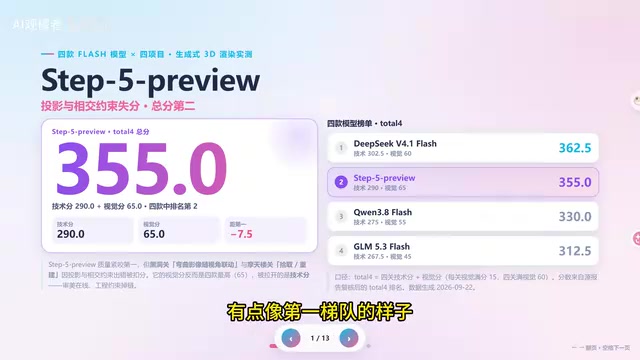
Despite official claims of strong performance, the total scores show Step-5-preview slightly behind DeepSeekAd V4.1 Flash. The gap is narrow, though — just 7.5 points — putting them firmly in the same tier.
The sub-scores are interesting: Step-5-preview ranks second on technical score, yet first on visual score. In other words, Astra judged Step-5-preview's visual output to be the best among all four models across the four projects; the score gap mainly comes from baseline technical execution.
By contrast, the "first tier" of Step-5-preview and DeepSeek V4.1 Flash holds a more substantial lead over Qwen3.8 Flash and GLM5.3 Flash, which cluster together in a clear second tier.
Project-by-Project Breakdown: Where Each Model Lost Points
Black Hole Demo
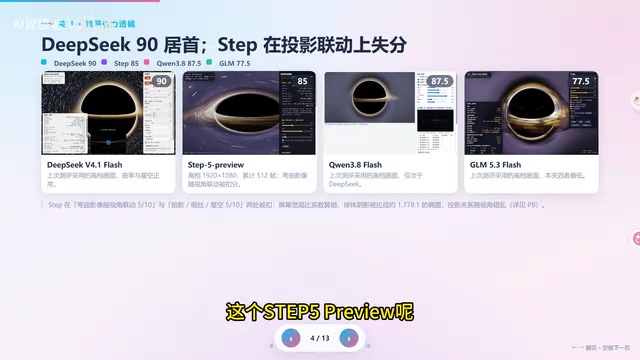
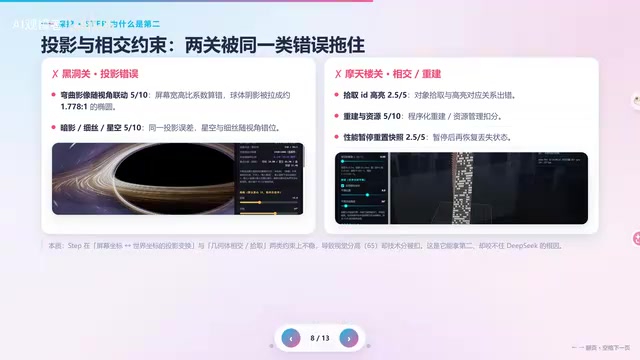
Judging from screenshots alone, DeepSeek V4.1 Flash did the best here — its 90-point score is well-deserved. Step-5-preview also holds up, though the proportions are slightly distorted and the shape looks a bit flat, with the main shadow stretched into an ellipse. That said, the code implementation, gravitational lensing parameters, and formula visualization are all solid. Qwen3.8 Flash ranks third — a bit plain but not problematic. GLM5.3 Flash finishes last, with a rougher visual and issues in the mathematical formula rendering.
Ray-Traced Art Gallery (Hardest Task)
This is where the biggest gaps emerge. DeepSeek V4.1 Flash stands out with bold, distinctive ray trajectories. Step-5-preview and Qwen3.8 Flash are both largely correct with minor imperfections. Notably, the reviewer observed that Step-5-preview's glass and metal spheres appeared to merge into each other, lacking a collision boundary — this was specifically raised with Astra, who noted the prompt didn't require material-based collision physics, so it wasn't counted as a deduction. GLM5.3 Flash, on the other hand, had visible errors in light refraction, which did count against it.
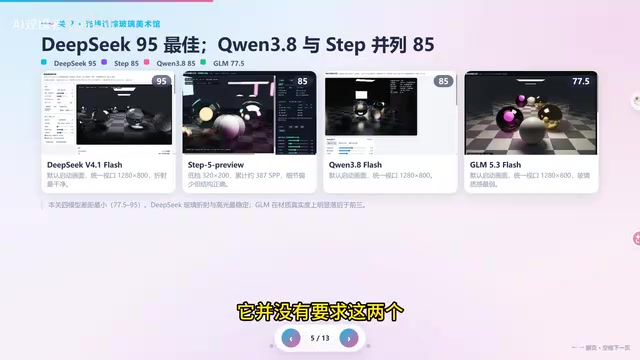
Ray tracing is a rendering technique that generates images by simulating the physical propagation of light rays through a scene. Its core involves calculating ray-surface intersection points and recursively simulating optical effects such as reflection, refraction, and shadows. Glass materials are particularly complex to implement, requiring simultaneous handling of refractive indices (typically using Snell's Law), the critical angle for total internal reflection, and the Fresnel equations governing the energy split between reflected and refracted light. Implementing ray tracing purely in code (such as WebGL or Canvas 2D) demands that the model accurately translate these physical formulas into working programs — which is why this project is rated the most difficult in this evaluation.
Skyscrapers
All four models performed well here. Astra considered Step-5-preview's implementation the strongest across the board. The clearest weak point was Qwen3.8 Flash, which produced a noticeably simpler result.
City Evacuation
Step-5-preview and DeepSeek V4.1 Flash tied for first. Qwen3.8 Flash and GLM5.3 Flash were close behind with a small gap between them.
Final Profiles: Where Each Model Stands
Putting all four projects together, here's a clear picture of each model:
- DeepSeek V4.1 Flash: Leads across the board with no obvious weak spots in any of the four projects. Overall strongest.
- Step-5-preview: Has a few minor shortcomings — like the distorted shadow and slightly squashed proportions — but tops the visual scores. Ranks first within the second-tier group.
- Qwen3.8 Flash: Decent overall, but took a significant hit on the skyscraper project. Most notably, it was the slowest of the four by a wide margin — averaging two to three times longer than the other models per project, with a serious "overthinking" problem.
- GLM5.3 Flash: Weakest overall, with particularly heavy deductions on the ray-traced art gallery.
It's worth emphasizing that the visual scores across all four models are actually fairly close — the biggest spread comes from baseline technical scores. Some projects also had minor issues like low frame rates or slow startup, but as long as a demo launched successfully, these weren't counted as deductions.
"Overthinking" refers to the tendency of reasoning-focused LLMs to generate redundant steps during their chain-of-thought process, leading to significantly higher latency without a proportional improvement in output quality. This is especially worth watching in lightweight Flash-tier models, whose core selling point is supposed to be low latency. Qwen3.8 Flash taking 2–3× longer than the other models suggests its reasoning chain may be far longer than necessary — in scenarios requiring real-time interaction or high-volume API calls, this would meaningfully impact both usability and cost.
Conclusion
For developers tracking domestic model progress, the key takeaway from this evaluation is: while Step-5-preview's official benchmark numbers look impressive, in real-world physics and engineering demo generation tasks it sits in the same tier as DeepSeek V4.1 Flash — slightly behind overall, but actually ahead on visual presentation. Its weaknesses are concentrated in technical implementation details.
Of course, four demo projects can't fully characterize a model's all-around capabilities — this article is more of a cross-reference coordinate than a definitive verdict. If your use case leans toward visual output quality, Step-5-preview is worth trying. If you need well-rounded stability, DeepSeek V4.1 Flash remains the safer bet. And if response speed matters, watch out for Qwen3.8 Flash's latency issues.
Related articles

Workbuddy for Absolute Beginners: How a Desktop AI Agent Fits Into Real Workflows
A beginner's guide to the Workbuddy desktop AI agent: installation, claiming credits, file management, and building automated workflows—compared with CodeX for fit and cost, helping professionals shift from AI question-askers to AI managers.

OpenAI's New Agent Stack: Computer Use, Decisions API, and Ultra-Fast Workflows
OpenAI Dev Day unveiled a new agent stack: Computer Use outperforms humans, Decisions API delivers ultra-low-latency classification via Luna, Agents API opens the same Computer Use capabilities, and GPT-6.1 Sol costs only one-seventh of Astra. Core updates, benchmark data, and developer insights.

Liang Wenfeng Open-Sources DeepInfo Inference Framework, Takes On U.S. Ban
DeepSeek open-sources its DeepInfo inference framework after its models, featuring GPU/CPU cross-pipelining, small-model prediction with large-model verification, and full Huawei Ascend and NVIDIA chip support—facing the U.S. federal ban head-on. This article analyzes its significance for AI deployment and open-source strategy.