Step Audio 2.5 In-Depth Review: How Does China's Voice AI Compare to GPT Realtime 2?

Step Audio 2.5 vs GPT Realtime 2: China's real-time voice AI shows promise but still needs polish.
This article provides an in-depth review of StepFun's Step Audio 2.5 real-time voice model with a head-to-head comparison against OpenAI's GPT Realtime 2. Step Audio 2.5 excels in Chinese understanding, role-playing, and voice naturalness, outperforming competitors like Doubao in some scenarios, but suffers from desktop client instability and relatively high pricing. GPT Realtime 2 leads in English scenarios and reasoning, but faces access restrictions in China. Each has its strengths, and developers should choose based on their specific use case.
Real-Time Voice AI Faces a Head-to-Head Showdown
Recently, OpenAI released the GPT Realtime 2 model, once again making waves in the real-time voice conversation space. Almost simultaneously, Chinese AI company StepFun launched Step Audio 2.5, claiming a major breakthrough in voice interaction capabilities. With both models debuting at the same time, a direct confrontation between Chinese voice AI and OpenAI became inevitable.
Real-time Voice AI refers to end-to-end systems capable of completing speech input understanding, semantic processing, and speech output with extremely low latency. Traditional voice interaction solutions use a "pipeline" architecture: first using ASR (Automatic Speech Recognition) to convert speech to text, then using an LLM (Large Language Model) to generate text responses, and finally using TTS (Text-to-Speech) to synthesize voice output. This three-stage architecture typically has a total latency of 1-3 seconds, with significant loss of paralinguistic information such as emotion and tone. Since 2024, end-to-end voice large models, represented by OpenAI's GPT-4o, have begun to emerge, integrating speech understanding and generation directly into the large model itself, dramatically reducing response latency while preserving richer speech expression details. It's against this technological wave that the simultaneous release of GPT Realtime 2 and Step Audio 2.5 becomes particularly noteworthy.
This article provides an in-depth evaluation of Step Audio 2.5 based on actual testing experience, covering model capabilities, interaction quality, API availability, and pricing, while making horizontal comparisons with GPT Realtime 2 to see just how far Chinese real-time voice AI has come.
OpenAI Realtime 2: The New Benchmark for Real-Time Voice Conversation
Before discussing Step Audio 2.5, let's look at its benchmark competitor. OpenAI actually updated three models this time: Realtime 2, a new version of Whisper, and a real-time translation model.
Whisper is a general-purpose speech recognition model open-sourced by OpenAI in 2022. Built on an encoder-decoder Transformer architecture, it was trained on 680,000 hours of multilingual labeled data, supporting speech recognition and translation in nearly 100 languages, approaching human-level performance on multiple benchmarks. Whisper's open-source release dramatically lowered the technical barrier for speech recognition, becoming an infrastructure-level tool for developers worldwide to build voice applications. The newly released Whisper version hasn't been open-sourced, but is reportedly significantly improved in recognition accuracy and processing speed, suggesting OpenAI may be shifting Whisper from an open-source public good toward a commercialized closed-source product. Meanwhile, Realtime 2's capabilities are truly impressive.
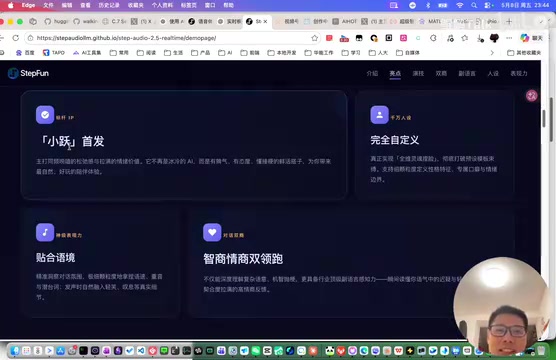
Three Core Highlights
- Dramatically improved reasoning ability: Realtime 2 deeply integrates the voice model with reasoning capabilities, achieving reasoning performance at the level of GPT 5.5 Instruct
- Near-zero latency real-time translation: The official demo of real-time simultaneous interpretation is stunning—cross-language conversations feel almost instantaneous
- Voice built directly on top of the large model: Moving beyond the traditional "small model + voice" approach, the model can listen, speak, and think deeply
However, for developers in China, OpenAI's models still face access restrictions and compliance issues in real projects, making them difficult to deploy directly for domestic business. This is precisely where domestic alternatives find their value.
Step Audio 2.5: Large Model-Powered Voice Interaction
StepFun was founded in 2023 by Jiang Daxin, former Vice President of Microsoft Research Asia, and is one of the leading startups in China's large model space. The company has completed multiple funding rounds in less than two years since its founding, with investors including internet giants like Tencent and Alibaba. Its core product line spans the Step series of large language models, multimodal models, and voice models, with consumer-facing products "Yuèwèn" (Ask Step) and the desktop AI assistant "Xiao Yue" targeting end users. StepFun has been making frequent moves recently—reportedly securing a new funding round and preparing for an IPO. Step Audio 2.5 debuted on "Xiao Yue," featuring three major capability upgrades.
Architecture Upgrade: Not Just Voice, But Reasoning Too
Traditional voice models are typically backed by smaller models (a few billion to around 13 billion parameters), with limited capabilities in complex dialogue and reasoning tasks. In the large model field, Parameters are the core metric for measuring model scale, typically measured in B (billions). The more parameters, the more knowledge patterns a model can learn and store, generally leading to better performance in complex reasoning, multi-turn dialogue, knowledge Q&A, and other tasks. Traditional voice models, to meet real-time requirements, often keep parameter counts between 1B-13B, since larger models mean higher inference latency and computational costs. But this also creates a contradiction: voice models "can speak" but "can't think deeply."
Step Audio 2.5 follows the same philosophy as OpenAI, building the real-time voice model directly on top of a large model—enabling not just "listening" and "speaking," but also "thinking." Through model architecture optimization and inference acceleration techniques (such as KV Cache optimization, speculative decoding, etc.), large-parameter models can maintain acceptable latency in real-time voice scenarios. This is the core technical breakthrough of this generation of voice models.
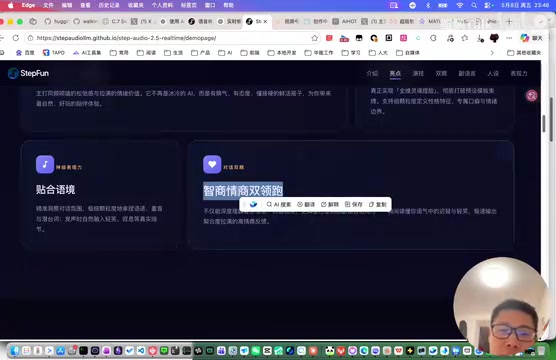
In actual testing, the model performed well in interview simulation scenarios. When asked to play the role of an interviewer, it quickly got into character, asked targeted questions, and organized language in a fairly natural and fluent way.
Role-Playing: Highly Flexible Character Construction
Step Audio 2.5 supports freely defining AI personas through conversation, such as having it play characters like Zhang Fei, Guan Yu, or Sun Wukong (from Chinese classical literature). The model can not only converse in the corresponding identity but also simulate matching vocal tones and speech characteristics.
In a "best friend chat" test scenario, the model performed quite naturally:
"Beibei, what should I do? My boyfriend is such a clueless guy..." "Oh no, what happened? Did you two have another argument over something?"
The pauses, interjections, and emotional fluctuations in the tone were handled well, with the overall feel being somewhat better than Doubao (ByteDance's voice product).

Voice Details: Laughter and Pauses Approaching Human-Like Quality
The model deserves recognition for its handling of voice expression details. Natural insertions of laughter like "haha" in conversations feel completely seamless. The granularity of pauses, filler words, and intonation changes is quite fine, approaching the naturalness of real human conversation. This is quite outstanding among Chinese domestic voice models.
Issues Exposed in Actual Use
The demos look great, but some issues are worth noting in actual use.
Xiao Yue Desktop Client: Stability Dragging It Down
As the debut platform for Step Audio 2.5, the "Xiao Yue" desktop client experience was less than ideal. During testing, promotional pop-ups on the desktop frequently froze after installation, severely impacting usability and ultimately requiring uninstallation. Judging from community activity levels, returning users were scarce, suggesting potential user retention issues.
This exposes a common pitfall: strong model capabilities don't equal good product experience. For AI products, stability and smoothness are fundamental. If you can't even guarantee the basic experience, no matter how powerful the model is, it's hard to convert into user value.
Compared to GPT Realtime 2, Where's the Gap?
In comparative testing, one obvious difference stands out: GPT still leads in response speed and naturalness in English scenarios. However, in Chinese scenarios, domestic models do have a natural advantage.
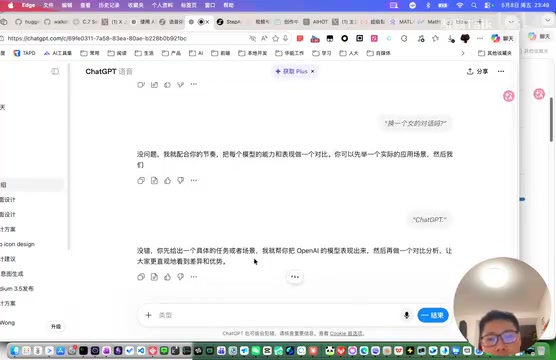
Interestingly, GPT Realtime 2 showed instances of "not understanding instructions" in Chinese conversations—when asked to switch to a female voice for conversation, the model failed to respond correctly and continued outputting at its own pace. This shows that Step Audio 2.5 is indeed superior in understanding Chinese context.
A simple summary of the differences:
| Comparison Dimension | Step Audio 2.5 | GPT Realtime 2 |
|---|---|---|
| Chinese Understanding | ★★★★★ | ★★★☆☆ |
| English Naturalness | ★★★☆☆ | ★★★★★ |
| Role-Playing | ★★★★☆ | ★★★★☆ |
| Reasoning Ability | ★★★★☆ | ★★★★★ |
| Domestic Availability (China) | ★★★★★ | ★☆☆☆☆ |
API Access and Pricing: How Should Developers Choose?
StepFun opened API documentation simultaneously with the model release, which is good news for developers. In contrast, many domestic models often take a long time after launch before opening their APIs.
Step Audio 2.5 Pricing Overview
According to officially published pricing:
- Input: 10 RMB / million tokens
- Cache hit: 2 RMB / million tokens
- Cache miss: 10 RMB / million tokens
The "cache hit" and "cache miss" here involve Prompt Caching technology. When developers use the same or highly similar system prompts across multiple API calls, the model server can cache the computation results for that portion of input (primarily the KV Cache), avoiding redundant computation and thereby reducing cost and latency. On cache hit, this portion of input costs only 2 RMB/million tokens—one-fifth the normal price. This technology is particularly valuable for applications using fixed character settings or fixed conversation templates (such as customer service bots, AI companion products), since these applications typically have fixed system prompts with very high cache hit rates, significantly reducing actual usage costs.
Honestly, this pricing isn't cheap. In voice model API pricing, token calculation differs from pure text models. Voice data is typically encoded as discrete audio tokens, with approximately 25-50 tokens per second of speech (depending on encoding method and sampling rate). Estimating with the input price of 10 RMB/million tokens, one minute of voice input consumes approximately 1,500-3,000 tokens, costing about 0.015-0.03 RMB. This seems low, but in high-concurrency scenarios like intelligent customer service, assuming 100,000 calls averaging 3 minutes per day, monthly costs could reach tens of thousands of RMB. By comparison, traditional ASR+TTS solutions typically cost around 0.005-0.01 RMB per minute for voice processing—a 3-5x cost difference. However, considering it's powered by a large model with stronger understanding and generation capabilities, this pricing is within a reasonable range.
Selection Recommendations
For developers with real-time voice conversation needs, here are scenario-based recommendations:
- Heavy Chinese voice interaction (customer service, companionship, education): Step Audio 2.5 is currently a reliable choice in China
- Lightweight voice scenarios: Traditional TTS+ASR+LLM combination solutions have cost advantages. In this architecture, ASR converts user speech to text, LLM understands semantics and generates text responses, and TTS synthesizes the response text into speech. Each module can be independently optimized and replaced—for example, ASR can use open-source Whisper, TTS can use Microsoft Azure or iFlytek in China, and LLM can be selected based on needs. The disadvantage is that information loses paralinguistic features like tone, emotion, and pauses during text conversion, and cumulative latency from chaining multiple modules is difficult to compress below 500 milliseconds. But for scenarios with lower requirements for latency and emotional expression, this remains the most cost-effective solution
- Multilingual or English-dominant scenarios: If compliance allows, GPT Realtime 2 remains the better choice
Before formally integrating into production environments, be sure to conduct thorough stability and latency testing.
Conclusion: Is Step Audio 2.5 Worth Using?
Step Audio 2.5 is a product with highlights that still needs polishing. In terms of voice naturalness, role-playing, and Chinese understanding, it demonstrates solid capabilities, even outperforming competitors like Doubao in certain scenarios. However, there's still clear room for improvement in product stability and pricing strategy.
From an industry trend perspective, real-time voice AI is moving from "usable" to "good to use." OpenAI's Realtime 2 has set a new benchmark, and Chinese domestic models are catching up quickly. For developers and enterprises in China, Step Audio 2.5 offers an option worth watching, but before committing to production, thorough testing and cost evaluation are recommended.
The competition in real-time voice AI has just begun, and the second half of 2025 is bound to be even more exciting.
Related articles
 Product Reviews
The Programmer's Desk Setup Guide: Building a Workspace That Feels Like Home
Discover how programmers build productive, comfortable workspaces. From multi-monitor setups to ergonomic design, explore the desk philosophy that drives focus and flow.
 Product Reviews
Qoder vs Cursor Real-World Comparison: Which $20/Month AI IDE Is Better?
Hands-on comparison of Qoder vs Cursor AI IDEs: Agent autonomy, human interaction count, and architecture decisions. Qoder needed only 2 interactions vs Cursor's 8.
 Product Reviews
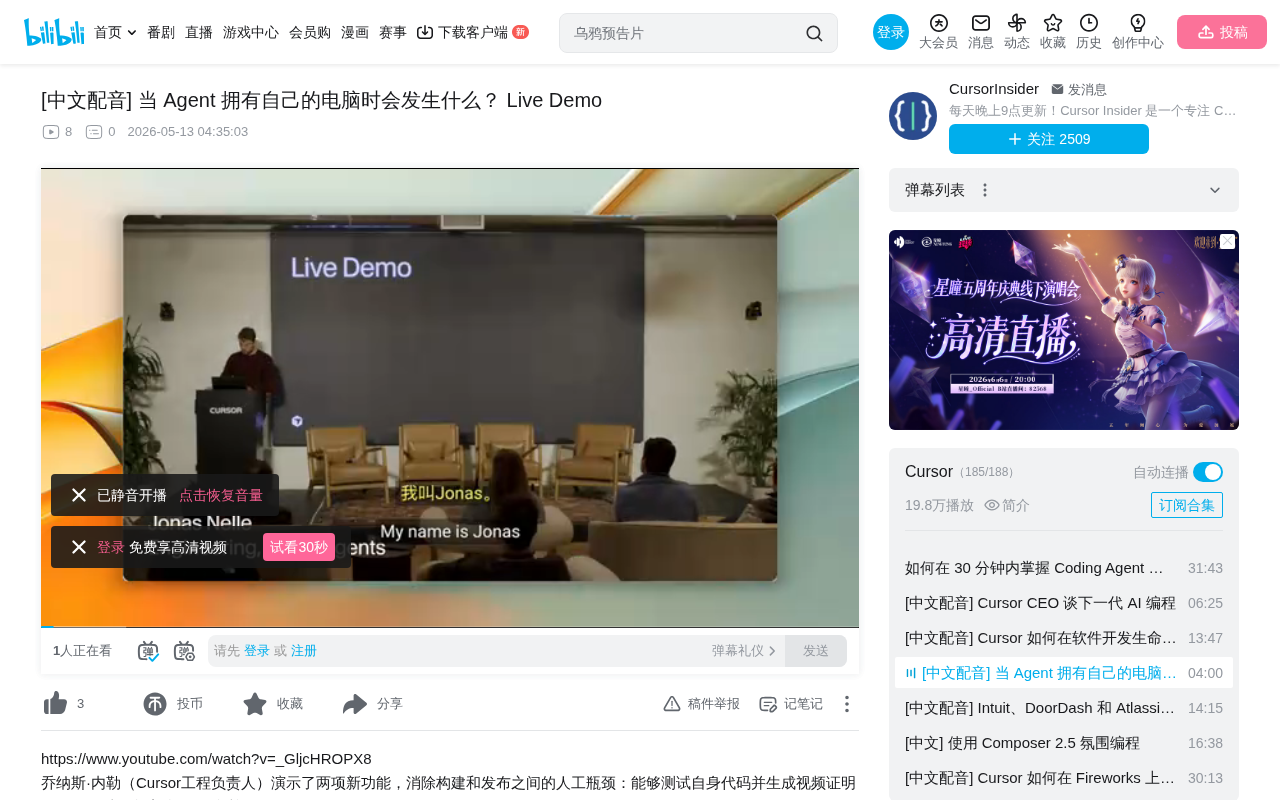
Cursor Cloud Agent Demo: Eliminating Bottlenecks Across the Entire Software Development Lifecycle
Deep analysis of Cursor's Cloud Agent demo showing how cloud VMs, automated test artifacts, and a full-chain control plane systematically eliminate human bottlenecks across the software development lifecycle.