StepFun Step-5-Preview Released: 600B Flagship Model Enters the Agent Race

StepFun launches Step-5-Preview, a 600B/27B MoE model with 1M context for agentic work.
StepFun has released Step-5-Preview, a flagship MoE model with 600B total and 27B activated parameters, plus a 1M-token context window. It targets agentic work, software engineering, and finance, emphasizing long-document reasoning and multi-step execution where general chat models often fall short.
Another Major Model Enters the Arena: StepFun Releases Step-5-Preview
A recent post circulating on Reddit reveals that StepFun has officially released its flagship model, Step-5-Preview. The model uses a MoE architecture with 600B total parameters and 27B activated parameters, supports a context window of up to 1M tokens, and is positioned as a flagship product built for agentic work.
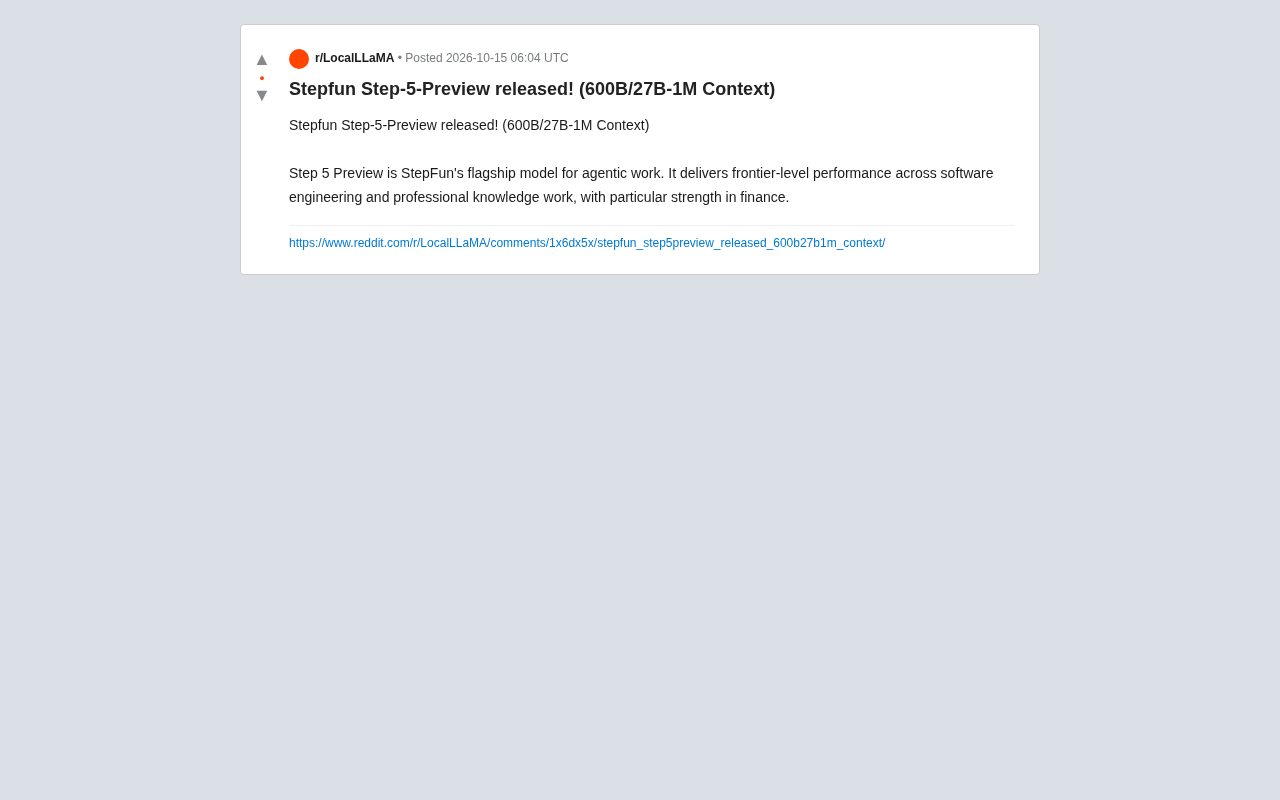
According to the official description, Step-5-Preview reaches frontier-level performance in both software engineering and professional knowledge work, with particular emphasis on its standout capabilities in financial scenarios. This positioning is worth reading closely—it deliberately avoids a broad, catch-all narrative and instead clearly stakes out several vertical directions.
600B/27B-1M: What These Numbers Mean
The Parameter Logic Behind the MoE Architecture
600B total parameters paired with 27B activated parameters reflects the MoE (Mixture of Experts) design approach common among today's flagship models. The total parameter count determines the upper bound of the model's knowledge capacity, while the activated parameter count directly affects computational overhead during inference. An activation level of 27B means its inference cost is far lower than that of a dense model with the same total parameter count—especially critical for agent scenarios that require frequent calls and multi-turn interaction.
MoE (Mixture of Experts) is an architecture that splits a single large model into multiple "expert" subnetworks. Each expert is essentially a feedforward network, and when processing each token, a router dynamically selects a small number of experts to participate in computation. This is why the total parameter count can be far larger than the activated parameter count: the 600B parameters are distributed across various experts, but only about 27B of them are awakened during each forward pass.
The direct benefit of this design is "trading parameters for efficiency"—the model can have a larger knowledge capacity without bearing inference costs proportional to the total parameter count. The trade-offs lie in training stability, routing load balancing, and VRAM usage: all expert weights still need to reside in VRAM, even though they are not all activated during computation. As a result, MoE models generally have higher requirements for memory bandwidth and parallel deployment strategies, which is also an important reason why flagship models from various companies widely adopt this architecture.
The Practical Significance of a 1M Context Window
The 1M token context window is another clear strength of this model. In software engineering scenarios, this means the model can digest the key files of a large code repository in one go; in financial analysis, it can cover complete financial reports, research reports, and prospectuses. The combination of long-context capability and agent tasks makes it possible for the model to complete complex tasks requiring cross-document reasoning in a single call, without relying on external retrieval stitching.
A context window refers to the total number of tokens a model can "see" in a single inference pass, including both input and output. It is constrained by the computational complexity of the attention mechanism—standard attention grows quadratically with sequence length, so extending to the 1M level typically requires engineering optimizations such as sparse attention, chunked processing, or linear attention.
It is important to note that nominally supporting 1M does not mean the model can still maintain the same inference quality at a length of 1M. The industry commonly uses tests such as "Needle in a Haystack" to examine a model's information retrieval and reasoning capabilities in ultra-long contexts, and performance often varies significantly across different positions and different densities of distraction. Therefore, when evaluating such models, the actual effective context length is more worth attention than the nominal value.
Why Target Finance and Professional Work Scenarios
StepFun lists finance as a particular strength of Step-5-Preview, and this choice is intriguing. The financial domain has extremely high requirements for a model's reasoning chain, data sensitivity, and understanding of professional terminology, and it is also one of the industries with the strongest willingness to pay.
Combined with the emphasis on software engineering capabilities, the target of Step-5-Preview is actually very clear: workflows that require deep professional judgment, long-document processing, and multi-step execution. These scenarios happen to be exactly where current general-purpose chat models most easily expose their weaknesses—context truncation, insufficient reasoning depth, and unstable tool calling.
Agentic work refers to a model no longer doing only single-turn question answering, but instead being able to autonomously plan steps, call tools, read files, and complete an entire task over multiple loops, such as fixing a bug in a code repository or generating an analysis report based on multiple financial statements.
This type of workflow places fundamentally different demands on a model compared with chat scenarios: first, it needs a stable tool-calling format to avoid drifting from instructions across multiple loops; second, it needs a sufficiently long context to accommodate intermediate results and historical trajectories; third, it needs a deeper reasoning chain to break down complex tasks. Current general-purpose chat models are most likely to expose shortcomings in these three areas—context truncation, insufficient reasoning depth, and unstable tool calling—which are precisely the industry-wide common problems noted in the article and also the targets Step-5-Preview attempts to address through its architecture and scenario positioning.
Another Variable Added to the Agent Race
Step-5-Preview defines itself as a flagship model for "agentic work," a positioning that shows StepFun is not content with building a chat product, but instead wants to enter the agent infrastructure layer. From an industry trend perspective, model vendors are shifting from competition over "who answers better" to "who can actually complete the task."
With a 600B scale, 1M context, and clear vertical scenario focus, whether this combination can gain a firm foothold in real workflows still needs to be verified by third-party evaluations and developer feedback. But at least in terms of specifications, Step-5-Preview has already placed itself in the first tier of flagship competition.
One-line Summary
StepFun releases Step-5-Preview, a 600B/27B MoE architecture with 1M context, targeting agentic work scenarios.
Paragraph Summary
StepFun has officially released its flagship model Step-5-Preview, featuring a MoE architecture with 600B total parameters and 27B activated parameters, supporting a 1M token context window, and positioned as a flagship product for agentic work, clearly distinguishing it from general-purpose chat models. The company emphasizes that it reaches frontier-level performance in both software engineering and professional knowledge work, with particular emphasis on financial scenario capabilities. The 600B/27B combination means large knowledge capacity coexists with relatively low inference cost, while the 1M context allows the model to digest large codebases or complete financial and research reports in one pass, supporting cross-document reasoning. The article argues that its target is workflows requiring deep professional judgment, long-document processing, and multi-step execution—precisely the areas where general models most easily expose their shortcomings. Competition among model vendors is shifting from "who answers better" to "who can truly complete the task," and whether Step-5-Preview can establish itself still needs verification through third-party evaluations and developer feedback.
Related articles

Chain of Thought Isn't Just for AI: How Humans Can Use CoT to Improve Thinking Quality
Chain of Thought isn't just a prompt trick for large models. Starting from a Hacker News discussion, this article analyzes why CoT works for human thinking too, breaks down actionable ways to transfer it, and highlights the key differences between human CoT and machine CoT.
Cloudflare Teams Up with OpenAI: Closi…
Cloudflare Teams Up with OpenAI: Closing the Loop from Vulnerability Discovery to Defense with AI
Cloudflare uses OpenAI Daybreak to investigate security vulnerabilities and generate reviewable remediation plans, while developers use Codex to boost coding efficiency and quality.

Orca Multi-Agent Orchestration in Practice: A Guide to Parallel Collaboration with Claude and Codex
Orca is Stable AI's free open-source agent workbench supporting 34 agents like Claude Code and Codex in parallel. Learn its Git worktree isolation, multi-model orchestration, and mobile management.