Behind Google's Agent Engine Launch: The 50-Millisecond Lifeline for Real-Time AI Agent Control

Google's agent governance announcement reveals the core gap: runtime per-call policy enforcement matters more than identity provisioning.
Google Cloud launched Agent Compute Engine and expanded agent governance. The announcement's key detail is verifiable agent identity and runtime per-call policy enforcement, not compute. Community discussion notes teams misjudge agent security as identity provisioning; the gap is at the call phase, where static policies fail and broad permissions clash with business needs. The blast radius window is under 50ms—too fast for humans. Infrastructure interception is coarse, SDK coverage incomplete, and independent engines face performance and standardization hurdles. Tool-call amplification is a shared challenge; a hybrid layered strategy may be the realistic transition.
Google Cloud this week launched Agent Compute Engine and expanded its agent governance capabilities. The official blog emphasized the need for verifiable agent identity and runtime per-call policy enforcement. But in community discussions, a sharper question has surfaced: when agents hold legitimate broad permissions, how exactly should real-time control be implemented?
The Buried Core: Runtime Policy Enforcement
The most critical detail in Google's announcement is not the compute engine itself, but its explicit callout of the need for verifiable agent identity and runtime per-call policy enforcement. This is not a gap unique to Google. According to security firm Wiz's earlier research on cloud service account compromise, and disclosures in Anthropic's model card about tool-call amplification effects, similar problems have repeatedly appeared across multiple platforms.
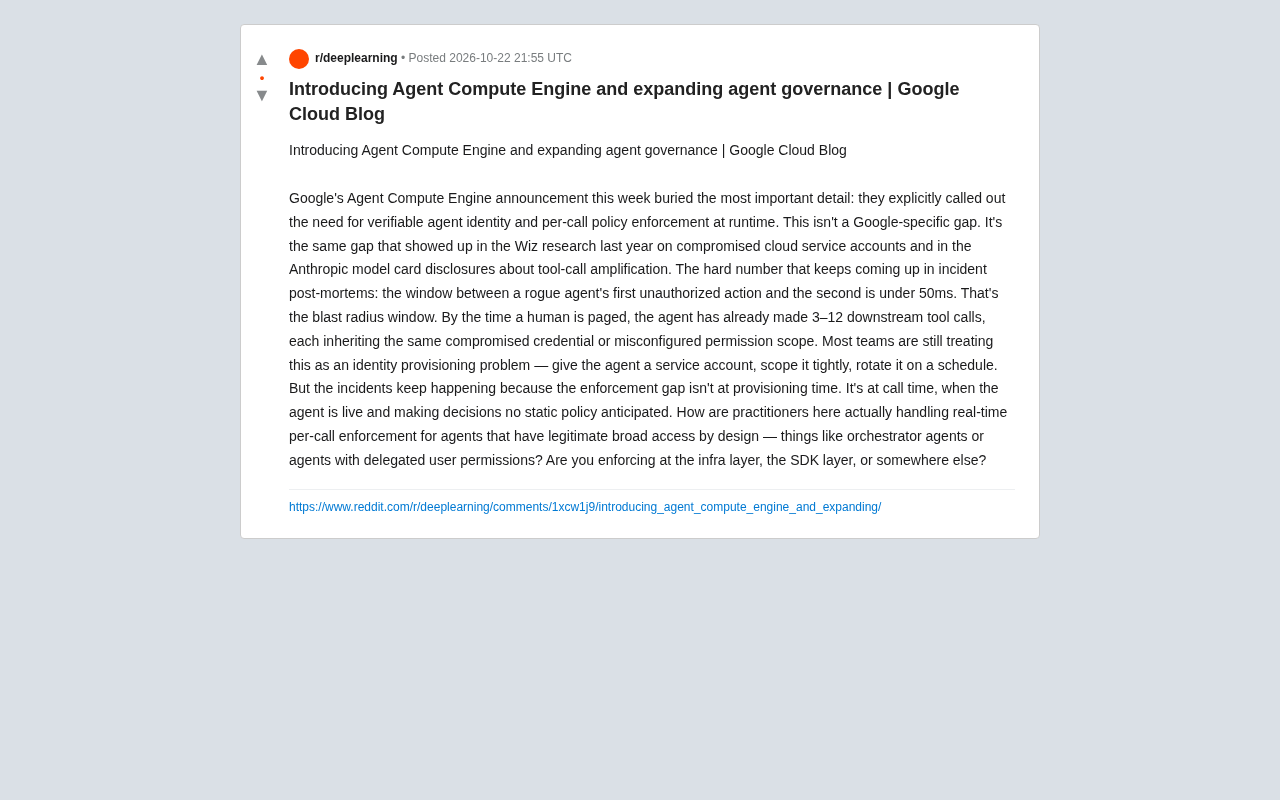
A number that recurs in incident post-mortems was mentioned in the Reddit discussion: from an anomalous agent's first unauthorized action to its second action, the window is under 50 milliseconds. This is the "blast radius window"—by the time a human is paged, the agent has already completed 3 to 12 downstream tool calls, each inheriting the same leaked credentials or misconfigured permission scope.
Verifiable Agent Identity refers to an agent's ability to cryptographically prove its identity and the permission scope granted to it when interacting with downstream services, rather than relying solely on static credentials (such as service account keys). The key difference from traditional authentication is that static credentials, once leaked, are wholesale impersonated, whereas verifiable identity is typically bound to short-lived tokens, workload attestation (such as SPIFFE/SPIRE SVIDs), or hardware root of trust, so that every call can be traced and constrained. For agent scenarios, this concept is especially important because agents often act on behalf of users or upstream systems, and their permissions may span multiple services and tenants. Without verifiable identity, a runtime policy engine cannot reliably distinguish "legitimate agent calls" from "malicious processes impersonating credentials," and per-call enforcement loses its basis for judgment.
Runtime Per-Call Policy Enforcement means that at the moment an agent initiates each tool or API call, a policy engine independent of the agent's code evaluates that call in real time: checking the caller's identity, target resource, parameter content, and context, and making an allow-or-block decision within milliseconds. It differs from pre-deployment static IAM policies and from post-hoc audit logs; it embeds the control point in the call path itself. Its technical challenges lie in low latency (evaluation must complete within tens of milliseconds), policy expressiveness (must cover parameter-level and contextual conditions), and standardization (there is currently no cross-platform policy description format).
Identity Provisioning Is Not Control: A Misaligned Security Assumption
Most teams still treat this type of problem as an identity provisioning issue: assign service accounts to agents, strictly scope permissions, and rotate regularly. But incidents keep happening because the enforcement gap is not in the provisioning phase but in the call phase—when agents go live and make decisions that static policies cannot foresee.
According to observations in the Reddit post, this misalignment stems from a fundamental assumption: that static policies can cover all agent behavior. In reality, the legitimate access scope of orchestration agents or agents delegated user permissions is broad by design. Tightening permissions at provisioning time often directly conflicts with business requirements.
Service accounts are identity entities in cloud platforms for non-human workloads, typically bound to a set of IAM permissions and long-lived. Traditionally, teams manage risk by assigning dedicated service accounts to agents, tightening scope under the principle of least privilege, and rotating keys regularly. But this model has a structural flaw in agent scenarios: agent behavior is dynamically generated, and its call sequences cannot be fully enumerated at provisioning time; orchestration agents also need to act on behalf of downstream users, inherently requiring broader permissions. The result is that "least privilege" at provisioning either gets relaxed due to business conflicts or is broken at runtime by the agent's legitimate decisions. This is the root of the misalignment between "identity provisioning" and "call control"—the former constrains "who has what permissions," while the latter needs to constrain "whether this particular call should happen right now."
How Practitioners Should Respond: Infrastructure Layer, SDK Layer, or Elsewhere?
The post raises a key question for practitioners: for agents that by design have legitimate broad access (such as orchestration agents or agents delegated user permissions), where exactly should real-time per-call enforcement be implemented? At the infrastructure layer, the SDK layer, or somewhere else?
Several directions emerged in the discussion. The infrastructure layer (such as service meshes and API gateways) can intercept calls at network boundaries but lacks awareness of the agent's internal decision logic; the SDK layer can embed policy checks in code but relies on developer discipline and struggles to cover third-party tools; others point to a runtime policy engine that sits outside the agent's code and evaluates and blocks each tool call in real time.
Cross-validated by Wiz research and Anthropic disclosures, tool-call amplification is a shared challenge: a compromised agent can cause cascading impact through legitimate toolchains in an extremely short time. This makes "in-flight interception" more urgently practical than "pre-provisioning."
Service mesh (such as Istio and Linkerd) intercepts service-to-service network traffic by attaching sidecar proxies alongside applications, enabling mTLS authentication, access control, and traffic policies at L4/L7. API gateways centrally enforce authentication, rate limiting, and routing policies at north-south traffic entry points. The shared advantage of both as infrastructure-layer controls is mature deployment, language independence, and difficulty of being bypassed by application code; the limitation is that they see network requests, not the agent's decision intent—for tool calls generated inside the agent, a gateway can only make coarse-grained judgments based on destination address and request content, unable to perceive "whether this call falls within the agent's legitimate task scope." Thus the infrastructure layer is suitable as a first coarse filter but can hardly bear semantic-level per-call policy enforcement alone.
Tool-Call Amplification refers to an agent's ability to consecutively call multiple downstream tools or APIs in a single decision, with each call potentially inheriting the same credentials and permissions, thereby amplifying a single point of failure or credential leak into cross-system cascading impact in an extremely short time. Compared with human operations, agent calls occur at millisecond speed, and call chains can unfold automatically, rendering traditional security processes that rely on human approval or post-hoc alerts completely ineffective. This effect is the core driver of the need for runtime per-call control: interception must occur before amplification happens, on each call path, rather than remediation at the end of the chain.
Consensus and Divergence Across Multiple Perspectives
Synthesizing the Reddit discussion, Wiz research, and Anthropic disclosures, the consensus is that runtime per-call policy enforcement is the core gap in agent security today. Divergence lies in implementation paths—infrastructure-layer solutions are mature but coarse-grained, SDK-layer solutions are flexible but incompletely covering, and independent policy engines are ideal in concept but still hindered by performance overhead and standardization.
A single-source viewpoint not fully discussed comes from the Reddit post: the 50-millisecond blast radius window means any security process relying on human response is too late to intervene, and policy enforcement must be embedded in the call path itself. Although this number has not been independently verified by other sources, it is consistent with the logic of tool-call amplification disclosures.
Signals Worth Watching Now
Google's inclusion of agent identity and runtime policy enforcement in its announcement marks that mainstream cloud vendors are beginning to confront this gap. But for practitioners, the question is no longer "whether runtime control is needed" but "at which layer to implement it so as to balance security with agents' legitimate broad permissions." Before standardized solutions emerge, a hybrid layered strategy—coarse-grained interception at the infrastructure layer, fine-grained verification at the SDK layer, and real-time evaluation by an independent engine—may be the more realistic transitional path.
One-line Summary
Google's agent governance announcement reveals the core gap: runtime per-call policy enforcement is more urgent than identity provisioning.
Paragraph Summary
Google Cloud launched Agent Compute Engine and expanded agent governance. The truly key detail in the announcement is the need for verifiable agent identity and runtime per-call policy enforcement, not the compute engine itself. Community discussion notes that most teams still misjudge agent security as an identity provisioning problem, but the enforcement gap actually occurs in the call phase: static policies cannot cover agents' dynamic decisions, and legitimate broad permissions directly conflict with business needs. According to Reddit discussion, the window from an anomalous agent's first unauthorized action to its second is under 50 milliseconds—too fast for human response. Implementation paths diverge: infrastructure-layer interception is coarse-grained, SDK-layer coverage is incomplete, and independent runtime policy engines are ideal in concept but still hindered by performance and standardization. Cross-source validation shows tool-call amplification is a shared cross-platform challenge, and a hybrid layered strategy may be a realistic transitional approach.
Related articles

Amphibious Transforming Drone: Beyond 100x Power Savings, What Are the Real Needs?
Is the amphibious transforming drone just a gimmick? Starting from the 100x power difference of the M4 Morphobot, explore real application scenarios and thesis topic ideas, analyzing boundary conditions where pure drones and pure ground robots both fail.

Warhound Raises $200 Million: Genetically Engineered "War Dogs" Paired with Anduril Gear
Warhound raises $200M, backed by Ben Lamm and Palmer Luckey, to genetically engineer dogs for military and law enforcement use and equip them with Anduril gear. This article analyzes its technology direction, funding logic, and ethical controversy.

Claude API Comes to Google Cloud: IAM Integration and SDK Access Guide
Anthropic hosts the full Claude API on Google Cloud with IAM-controlled permissions and unified billing. This guide covers the Vertex AI and Anthropic-hosted entry points, IAM role configuration, and SDK access.