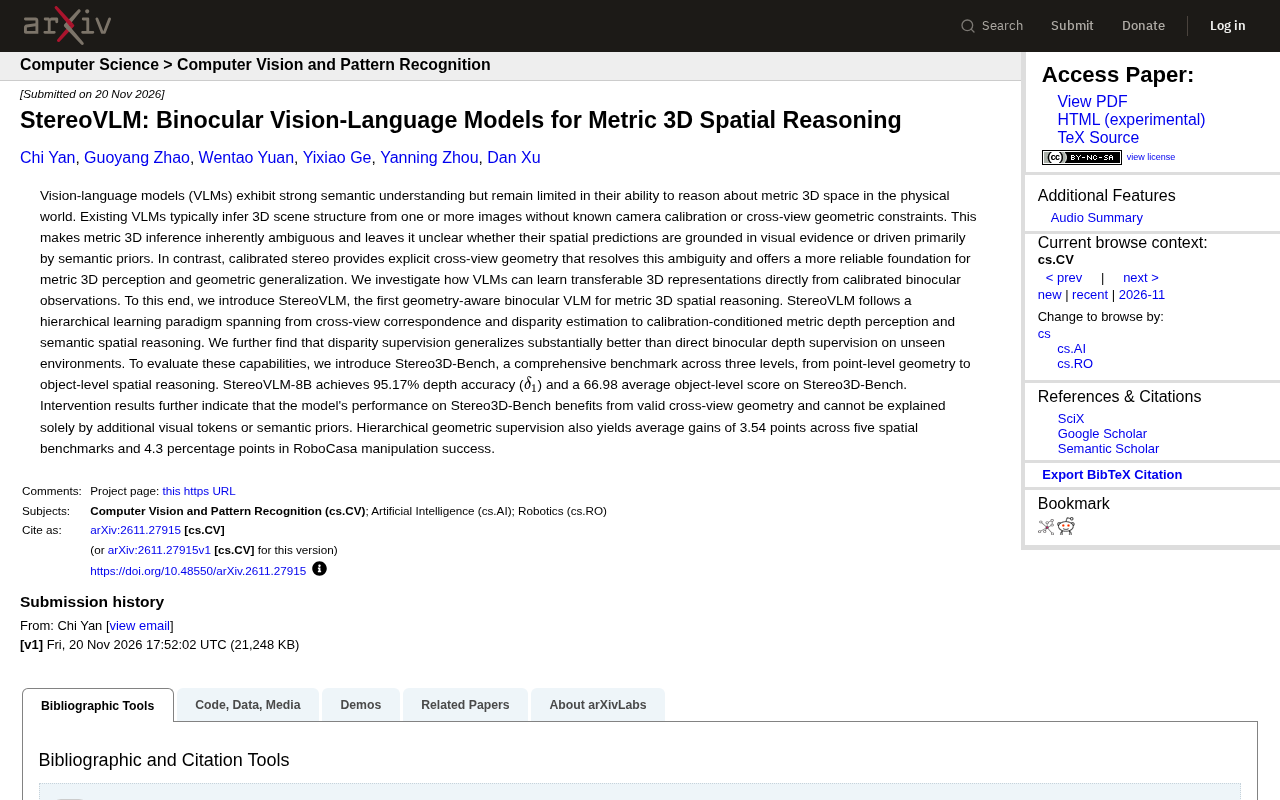
StereoVLM: A Binocular Vision-Language Model for Metric 3D Spatial Reasoning

StereoVLM uses calibrated binocular vision and hierarchical geometric supervision to enable VLMs to perform generalizable metric 3D spatial reasoning.
VLMs excel at semantic tasks but lack metric-level 3D spatial reasoning because monocular or multi-view images lack camera calibration and cross-view geometric constraints, causing scale ambiguity. Researchers propose StereoVLM—the first geometry-aware binocular VLM—using hierarchical learning from cross-view correspondence and disparity to calibration-conditioned metric depth. Disparity supervision generalizes better than direct depth supervision on unseen environments. On the three-level Stereo3D-Bench, StereoVLM-8B achieves 95.17% depth accuracy (δ₁) and 66.98 object-level average score; intervention experiments confirm performance stems from effective cross-view geometry rather than extra tokens or semantic priors. Hierarchical geometric supervision also improves five spatial benchmarks by 3.54 points on average and RoboCasa manipulation success rate by 4.3 percentage points.
From Semantic Understanding to Metric 3D Spatial Perception: The Inherent Weakness of VLMs
Vision-language models (VLMs) excel at semantic tasks such as image captioning and visual question answering, but their limitations become glaringly obvious once metric-level 3D spatial reasoning about the physical world is required. Existing VLMs typically infer 3D scene structure from one or more images without camera calibration, lacking cross-view geometric constraints, which makes metric 3D inference fundamentally ambiguous. More troublesome still, researchers find it hard to determine whether a model's spatial predictions are grounded in visual evidence or mainly rely on semantic priors to "guess."
The core of this predicament is insufficient information: monocular images lose scale information, and multi-view images, without knowledge of camera calibration parameters, likewise cannot recover precise metric geometry. Calibrated binocular vision, by contrast, provides explicit cross-view geometric relationships that can resolve the above ambiguity and offer a more reliable foundation for metric 3D perception and geometric generalization.
Camera calibration and binocular vision: Camera calibration is the process of determining a camera's intrinsic parameters (such as focal length, principal point, and distortion coefficients) and extrinsic parameters (the camera's position and orientation in the world coordinate system). For a binocular system, the relative pose between the two cameras (baseline distance and rotation) must also be calibrated. With calibration parameters, the epipolar constraints and the disparity-depth relationship between the left and right views can be precisely established, thereby converting pixel disparity into metric depth. Uncalibrated multi-view images lack this explicit geometric bridge, so models can only rely on semantic cues to infer structure, leaving the metric scale unrecoverable. Calibrated stereo thus provides the hard geometric constraints needed for disambiguation and is the informational foundation for StereoVLM's metric 3D perception.
StereoVLM: The First Geometry-Aware Binocular VLM
To address this problem, the research team proposes StereoVLM—the first geometry-aware binocular vision-language model for metric 3D spatial reasoning. Its core idea is to let the VLM learn transferable 3D representations directly from calibrated binocular observations, rather than "blindly guessing" scene structure under unconstrained conditions.
StereoVLM adopts a hierarchical learning paradigm that progresses step by step: from cross-view correspondences, to disparity estimation, to calibration-conditioned metric depth perception, and finally to semantic spatial reasoning. The design logic of this path is to first establish a geometric foundation and then layer semantic understanding on top of it, avoiding premature interference from semantic priors that could disrupt geometric judgments.
A notable finding is that on unseen environments, disparity supervision generalizes significantly better than direct binocular depth supervision. This means that letting the model learn the intermediate representation of "how left and right views correspond" captures transferable geometric structure better than directly regressing depth values. For embodied intelligence systems that need to be deployed in new scenes, this conclusion has direct engineering value.
The difference between disparity supervision and depth supervision: Disparity is the horizontal position difference between corresponding pixels in the left and right images, and depth is inversely proportional to disparity (Z = f·B/d, where f is focal length and B is baseline). Direct depth supervision requires the model to regress absolute depth values, making it prone to overfitting to the scale distribution of training scenes; disparity supervision instead lets the model learn cross-view pixel correspondences, an intermediate representation closer to geometric essence and less dependent on camera parameters and scene scale. Therefore, in unseen environments, disparity supervision can capture more transferable geometric structure, whereas depth regression may memorize statistical biases of the training set. This also explains why hierarchical learning—first learning correspondences and disparity, then conditioning to metric depth—generalizes better than end-to-end depth regression.
Stereo3D-Bench: A Three-Level Evaluation System
To systematically evaluate these capabilities, the research also introduces Stereo3D-Bench, a comprehensive benchmark covering three levels, extending from point-level geometry all the way to object-level spatial reasoning.
In terms of performance, StereoVLM-8B achieves 95.17% depth accuracy (δ₁) and an object-level average score of 66.98 on Stereo3D-Bench. More critically, the results of intervention experiments show that the model's performance on Stereo3D-Bench benefits from effective cross-view geometry and cannot be explained solely by additional visual tokens or semantic priors. This conclusion directly answers the question raised at the outset—StereoVLM's spatial predictions are indeed rooted in visual geometric evidence rather than semantic guessing.
The gains from hierarchical geometric supervision also extend to other tasks: an average improvement of 3.54 points on five spatial benchmarks and a 4.3 percentage point increase in success rate on RoboCasa manipulation tasks. This shows that improved geometric perception transfers across tasks, with clear significance for downstream applications such as robotic manipulation.
δ₁ depth accuracy: δ₁ is a standard evaluation metric in the depth estimation field, defined as the proportion of pixels for which the ratio between predicted and ground-truth depth (taking max(d_pred/d_gt, d_gt/d_pred)) is below a threshold of 1.25. This metric is relatively tolerant of scale errors and focuses on measuring the correctness of overall depth ordering and relative structure rather than absolute precision. A δ₁ of 95.17% means that the vast majority of pixels have depth predictions within 25% relative error, indicating high consistency in metric depth. Combined with the object-level average score (e.g., 66.98), it enables comprehensive evaluation of capabilities from point-level geometry to object-level spatial reasoning.
Why This Direction Is Worth Attention
The spatial reasoning capabilities of current mainstream VLMs rely heavily on statistical patterns implicit in large-scale data. When faced with tasks requiring precise metric judgments—such as robotic arm grasping, navigation and obstacle avoidance, or AR spatial anchoring—semantic priors cannot substitute for real geometric constraints. The value of StereoVLM lies in reintroducing calibrated binocular vision, a mature and reliable source of geometric information, into the VLM training paradigm, and through hierarchical supervision allowing geometric and semantic capabilities to collaborate rather than interfere with each other.
The finding that disparity supervision outperforms depth supervision also provides a reusable design principle for future research: intermediate geometric representations may be more conducive to generalization than end-to-end regression. Of course, binocular calibration is not always available in real-world deployment, and how to maintain geometric perception when calibration conditions weaken remains an open problem this direction must face.
One-line Summary
StereoVLM uses calibrated binocular vision and hierarchical geometric supervision to enable VLMs to achieve generalizable metric 3D spatial reasoning.
Paragraph Summary
Vision-language models excel at semantic tasks but lack metric-level 3D spatial reasoning, fundamentally because monocular or multi-view images lack camera calibration and cross-view geometric constraints, leading to scale ambiguity and making it hard to determine whether predictions stem from visual evidence or semantic priors. To address this, researchers propose StereoVLM—the first geometry-aware binocular VLM—adopting a hierarchical learning paradigm from cross-view correspondence and disparity estimation to calibration-conditioned metric depth, establishing a geometric foundation before layering semantic understanding. Experiments find that disparity supervision generalizes significantly better than direct depth supervision on unseen environments. The accompanying three-level Stereo3D-Bench benchmark shows that StereoVLM-8B achieves 95.17% depth accuracy (δ₁) and an object-level average score of 66.98, with intervention experiments proving its performance stems from effective cross-view geometry rather than extra tokens or semantic priors; hierarchical geometric supervision also improves five spatial benchmarks by an average of 3.54 points and raises RoboCasa manipulation success rate by 4.3 percentage points.
Related articles

Prompt Engineering for Beginners: From Writing Prompts to Engineering Thinking
Starting from the essence and four functions of prompts, this article systematically explains the six-step process, four success criteria, learning value, and practical limitations of prompt engineering to help you build a complete understanding.

Anthropic Launches Nasdaq IPO: AI Giant's Listing and Risk Disclosures
Anthropic officially launches its Nasdaq IPO under ticker ANT, with market valuation expected to potentially exceed SpaceX's record. The prospectus devotes nearly 100 pages to AI risks, while first-half revenue grew over 14x but net losses widened sharply, reigniting the AI bubble debate.

Rust cURL Clone Uses 4,832 unsafe Blocks—Is the Memory Safety Myth Broken?
A Rust cURL clone uses 4,832 unsafe keywords, challenging Rust's memory safety narrative. We analyze what unsafe really means, compare Fil-C, and examine rewrite motives.