Stop Burning Money: A 3-Step Method to Drastically Cut LLM Token Costs with n8n Workflows

A 3-step method to use LLMs only at design time and run repeatable tasks via n8n at zero token cost.
This article introduces a 3-step AI automation cost optimization method by YouTube creator Chris Levn: use the most powerful model during exploration for fast, high-quality results; have the AI solidify the output into a reusable "skill" that converts dynamic reasoning into deterministic logic; then connect the skill to n8n via MCP so all future executions bypass LLM API calls entirely — zero token cost. The approach also features self-healing capabilities for automatic error detection and recovery. The core engineering principle: intelligence at design time, determinism at runtime. Best suited for fixed, high-frequency automation tasks.
Why Your AI App Keeps Burning Money
The cost of calling large language models (LLMs) is often underestimated. Every request you send to a model — whether for data analysis, text generation, or reasoning tasks — consumes tokens, and tokens translate directly into real money. For automation scenarios that repeatedly execute the same logic, these costs can grow linearly or even exponentially.
YouTube creator Chris Levn makes a key point in his breakdown: many developers keep calling LLMs for repetitive tasks, essentially letting model providers continuously "burn through" their token budget. He proposes a three-step approach centered on one core idea — only use LLMs during the necessary exploration phase, then eliminate model calls entirely once the logic is solidified.
Breaking Down the 3-Step Method: From LLM Exploration to Zero-Cost Execution
Step 1: Use the Latest Model — Don't Cut Corners Here
This is counterintuitive but critical advice. During the exploration and debugging phase, the author recommends using the latest and most capable LLM, rather than opting for a cheaper, weaker version to save money.
"I try to use the latest LLM model so I don't try to save the money at this step."
The reasoning: the goal of the exploration phase is to get correct, high-quality results as fast as possible. Using a more capable model reduces trial-and-error iterations and helps you converge on a working solution sooner. Pinching pennies here by using an underpowered model can actually cost more in the end, since you'll need more rounds of calls to get usable results. Real cost control happens in the later steps — not here.

Step 2: Have the AI Solidify the Result into a "Skill"
Once you're satisfied with the LLM's output, the next step is not to keep calling it — it's to have the AI generate a reusable skill from that logic.
"When you happy with the result, you ask the AI to generate the skill."
This is the pivotal moment in the entire methodology. It transforms what was originally dynamic, real-time model reasoning into a deterministic, executable description. In other words, you use the LLM to do a one-time "programming" job, rather than having it re-think everything from scratch on every run.

Step 3: Connect to n8n via MCP and Convert to a Zero-Cost Workflow
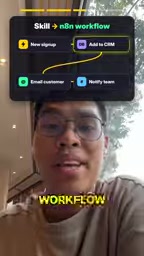
The final step is deploying the generated skill onto the n8n automation platform (pronounced "NAN" in the video). The author suggests connecting directly to n8n's MCP server to convert the skill into a standard n8n workflow.
"So you can connect n8n MCP server directly to turn the skill into the n8n workflow... to execute that workflow without any further LLM cost. Zero cost at all."
Once the skill becomes an n8n workflow, every subsequent execution runs through deterministic node logic — no LLM API calls triggered whatsoever. This means no matter how many times you run it, the token cost is zero. The LLM only appears during the initial "design phase"; the workflow engine takes over entirely at runtime.

n8n is an open-source workflow automation platform similar to Zapier or Make (formerly Integromat), but with support for self-hosted deployment. It uses a visual node-based approach to connect APIs, databases, and cloud services into automated pipelines — well-suited for technical users building complex business logic. Each "node" represents a specific operation (such as an HTTP request, data transformation, or conditional branch), nodes are linked by data flow, and the entire process executes deterministically without needing to call an AI model each time.
MCP (Model Context Protocol) is an open protocol proposed and championed by Anthropic in late 2024, designed to give LLMs a standardized interface for tool calls and context access. Through MCP, AI models can interact with external systems — such as n8n, databases, and file systems — much like calling a function, without needing custom adapter code for each platform. n8n's MCP server support allows AI agents to directly create, trigger, and manage workflows within n8n, enabling a clean separation between "AI designs the workflow" and "engine executes the workflow."
Self-Healing Workflows: Automatic Error Detection and Recovery
Beyond cost savings, the author also highlights that this approach has self-healing capabilities. When the workflow encounters an error during automated execution, the system independently investigates the cause and attempts to fix it.
"It's an automatic error fixing self-healing app. So it will run automatically and investigate the error and fix the error for you."
This makes automated pipelines significantly more resilient in production. Traditional hardcoded workflows break the moment they encounter unexpected input or API changes, whereas a self-healing workflow reduces the need for manual intervention and improves overall reliability. It's worth noting, however, that the original source does not go into technical implementation details of the self-healing mechanism — this aspect should be verified against the relevant platform documentation.
The concept of self-healing workflows has deep roots in engineering, commonly seen in fault-tolerant distributed systems design — for example, Kubernetes' automatic Pod restart mechanism. In AI automation contexts, self-healing is typically implemented as follows: when a workflow node throws an exception, the error information is captured and passed to an LLM, which analyzes the cause, generates a fix, writes the corrected logic back to the node, and retries. This is still fundamentally an LLM call, but the trigger shifts from "normal execution" to "exception handling," dramatically reducing its frequency. Compared to purely hardcoded try-catch logic, AI-driven self-healing handles unexpected error types more gracefully (such as third-party API field structure changes) — at the cost of occasional additional token consumption.
The Value and Limitations of This Methodology
From an architectural standpoint, this three-step method embodies a well-established engineering principle: use intelligence at design time, use determinism at runtime. LLMs excel at open-ended reasoning and generation, but they're expensive and not fully predictable; workflow engines excel at stable, cheap, repeatable execution. Combining both plays to each one's strengths.
The approach works best for tasks with relatively fixed logic that need to be executed at high frequency — such as data cleaning, format conversion, or structured information extraction. For these cases, "teaching" the system once with an LLM and then running it indefinitely at zero cost yields enormous returns.
Limitations also exist: if a task genuinely requires semantic understanding or creative generation every single time (such as writing original content on a different topic each run), the logic can't be fully solidified and LLM calls can't be entirely eliminated. Additionally, the original sharing is fairly high-level about the specifics of connecting MCP to n8n and generating skills — actual implementation will require consulting detailed platform documentation.
Summary
Chris Levn's three-step method offers a clear conceptual framework for controlling AI automation costs: boldly use the most powerful model during exploration for speed and quality, have the AI solidify the result into a skill once satisfied, then connect to n8n via MCP for zero-token-cost continuous execution — with self-healing capabilities added for stability. For developers building AI workflows who are struggling with token bills, this is an optimization direction well worth exploring.
Related articles

Receipt Forgery Detection Near Random? Real-World Struggles and Solutions in Document Image Forensics
A receipt forgery detection project with ROC-AUC near random reveals the pitfalls of small-sample document forensics. Explores anomaly detection, self-supervised pre-training, and numerical consistency as viable alternatives.

From Workflows to Eval-Driven Development: A Paradigm Shift in How We Solve Problems with AI
AI problem-solving is shifting from deterministic workflows to "define evals + hillclimb." This piece explores how eval-driven development reshapes tasks, data vendors, human roles, and Agent UX.

Tesla Powerwall + Electric Vehicle: A Dual Backup Power Solution for Outages
Tesla Powerwall combined with EV bidirectional charging can provide multi-layer home backup power during outages. We break down runtime, V2H realities, and Supercharger loop feasibility.