Stop Just Writing Prompts! 9 Steps to Building Safe, Controllable AI Skills

A 9-step framework that transforms AI Skill development from prompt alchemy into rigorous software engineering.
This article introduces a 9-Step Method for building production-ready AI Skills, organized into three layers: framing, execution, and safety. The framing layer defines what the AI should do and draws clear boundaries between AI and human responsibilities. The execution layer covers tool contracts (failures must throw errors, never silently swallowed), human-defined workflow orchestration, intermediate result persistence, and data accuracy fallbacks. The safety layer adds guardrails to constrain AI behavior, operation logs for auditability, thorough pre-deployment testing, and clear usage documentation. The core principle throughout: AI handles judgment and execution, while stability, safety, and reliability always depend on the rules and mechanisms that developers design.
Why Writing Good Prompts Isn't Enough
When building AI capabilities, many people pour all their energy into crafting the perfect prompt — as if a sufficiently clever prompt will guarantee stable output. In practice, however, skills that rely purely on prompts tend to be brittle: they break in new scenarios, silently fail at edge cases, and leave you with no diagnostic trail when things go wrong.
A truly production-ready AI Skill that can run reliably over the long term requires a complete engineering design philosophy. The "9-Step Method" proposed by a Bilibili content creator breaks skill development into three layers — framing, execution, and safety — covering the full lifecycle from task definition to deployment and operations. The core idea can be summed up in one sentence: establish clear rules for the AI, hand deterministic work to the program, and reserve judgment calls for the AI.
Framing Layer: Get Clear on What the AI Should Do
Step one is framing — defining the skill's core task and drawing a clear boundary between what the AI handles and what humans handle. This step sets the direction for the entire skill. Blurry boundaries are the root cause of all the confusion that follows.
Step two is classification — dividing tasks into three categories to clearly define the skill's capability boundaries. This makes explicit what the skill can handle, what it cannot, and prevents you from asking the AI to do things beyond its reliable range. These two steps may seem simple, but they are the prerequisite for a skill being "usable" at all. A poorly positioned skill, no matter how solid its execution layer, will ultimately fail due to role misalignment.
Execution Layer: Build the Logic Solid, Rely on Fallback Mechanisms for Stability
The execution layer is the heart of the 9-Step Method. The goal is to refine the skill's execution logic until it is stable enough for production.
Step three emphasizes that tools are contracts. When a skill needs to call an external tool, the invocation rules and error-handling behavior must be explicitly defined. The author specifically cites "silent failure" as a cautionary example: if a tool fails but doesn't report the error, the skill continues running with bad data and ultimately produces output that looks correct but is built on a faulty premise. The contract principle is simple — failure must throw an error. Silently swallowing exceptions is never acceptable.
Step four is "Don't let AI run the workflow." The core idea here is that humans define the process; AI is only responsible for executing specific steps within it. Delegating workflow orchestration to deterministic program logic — rather than letting the AI improvise — is what ensures the stability of the overall system.
Step five is save records first. During execution, key intermediate results should be saved promptly to support future debugging and auditing. When a skill breaks, those intermediate records are the critical clues for tracing the fault.
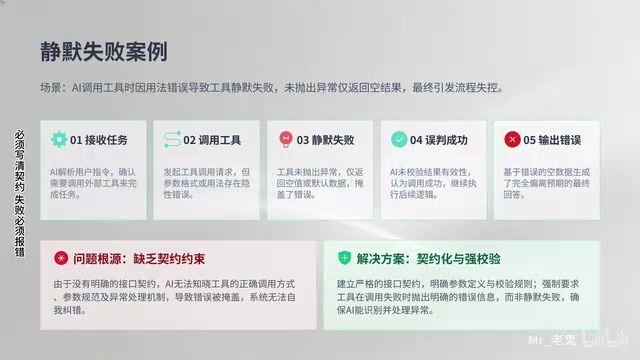
Step six is human fallback for data accuracy. A dual-layer mechanism — programmatic validation plus human review — ensures the reliability of final outputs. This leads to the execution layer's core conclusion: a skill's stability doesn't come from how smart the AI is; it comes from the fallback mechanisms the developer designs.
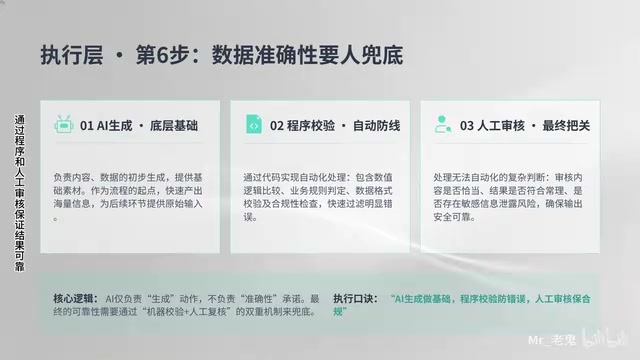
Silent Failure is a particularly insidious fault pattern in software systems: when an error occurs, the program neither throws an exception nor returns an error code — it "pretends to succeed" and keeps running. For AI Skills, this is especially dangerous. For example, if a database query tool returns an empty result set and there's no validation, the AI might interpret "no data" as "the data is empty," and go on to generate a seemingly complete conclusion built on a false premise. The traditional software principle of fail fast exists precisely for this reason: the moment something goes wrong, halt and report immediately rather than propagating a broken state downstream. The 9-Step Method brings this principle into AI Skill development, requiring that all tool calls define explicit failure responses so that problems surface at the source instead of being buried.
Safety Layer: Keep the Skill Well-Behaved at Runtime
The goal of the safety layer is to ensure the skill runs safely and in a controlled manner in real-world environments, and that problems can be located quickly when they occur.
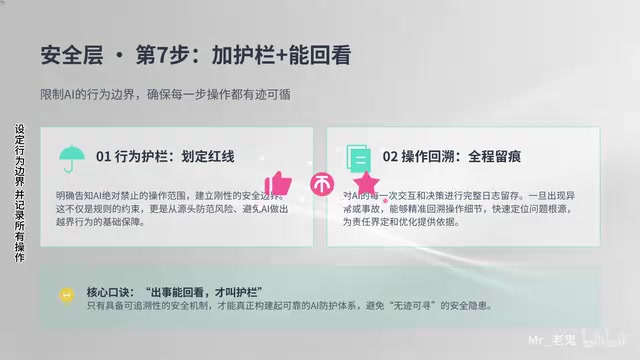
Step seven is "add guardrails and make it auditable." Guardrails set clear behavioral boundaries for the AI, preventing it from taking out-of-scope actions. Auditability requires logging all operations so every action is traceable. Together, they constrain AI behavior while preserving a complete audit trail.
Step eight is test before you migrate. Before deploying a skill to the production environment, it must go through thorough testing and validation. Only after confirming stability should it be migrated to production. This step is the key safeguard against "launching and immediately breaking."
Step nine is write clear usage documentation. Clear usage docs enable others to call the skill correctly and reduce the risk of misuse. The safety layer's conclusion is this: a reliable skill isn't one that never fails — it's one where failures can be quickly located and resolved.
Guardrails is a technical term in AI engineering referring to mechanisms that constrain the range of a model's outputs or behaviors. They can be prompt-level instructions (e.g., "never perform delete operations") or code-level interception logic (e.g., whitelist-validating AI-generated SQL before execution). The necessity of guardrails stems from a fundamental characteristic of LLMs: no matter how carefully the prompt is written, the probabilistic nature of LLM output means there is always some non-zero chance of out-of-bounds behavior — and in production, that "non-zero chance" will eventually be triggered. Operation logs, which complement guardrails, serve post-hoc auditing: when something does go wrong, a complete call chain record can reduce the time to diagnose "why did this fail" from hours to minutes. Together, they form the runtime safety baseline for any AI Skill.
The Value of the 9-Step Method: From Alchemy to Engineering
Viewed as a whole, the nine steps are fundamentally pulling AI application development back from the "alchemy of prompt-tuning" into the common sense of software engineering. Contracts, error handling, logging, testing, documentation — these are all mature practices from traditional software engineering, simply re-applied to the context of building AI Skills.
For developers looking to genuinely deploy AI capabilities into production environments, this framework provides an actionable checklist. It reminds us that the AI is responsible for judgment and execution, while stability, safety, and reliability always depend on the rules and mechanisms that humans design. Follow these nine steps and you can create AI Skills that are both capable and controllable.
Transplanting mature software engineering practices into AI application development is, at its core, a response to the fundamental tension between the uncertainty that AI introduces and the determinism that engineering systems require. Traditional software's inputs and outputs are fully determined by code logic and can be made completely predictable. LLM outputs are statistically stable in aggregate, but always carry variance at the level of a single call. The 9-Step Method's engineering approach doesn't aim to eliminate that uncertainty — that's impossible — but to isolate it within the AI's judgment steps, then use upstream process definition, downstream validation fallbacks, and end-to-end logging to reduce its impact on overall system stability to an acceptable range. This is conceptually identical to using circuit breakers in microservice architectures to isolate unstable downstream services.
Related articles

A Meta Senior Engineer's Deep Dive into AI-Assisted Programming: Is Hand-Written Code Dying?
A Meta L7 engineer shares real-world AI coding insights: why hand-written code is fading, how to review AI output, Codex vs Claude Code, and career advice for the AI era.

Qwen Image 2.1 Open Source Release Imminent: VRAM Requirements Dominate Community Discussion
Qwen Image 2.1 open-source release is imminent. Community discussion centers on VRAM requirements — can it run on mainstream 12–16GB consumer GPUs?

PlanetScale Launches Tin: A Full-Text Search Solution Built for Postgres
PlanetScale launches Tin, a full-text search tool built for PostgreSQL that aims to eliminate the need for separate search engines like Elasticsearch.