Stop Overthinking: Break the Mental Drain Cycle with Action

Break free from overthinking and analysis paralysis by embracing action, iteration, and practical strategies.
Tech professionals are especially prone to overthinking due to choice overload, perfectionism, and information anxiety. This article explores why action is more effective than endless analysis, drawing on psychology research and software development philosophy. It offers practical strategies — setting absurdly low starting thresholds, time-boxing decisions, embracing "good enough," and leveraging AI tools — to help you break the mental drain cycle and start shipping.
A Tweet That Sparked Reflection
A tweet that recently went viral on Twitter cut straight to a universal problem with remarkable simplicity:
"how to stop overthinking things: stop thinking, start doing."
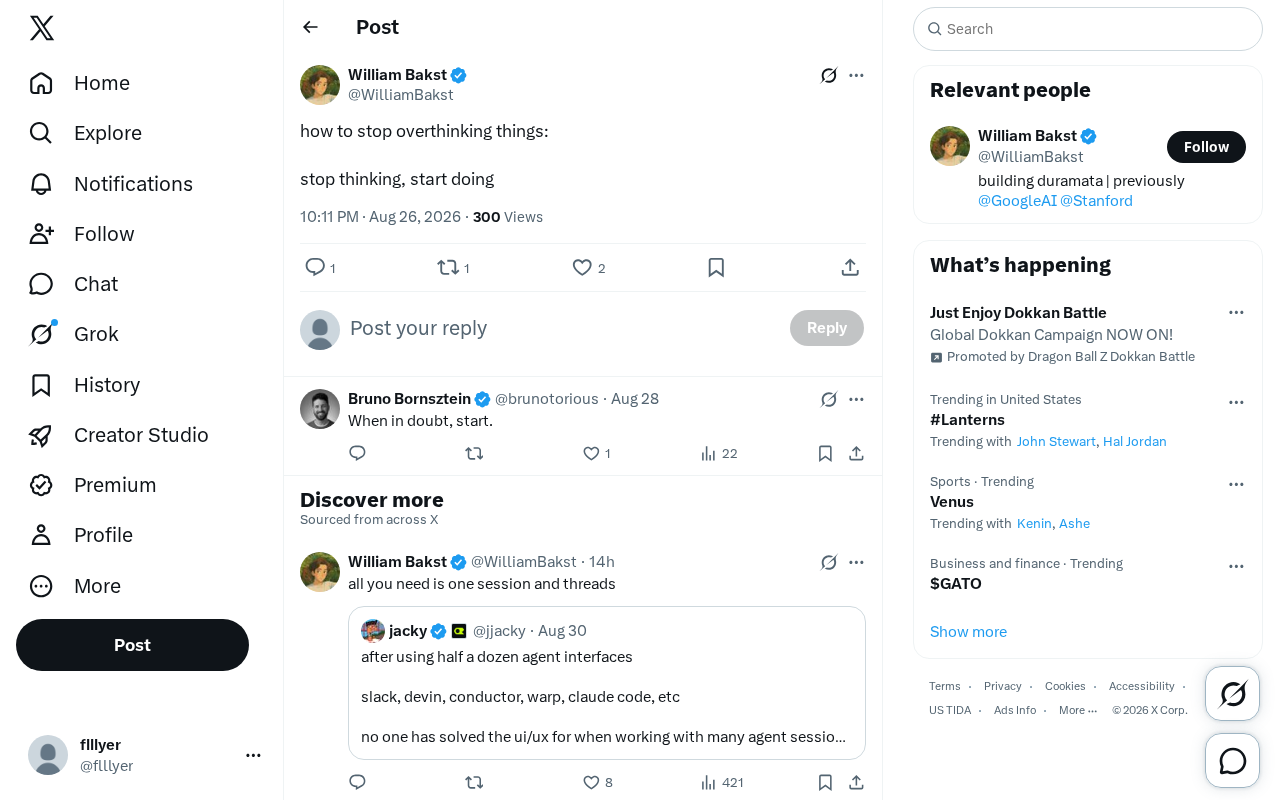
At first glance, this looks like a motivational cliché. But for those of us who spend our days immersed in AI, programming, and knowledge work, it touches on a very real and recurring struggle — action paralysis caused by overthinking. This phenomenon is especially common in the tech world: we spend enormous amounts of time on technology selection, comparing frameworks, and planning architectures, yet never write the first line of code.
Why Tech Professionals Are Particularly Prone to Overthinking
Choice Overload Drives Up Decision Costs
The richness of the modern tech ecosystem is a double-edged sword. In frontend alone, there's React, Vue, Svelte, Solid, and countless other frameworks. In AI application development, models, vector databases, and Agent frameworks emerge one after another. Every decision point comes with the anxiety of "did I pick the wrong one?" — and that anxiety keeps pushing back the moment you actually start building.
This phenomenon is known in psychology as Choice Overload, first systematically described by psychologist Barry Schwartz in The Paradox of Choice. He demonstrated that when the number of options exceeds a certain threshold, decision quality actually declines and satisfaction drops. Sheena Iyengar of Columbia University confirmed this with her classic "jam experiment": consumers presented with 24 varieties of jam had a far lower purchase rate than those offered just 6. In the tech world, every framework comes with exhaustive documentation, comparison reviews, and community discussions. This abundance of information makes it easy for developers to fall into Decision Fatigue — as consecutive decisions pile up, decision-making ability and willpower gradually deplete, and ultimately nothing gets chosen.
The Perfectionism Trap Leads to Analysis Paralysis
Engineers tend to have a strong drive to find the optimal solution. Mentally simulating every edge case, performance optimization, and scalability concern is essentially "premature optimization." And as we all know, premature optimization is the root of all evil. More often than not, these carefully designed scenarios never actually materialize in a real product.
"Premature optimization is the root of all evil" comes from computer scientist Donald Knuth's 1974 paper Structured Programming with GoTo Statements. The full quote reads: "We should forget about small efficiencies, say about 97% of the time: premature optimization is the root of all evil." Knuth's point was that developers shouldn't optimize code details based on intuition without performance data, because a programmer's intuition about performance bottlenecks is wrong about 97% of the time. This principle has since been extended broadly to software architecture design and system planning — trying to design a "perfect" architecture before requirements are even clear is fundamentally a misallocation of intellectual resources.
Information Anxiety Creates the Illusion of Perpetual Preparation
Every day brings new model releases and new tools, creating the illusion that "maybe I should learn all of this before I start." The result: you're always preparing, never producing.
Why "Doing" Is More Effective Than "Thinking"
Action Generates Real Feedback
Thinking can only spin within the space of hypotheticals, while action produces real-world feedback. When you actually build a prototype, many of the problems you agonized over in your head simply dissolve — reality gives you the answers directly. A running demo beats ten pages of perfect design docs.
This is also one of the deeper reasons behind the popularity of AI coding tools like Cursor, Claude Code, and GitHub Copilot: they dramatically lower the barrier to "just start doing." They let developers quickly turn ideas into runnable code, get real feedback at minimal cost, and iterate from there. These tools rely on the code generation capabilities of large language models (LLMs) — GitHub Copilot is based on OpenAI's Codex model (later upgraded to the GPT-4 series), trained on massive amounts of open-source code to auto-complete code based on context and natural language comments; Cursor builds on this with deep editor integration, supporting multi-file context understanding and code refactoring; Claude Code is a command-line programming agent from Anthropic that can directly understand codebases and execute complex multi-step programming tasks. The core value of these tools isn't to replace a developer's thinking ability, but to eliminate the psychological resistance and time cost of "starting from scratch." When you can describe your intent in natural language and get a runnable code skeleton in seconds, the friction of "getting started" drops dramatically.
Iteration Beats Planning
Software development has long moved from the waterfall model to agile iteration — fundamentally a rebellion against "excessive upfront thinking." Rather than spending three months planning a perfect system, it's better to build an MVP (Minimum Viable Product) in two weeks and let users and data guide the next step. This mindset applies equally to personal learning and creative work.
This transition follows a clear methodological lineage. The Waterfall Model was proposed by Winston Royce in 1970, emphasizing strict linear phases: requirements analysis → system design → coding → testing → deployment → maintenance, where each phase had to be completed before moving to the next. This approach works well when requirements are clear and change is minimal, but proves rigid in fast-moving software markets. In 2001, 17 software developers signed the Agile Manifesto in Utah, USA, proposing four core values. Among them, "working software over comprehensive documentation" and "responding to change over following a plan" directly addressed the waterfall model's shortcomings. The MVP concept was systematized by Eric Ries in The Lean Startup, advocating for building a product version with minimal resources that can collect real user feedback, then rapidly iterating through "build-measure-learn" loops. This philosophy has since expanded from startups to product development across all types of organizations and personal projects.
Action Is the Most Direct Way to Reduce Anxiety
Psychological research shows that anxiety often stems from uncertainty, and action is the most direct way to eliminate uncertainty. When you start doing just one small thing, your brain switches from "worry mode" to "execution mode" — and that switch alone can significantly alleviate mental drain.
From a cognitive behavioral psychology perspective, Aaron Beck, the founder of Cognitive Behavioral Therapy (CBT), pointed out that the core mechanism of anxiety is overestimating future threats while underestimating one's ability to cope. When a person is in an overthinking state, the brain's Default Mode Network (DMN) is highly active — this brain region handles introspection, self-referential thinking, and future scenario simulation, but overactivation leads to rumination and escalating anxiety. When a person shifts into goal-directed action, the Task-Positive Network is activated and DMN activity is suppressed, switching the brain from diffuse worry to focused problem-solving mode. Psychologist Mihaly Csikszentmihalyi's "Flow" theory also supports this: when challenge matches skill and attention is fully invested in the current task, anxiety and self-doubt naturally recede.
How to Break the Overthinking Cycle in Practice
Set an Absurdly Low Starting Threshold
Don't think "I need to build a complete project." Think "I'll just write the first function" or "I'll just get Hello World running." Break the task down to something so small it's impossible to fail, and action will naturally follow.
Use Time-boxing to Limit Decision Time
Set a clear time limit for decisions. For example: "I'll spend only 30 minutes on tech selection — when the time is up, I start building regardless of whether I've resolved every doubt." This effectively prevents unlimited analysis paralysis.
Time-boxing originated from the Scrum framework in agile development, systematized by Jeff Sutherland and Ken Schwaber in the 1990s. The Sprint in Scrum is a classic time box — teams complete a predetermined amount of work within a fixed time period (typically 1–4 weeks) and must deliver a usable increment when time's up. Parkinson's Law explains the necessity of time-boxing from the opposite angle: "Work expands to fill the time available for its completion." Without time constraints on decisions, analysis and comparison will sprawl indefinitely. The Pomodoro Technique is a classic personal-level application of time-boxing — 25-minute focus cycles with 5-minute breaks force attention to anchor on the current task, effectively combating attention drift and procrastination.
Embrace "Good Enough" Over "Perfect"
Accept the fact that the first version will never be perfect. The purpose of the first version isn't perfection — it's existence. Only when something exists can you have something to improve.
Use Tools to Reduce Starting Friction
Leverage AI-assisted tools to quickly scaffold your project, and invest the cognitive resources you save into decisions that truly require judgment. The purpose of tools is to get you into the "doing" state faster.
Conclusion
This tweet resonated so widely because it struck a universal pain point for knowledge workers. "Stop thinking, start doing" isn't a rejection of thinking's value — it's a reminder that thinking should serve action, not replace it. In an era of information overload and abundant tools, what's truly scarce isn't ideas, but the execution to bring them to life. Next time you find yourself trapped in endless deliberation, remember this: just start doing it. The answers often reveal themselves through action.
Related articles

Chain of Thought Isn't Just for AI: How Humans Can Use CoT to Improve Thinking Quality
Chain of Thought isn't just a prompt trick for large models. Starting from a Hacker News discussion, this article analyzes why CoT works for human thinking too, breaks down actionable ways to transfer it, and highlights the key differences between human CoT and machine CoT.
Cloudflare Teams Up with OpenAI: Closi…
Cloudflare Teams Up with OpenAI: Closing the Loop from Vulnerability Discovery to Defense with AI
Cloudflare uses OpenAI Daybreak to investigate security vulnerabilities and generate reviewable remediation plans, while developers use Codex to boost coding efficiency and quality.

Orca Multi-Agent Orchestration in Practice: A Guide to Parallel Collaboration with Claude and Codex
Orca is Stable AI's free open-source agent workbench supporting 34 agents like Claude Code and Codex in parallel. Learn its Git worktree isolation, multi-model orchestration, and mobile management.