Stremio Web: A Deep Dive into the Open-Source Streaming Aggregation Platform

Stremio Web is an open-source JavaScript platform that aggregates multi-source streaming content via a plugin ecosystem, with 14K+ Stars.
Stremio Web (`stremio-web`) is an open-source streaming aggregation platform built in JavaScript. Its core philosophy is "aggregate, don't host" — the platform holds no content of its own, but instead uses a standardized Add-on protocol to let third-party developers supply content catalogs, metadata, and playable stream URLs. Users can access content from multiple sources in a single interface without switching between apps. The project has 14,127 GitHub Stars with ~111 new Stars per day, and 1,600+ Forks reflecting strong community engagement. Note that available content and its legality depend entirely on the third-party Add-ons a user chooses to install.
What Is Stremio
Stremio is an open-source streaming aggregation and playback platform. Its tagline, "Freedom to Stream," captures the project's core mission — giving users a single, unified interface to manage, discover, and watch content from a wide variety of sources. This article focuses on the Stremio/stremio-web repository, the platform's web-based implementation written in JavaScript. It has accumulated 14,127 GitHub Stars and 1,619 Forks, with an active growth rate of around 111 new Stars per day.
Unlike traditional single-source content platforms, Stremio does not host any content itself. Instead, it uses an Add-on system to integrate diverse content sources into one unified playback and management experience. This architecture makes it more of a "media hub" — users can freely extend its capabilities based on their own needs.
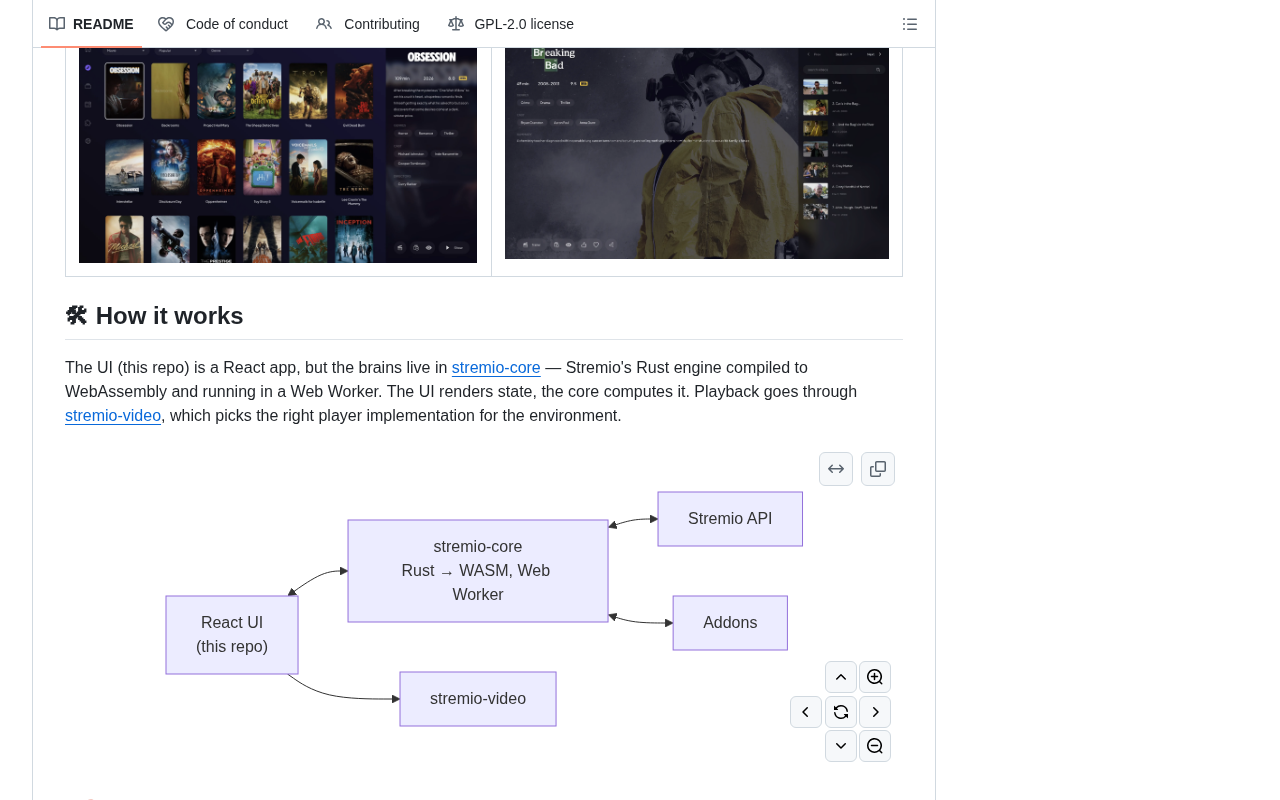
Technical Architecture and Design Philosophy
stremio-web is primarily written in JavaScript, which gives it natural cross-platform compatibility in the browser. Compared to desktop clients that require downloading and installing, the web version lowers the barrier to entry — users only need a browser to access core features, making it especially appealing for lightweight use cases.
A Plugin-Based Extension System
The most fundamental design decision in Stremio is its Add-on system. Content discovery, subtitles, metadata, and other capabilities are all provided through plugins. Developers can write their own Add-ons following a standardized protocol, which has led to a rich community ecosystem. This decoupled design offers two clear benefits: it keeps the core codebase lean, and it allows functionality to evolve alongside community needs without frequent changes to the main application.
Stremio's Add-on protocol is built on HTTP/HTTPS and communicates via JSON. An Add-on is essentially a service that implements a specific set of REST endpoints. The core endpoints include: /manifest.json (declaring plugin capabilities and metadata), /catalog (providing a content catalog), /meta (returning detailed metadata for a single item), and /stream (returning a list of playable stream URLs). This "URL as plugin identifier" design is remarkably lightweight — users simply paste a link to install an Add-on, and developers can publish without going through any centralized review process. While the official Stremio Add-on SDK maintains a curated directory, the community is also free to host plugins outside of it. This means the ecosystem has both an officially endorsed entry point and the option to remain fully decentralized.
The Value of Open-Source Collaboration
Over 1,600 Forks reflect the project's customizability and community engagement. Developers can build on the existing codebase or contribute improvements upstream. For engineers interested in understanding how streaming players and plugin systems are built, this is a real-world case study worth exploring.
Why It Continues to Attract Attention
Gaining 111 new Stars per day is a notably active growth rate for a mid-sized open-source project, indicating that Stremio continues to draw in new users and developers. Its appeal comes from several factors:
- Unified experience: Consolidating scattered content sources into a single interface reduces the friction of switching between multiple apps.
- Open and in control: Being open source gives users greater visibility into how the software behaves and makes security auditing more accessible.
- Cross-platform coverage: The web version fills the gaps left by desktop and mobile clients.
Notes for Users and Developers
As a content aggregation platform, Stremio does not provide content itself — what you can actually watch depends entirely on the Add-ons you install. This means the real-world experience and legal compliance are largely determined by third-party plugins. Users should exercise their own judgment about the legality and safety of any Add-on they choose to install.
For engineers looking to contribute, the JavaScript tech stack and well-defined Add-on protocol make stremio-web a solid starting point. A good approach is to start by reading the repository documentation, spinning up a local development environment, and gradually working through the data flow and rendering logic.
On the local development side, stremio-web relies on the Node.js ecosystem — typically npm install to install dependencies and npm start to launch the development server. The web client is a frontend SPA (single-page application), and full functionality often requires running it alongside stremio-service (a local backend service), since browser security sandboxes prevent directly handling torrents or certain streaming protocols. Users who simply want to try the web version can use the officially hosted online version. Developers who want to run the full stack locally should pay close attention to the configuration required to get the frontend and backend communicating correctly. Understanding this frontend/backend separation is key to making sense of how data flows through the codebase.
Summary
Stremio Web embodies an "aggregate, don't host" approach to streaming: it returns control to users through an open plugin ecosystem. Its 14,127 Stars and steady daily growth confirm that this model continues to resonate with both developers and end users. Whether you're looking for a practical media hub for everyday use or an open-source reference for studying frontend player design and plugin architectures, Stremio Web is well worth your attention.
Related articles

Chain of Thought Isn't Just for AI: How Humans Can Use CoT to Improve Thinking Quality
Chain of Thought isn't just a prompt trick for large models. Starting from a Hacker News discussion, this article analyzes why CoT works for human thinking too, breaks down actionable ways to transfer it, and highlights the key differences between human CoT and machine CoT.
Cloudflare Teams Up with OpenAI: Closi…
Cloudflare Teams Up with OpenAI: Closing the Loop from Vulnerability Discovery to Defense with AI
Cloudflare uses OpenAI Daybreak to investigate security vulnerabilities and generate reviewable remediation plans, while developers use Codex to boost coding efficiency and quality.

Orca Multi-Agent Orchestration in Practice: A Guide to Parallel Collaboration with Claude and Codex
Orca is Stable AI's free open-source agent workbench supporting 34 agents like Claude Code and Codex in parallel. Learn its Git worktree isolation, multi-model orchestration, and mobile management.