StringQFT: An Open Textbook and Toolkit for AI-Assisted Theoretical Physics

StringQFT integrates string theory textbooks with benchmarks, retrieval, and computational tools into open infrastructure for AI-assisted theoretical physics.
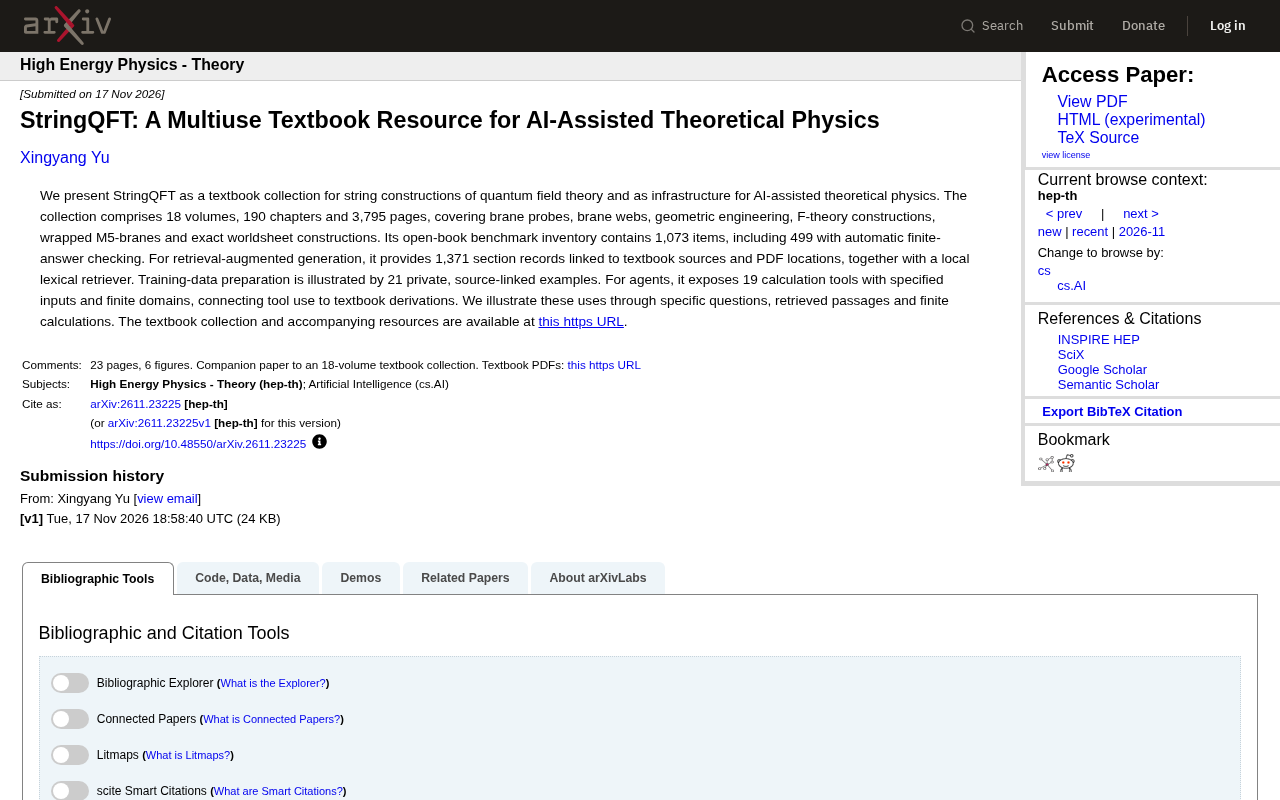
StringQFT is an open GitHub project combining systematic textbooks on string-built quantum field theory with AI-oriented workflow infrastructure. The collection spans 18 volumes, 190 chapters, and 3795 pages covering brane probes, brane webs, geometric engineering, F-theory, wrapped M5-branes, and worldsheet constructions. It offers an open book benchmark with 1073 entries (499 with automatic finite answer checking), 1371 chapter records with a local lexical retriever linked to sources and PDF locations, and 19 finite-domain computational tools for AI agents, plus 21 source-linked training examples. Its value lies in bridging deep domain knowledge and AI workflows through verifiable checks and traceable retrieval, though real-world effectiveness still needs external validation.
Project Overview: From Textbook to AI Infrastructure
Theoretical physics has always had a high barrier to entry, and the introduction of AI is changing how knowledge is acquired and derived. The recently released StringQFT project attempts to combine systematic textbooks on string theory and quantum field theory with AI-assisted infrastructure, providing researchers and AI agents with a set of open resources that are searchable, computable, and traceable.
StringQFT positions itself as a textbook collection on "string-built quantum field theory" while also serving as infrastructure for AI-assisted theoretical physics. According to the project, the collection comprises 18 volumes, 190 chapters, and 3795 pages, covering topics such as brane probes, brane webs, geometric engineering, F-theory constructions, wrapped M5-branes, and exact worldsheet constructions. The content is organized as open textbooks and is accompanied by a range of resources designed for AI workflows.
The project is hosted on GitHub (https://github.com/xingyang-yu/StringQFT), meaning both the textbooks and tools are publicly accessible, facilitating community reproduction and extension.
String-built QFT is a core research direction at the intersection of string theory and quantum field theory. The basic idea is that many quantum field theories (especially gauge theories) can be "derived" from geometric or topological constructions in string theory—for example, through brane probes, brane webs, and geometric engineering—by mapping field theory parameters to the geometric data of string compactification manifolds. The F-theory constructions, wrapped M5-branes, and exact worldsheet constructions mentioned in the text all belong to specific techniques within this framework: F-theory encodes gauge symmetries and matter spectra through elliptically fibered Calabi-Yau manifolds; wrapped M5-branes are often used to construct superconformal field theories or study their low-energy effective theories; and worldsheet constructions start from the worldsheet conformal field theory of strings to precisely compute partition functions and correlation functions. Understanding these terms helps grasp the technical depth and mathematical density of the content covered by StringQFT.
Three AI-Assisted Capabilities: Evaluation, Retrieval, and Tool Invocation
StringQFT does not simply digitize textbooks; it designs three layers of infrastructure around AI-assisted theoretical physics.
Open Book Benchmark: 1073 Questions with Automatic Checking
The project has built an open book benchmark list containing 1073 entries, of which 499 have automatic finite answer checking capability. This means AI systems can verify answers against textbook content without relying on human grading. For a derivation-intensive field like theoretical physics, finite answer checking can cover a large number of decidable computational problems, providing a repeatable yardstick for model evaluation.
"Finite answer checking" refers to benchmark questions whose answers are discrete or closed-form and can be programmatically determined—such as an integer, a rational number, the dimension of a particular group representation, the dimension of a moduli space, or a symbolic expression—rather than open-ended derivations requiring lengthy argumentation. Many exercises in theoretical physics papers and textbooks fall precisely into this category of decidable computations, making them suitable for automated evaluation. In contrast, proof problems, constructive derivations, or essay questions requiring physical insight are difficult to check automatically and typically still require human grading or model-based grading, the latter of which has its own evaluation biases. The fact that about half of the entries in StringQFT have automatic checking capability reflects the realistic constraints of exercise type distribution in textbooks, and also suggests that future extensions could consider introducing formal proof assistants or symbolic computation backends to improve the coverage of decidable problems.
Retrieval-Augmented Generation: 1371 Chapter Records with a Local Retriever
For RAG (retrieval-augmented generation) scenarios, StringQFT provides 1371 chapter records, each linked to the textbook source and PDF location, along with a local lexical retriever. This design allows AI to locate specific chapters and page numbers when answering questions, rather than generating from thin air. For theoretical physics discussions requiring precise citations, source traceability is crucial.
Lexical retrievers and semantic vector retrieval are the two main technical approaches to RAG. Lexical retrieval is based on sparse retrieval algorithms such as BM25 and TF-IDF, relying on exact or approximate matching between query terms and document terms. Its advantages include strong interpretability, no need for embedding models, good performance on proper nouns and mathematical symbols, and fully local operation without dependence on external APIs. Its limitations lie in difficulty handling synonymous paraphrasing and cross-lingual queries, with recall for natural language questions typically lower than dense retrieval. StringQFT's choice of a local lexical retriever aligns with its positioning of "source traceability and offline reproducibility": each record is bound to a textbook chapter and PDF location, so retrieval results can be directly traced to original page numbers for researchers to verify and cite. In theoretical physics scenarios, precise terminology (such as "Seiberg duality" or "orientifold") is often the key clue for retrieval, and lexical methods have practical advantages here.
Agent Tools: 19 Computational Tools with Finite Domains
For AI agents, the project exposes 19 computational tools, each with specified inputs and finite domains, connecting tool use with textbook derivations. Agents can call these tools to perform specific computations, and the domain restrictions help reduce uncertainty in open-ended computations.
"Finite domain" in the context of tool invocation means that the input parameters accepted by a tool are restricted to a clear, enumerable, or verifiable range—for example, only accepting specific types of groups, manifolds of specific dimensions, or integer parameters within a specific range. This constraint serves three purposes: first, agents can determine whether inputs are valid before calling, reducing invalid calls; second, tools can return clear errors for out-of-bounds inputs, avoiding seemingly plausible but meaningless computation results; third, during evaluation, it becomes possible to distinguish between "insufficient tool capability" and "agent selection error." In theoretical physics, many computations (such as group theory indices, moduli space dimensions, and anomaly coefficients) naturally have discrete domains and are suitable for encapsulation as restricted tools. However, finite domains also mean that tools cannot handle complex derivations requiring the combination of multiple steps or dependence on continuous parameters—which is precisely the deeper reason for the limited coverage noted in the text.
Training Data Preparation and Examples
The project also demonstrates its approach to training data preparation, providing 21 private, source-linked examples. These examples illustrate how to associate textbook content with sources for training or fine-tuning. Although the number of examples is limited, they provide a template for future extension.
Significance for AI-Assisted Theoretical Physics
The value of StringQFT lies in integrating textbooks, evaluation, retrieval, and tool invocation into an operable infrastructure. AI assistance in theoretical physics has long faced two challenges: first, the depth of domain knowledge is so great that general-purpose models struggle to master it precisely; second, derivation processes require verifiable intermediate steps. Through finite answer checking, source-linked retrieval records, and finite-domain computational tools, StringQFT attempts to build a verifiable bridge between textbooks and AI workflows.
The open nature of the project is also noteworthy. The textbooks and accompanying resources are all public, and the definitions of benchmarks and tools are clear, making it easy for other researchers to reuse or build new evaluation and agent systems on top of them. For researchers interested in AI for Science, StringQFT provides a sample worth studying.
Limitations and Outlook
Based on public information, StringQFT currently remains primarily a textbook resource and infrastructure, and its actual AI-assisted effectiveness requires more external validation. Of the 1073 benchmark entries, only 499 have automatic checking; the evaluation methods for the remaining entries are not yet specified. The coverage of the 19 computational tools is also limited, and whether they can support complex theoretical physics derivations remains to be seen.
Nevertheless, as an open, traceable, AI-workflow-oriented textbook resource, StringQFT provides a new experimental platform for combining theoretical physics with AI. The open access of its GitHub repository also lowers the barrier to community participation.
One-line Summary
StringQFT integrates string theory textbooks with benchmarks, retrieval, and computational tools into open infrastructure for AI-assisted theoretical physics.
Paragraph Summary
StringQFT is an open project hosted on GitHub that combines systematic textbooks on string-built quantum field theory with AI-oriented workflow infrastructure. The textbook collection comprises 18 volumes, 190 chapters, and 3795 pages, covering topics such as brane probes, brane webs, geometric engineering, F-theory constructions, wrapped M5-branes, and worldsheet constructions. The project designs three layers around AI assistance: an open book benchmark with 1073 entries, of which 499 support automatic finite answer checking; RAG resources with 1371 chapter records and a local lexical retriever, each record linked to textbook sources and PDF locations; and 19 finite-domain computational tools for AI agents to invoke. The project also provides 21 source-linked training data examples. Its value lies in building a bridge between deep domain knowledge and AI workflows through verifiable answer checking, traceable retrieval, and restricted tool invocation, but its actual effectiveness and coverage still require external validation.
Related articles

Prompt Engineering for Beginners: From Writing Prompts to Engineering Thinking
Starting from the essence and four functions of prompts, this article systematically explains the six-step process, four success criteria, learning value, and practical limitations of prompt engineering to help you build a complete understanding.

Anthropic Launches Nasdaq IPO: AI Giant's Listing and Risk Disclosures
Anthropic officially launches its Nasdaq IPO under ticker ANT, with market valuation expected to potentially exceed SpaceX's record. The prospectus devotes nearly 100 pages to AI risks, while first-half revenue grew over 14x but net losses widened sharply, reigniting the AI bubble debate.

Rust cURL Clone Uses 4,832 unsafe Blocks—Is the Memory Safety Myth Broken?
A Rust cURL clone uses 4,832 unsafe keywords, challenging Rust's memory safety narrative. We analyze what unsafe really means, compare Fil-C, and examine rewrite motives.