Strix Integrates Vercel AI Gateway: Pentesting Across 400+ Switchable Models

Strix integrates Vercel AI Gateway, letting a single API call 400+ models for pentesting.
The open-source AI pentesting tool Strix has integrated Vercel AI Gateway, enabling calls to 400+ models from Anthropic, OpenAI, Kimi, GLM, and Deepseek through one API with no per-provider accounts or keys. It adds no markup and unifies cross-model usage and cost tracking. Configuration uses the STRIX_LLM variable in the form vercel_ai_gateway/<provider>/<model> with an AI Gateway key.
The open-source AI pentesting tool Strix has rolled out a key integration update: it can now call over 400 models through Vercel AI Gateway, spanning providers including Anthropic, OpenAI, Kimi, GLM, and Deepseek. For teams that need to run security tests and compare results across different models, this means no more registering separate accounts and maintaining multiple sets of keys for each provider.
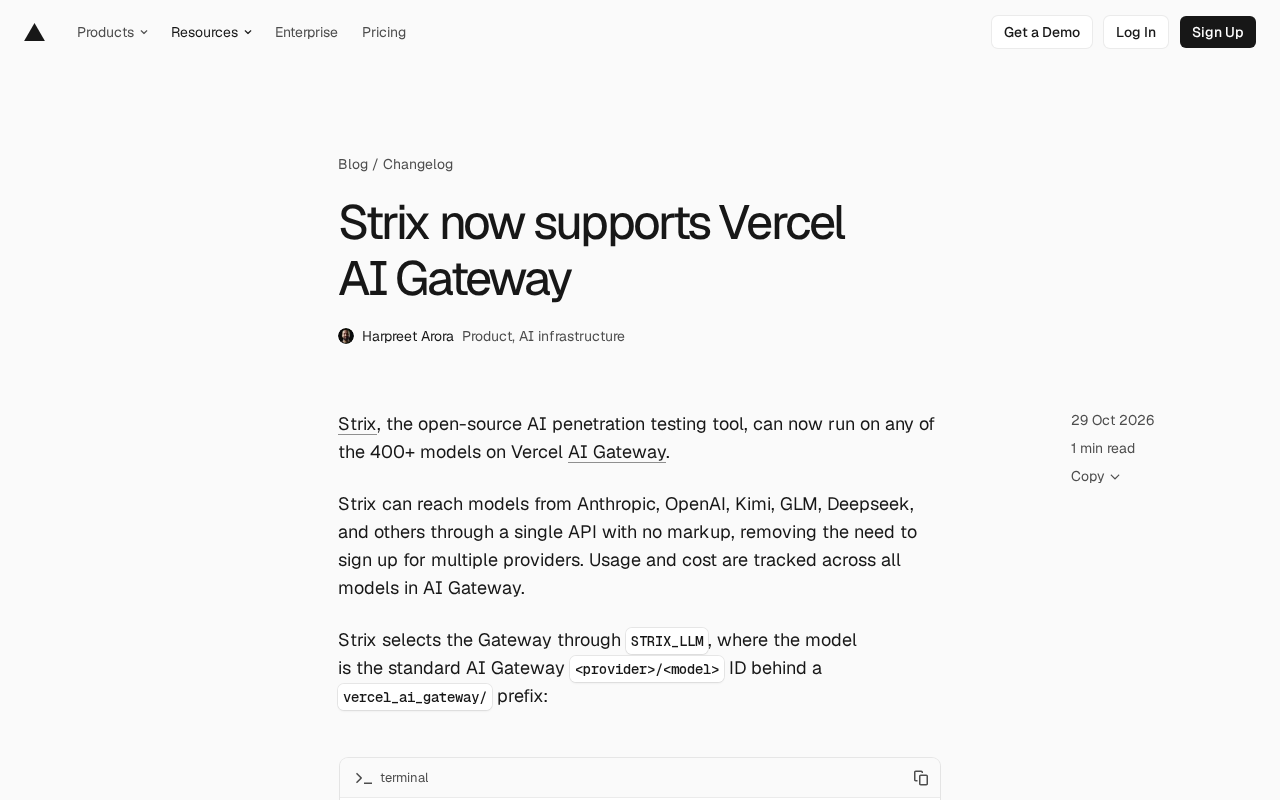
One API for many models: what actually changed
Strix was originally used by binding it to a single model provider, and switching models often meant reworking configuration and billing. With AI Gateway, multiple models are consolidated behind a single API entry point. The official announcement emphasizes that this layer adds no extra markup and that usage and cost can be tracked across models in AI Gateway.
This brings two direct changes. First, the cost of model selection drops: in pentesting scenarios, models differ noticeably in reasoning depth, instruction following, and tool-calling stability, and the ability to compare them side by side at low cost directly affects whether a testing strategy is reliable. Second, billing transparency improves: when test tasks are spread across multiple models, usage and spend for all of them are centralized in one dashboard, which is more manageable than reconciling bills provider by provider.
What is AI Gateway
Vercel AI Gateway is a unified routing layer that sits between applications and LLM providers. It exposes an OpenAI-compatible interface, forwards requests internally to models from Anthropic, OpenAI, Google, Meta, and several Chinese providers, and handles authentication, rate limiting, retries, and usage statistics for those calls. For developers, the change is that you only need a single gateway key and send requests using model IDs in the <provider>/<model> form, rather than maintaining a separate SDK and account system for each provider. Gateways like this typically also offer model fallback, caching, and observability, at the cost of adding an extra hop in the request path.
Configuration: one prefix decides the route
Strix selects the model channel through the STRIX_LLM environment variable. The format is a standard AI Gateway <provider>/<model> ID prefixed with vercel_ai_gateway/:
export STRIX_LLM="vercel_ai_gateway/zai/glm-5.3"
export LLM_API_KEY="your-ai-gateway-api-key"
Note that the model ID format is tightly coupled to the gateway's routing rules; a wrong prefix or a mismatched provider name will cause the call to fail. For the key, you use an AI Gateway API key rather than the original keys from each provider—this is precisely the key to reducing multi-account management overhead. The official AI Gateway configuration guide for Strix provides the full steps; once configured as documented, you can start using it.
Resolving STRIX_LLM and model IDs
STRIX_LLM is the environment variable Strix uses to declare "which model to run tests with." Its value is not the model name itself but a channel identifier parsed by the tool. The vercel_ai_gateway/ prefix in the format tells Strix to take the gateway branch, and the remaining <provider>/<model> is passed through as the gateway's routing key—for example, in zai/glm-5.3, zai is the provider identifier and glm-5.3 is the specific model version under that provider. Because provider identifiers are defined by the gateway rather than named by the vendors themselves, a wrong prefix or a model ID not listed on the gateway will cause the request to be rejected at the routing stage, manifesting as an authentication-succeeded-but-model-not-found error.
What this means for security testing workflows
Pentesting is a task type highly sensitive to model capability. Task decomposition, vulnerability reasoning, and the stability of the tool-calling chain—a shortfall in model performance at any one of these steps can distort test results. With model selection delegated to the gateway, teams can choose different models for different testing phases—for example, using a stronger-reasoning model for path planning and a lower-cost model for batch probing tasks.
The price of this flexibility is that configuration complexity shifts from the "provider dimension" to the "model ID dimension." When the number of available models exceeds 400, establishing a reproducible record of model selection and evaluation becomes an engineering practice teams need to fill in themselves.
What pentesting agents demand from models
Tools like Strix are a typical agent form: the model does not answer a question once but repeatedly decides the next action in a loop, calls scanning or exploitation tools, reads the returned results, and revises its plan. This makes its demands on model capability different from ordinary chat scenarios—tool-call argument formats must be strictly valid, early context must not be lost across multiple loop iterations, and when a command fails the model must self-correct rather than repeat the same action. Reasoning depth determines how sound the vulnerability path planning is, while instruction following and tool-calling stability determine whether the whole chain can run to completion. So in pentesting, switching models is often not "a slight difference in results" but potentially a completely different scope of test coverage—which is exactly why side-by-side comparison capability matters so much in this scenario.
Choices and trade-offs
In essence, this Strix update outsources the complexity of model integration to the gateway layer, letting the tool itself focus on testing logic. For teams already in the Vercel ecosystem, the migration path is quite short; for users not yet on the gateway, they need to assess whether an extra dependency fits their security and compliance requirements—after all, the supply-chain risk of a pentesting tool itself is also worth factoring in.
Contributors to this update include Eric Dodds.
One-line Summary
Strix integrates Vercel AI Gateway, letting a single API call 400+ models for pentesting.
Paragraph Summary
The open-source AI pentesting tool Strix has integrated Vercel AI Gateway, enabling calls to over 400 models through the same API, covering providers such as Anthropic, OpenAI, Kimi, GLM, and DeepseekAd, so teams no longer need to register accounts or maintain multiple keys per provider. The official announcement states the layer adds no extra markup and that usage and cost can be tracked across models in the gateway. Configuration uses the STRIX_LLM environment variable to specify the channel in the form vercel_ai_gateway/<provider>/<model>, with an AI Gateway API Key as the credential. The article argues this lowers the cost of model selection and side-by-side comparison, letting teams assign different models to different testing phases, but configuration complexity shifts from the provider dimension to the model ID dimension, and the extra dependency should be included in security and compliance assessments.
Related articles

GitHub Daily · October 30: Skills Ecosystem Explodes, Agents Start Provisioning Their Own Computers
GitHub Daily Oct 30: Skills ecosystem hits three layers (official, personal, vertical), agents get their own computers, and cross-session memory becomes essential.
AWS AgentCore Gateway: Connecting AI A…
AWS AgentCore Gateway: Connecting AI Agents to Enterprise Backends with MCP
How AWS AgentCore Gateway acts as a primary MCP server to aggregate REST APIs, Lambda, and existing MCP services? Analyzing its AST real-time mapping, zero cold start, semantic search for tool overload, session isolation, and key injection security design, plus the architectural approach to decoupling enterprise AI agents from backends.

One Link Gives Figma AI a New Skill: Hands-On with MCP Connectors
Paste one MCP server link and the AI Agent in Figma gains new tool capabilities. We break down the setup flow, 20+ one-click apps, read/write permissions and execution policies, and the public HTTPS requirement.