Strot: Compile LLM Intent Once, Run Decisions Locally Forever

Strot proposes compiling LLM intent once into local decision logic, eliminating inference cost and latency.
Strot is an early project on Hacker News that extracts LLM intent once and compiles it into locally executable decision code or rules, removing runtime dependence on model APIs. It analyzes the value of this compilation approach—lower inference cost and latency, plus deterministic, auditable decision paths for regulated industries—and its boundaries: clear, stable tasks fit compilation, while complex reasoning needs real-time calls. Key challenges are lossless intent compilation and OOD adaptability.
In the Show HN section of Hacker News, a project called Strot proposed a bold idea: compile the intent of a large language model (LLM) once, then run the decision logic locally forever without repeatedly calling the model. This approach directly targets the core pain points of current LLM applications—inference cost and latency.
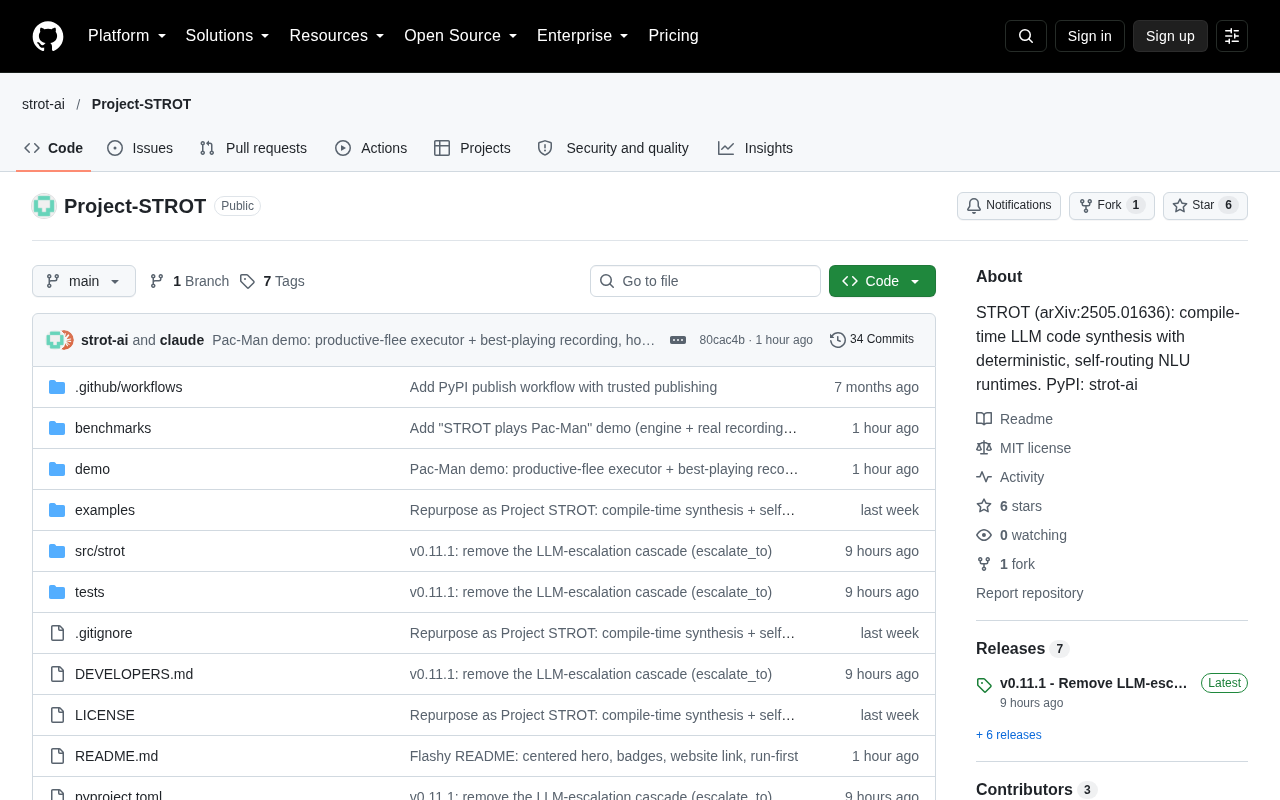
From "Inference Every Time" to "Compile Once"
The current mainstream LLM application model is "request-response": user input triggers model inference, and the model generates output. This model is flexible, but every decision incurs computational overhead and network latency. The core idea of Strot is that the decision logic in many business scenarios is actually relatively fixed—such as customer service ticket classification, content moderation rules, and transaction risk control judgments. Rather than having the LLM reason from scratch every time, it is better to extract the LLM's "intent" once and compile it into locally executable decision code or rule sets.
This is similar to the concept of "compilation" in traditional software engineering: once high-level language code is compiled into machine code, it can run efficiently without relying on the compiler. Strot attempts to "compile" the LLM's fuzzy judgments into deterministic local logic, thereby completely eliminating dependence on the model API at runtime.
Knowledge Distillation is a relevant technical background worth comparing here: it allows a smaller "student model" to learn the output distribution or intermediate representations of a large "teacher model," thereby reproducing most of the teacher's capabilities at lower inference cost. Strot's approach is similar but goes further—the product of distillation is still a neural network, and runtime still requires forward computation; while the "compilation-style" solution attempts to solidify capabilities into rules or lightweight classifiers, with almost no model inference at runtime. The common premise of both is: the teacher model's behavior on a specific task has summarizable regularity, otherwise compression or solidification will bring obvious accuracy loss.
Why This Direction Is Worth Watching
LLM inference cost has always been a bottleneck for scaled applications. Even as model prices continue to fall, the cumulative cost under massive requests remains considerable, not to mention the limitations of network latency on real-time decision scenarios. The "compilation-style" approach represented by Strot, if feasible, means that enterprises can invest LLM call costs once in exchange for long-term zero-marginal-cost local decision-making capability.
Another advantage is controllability. Locally compiled decision logic is deterministic, making it easy to audit, version-manage, and roll back. For heavily regulated industries such as finance and healthcare, deterministic decision paths are easier to pass compliance reviews than black-box model calls.
However, the challenges of this approach are equally obvious. Can the LLM's "intent" always be compiled completely and losslessly into rules? Real-world inputs vary greatly; how does the compiled logic handle out-of-distribution samples? These questions determine whether Strot-like solutions can move from demo to production.
Marginal cost is a key economic concept for evaluating this approach: it refers to the cost added for each additional request processed. When calling an LLM API, marginal cost grows linearly with request volume; once locally compiled decision logic is deployed, the marginal cost per execution is close to zero, with the main overhead shifting to one-time compilation and validation investment. Therefore, the economics of such solutions depend on the ratio of "number of repeated decisions" to "compilation cost"—high-frequency, patterned decisions amortize costs fastest, while low-frequency or long-tail scenarios struggle to recoup the investment. This also determines the priority ranking of Strot-like solutions in business selection.
Technical Implementation and Applicable Boundaries
Inferring from the project description, Strot may adopt a two-stage architecture of "intent extraction—logic solidification": first, the LLM analyzes input-output pairs to induce decision rules or small classifiers; then the rules are compiled into locally executable code. This is similar to knowledge distillation and rule learning, but emphasizes abstraction at the "intent" level.
Scenarios suitable for compilation usually have the characteristics of clear features and relatively stable decision boundaries, such as spam filtering, simple intent routing, and coupon distribution with fixed policies. Scenarios requiring complex reasoning, open-domain dialogue, or frequent policy changes are still better suited to direct LLM calls.
Out-of-Distribution (OOD) samples refer to inputs whose distribution differs significantly from the data seen during training or compilation. One of the LLM's major advantages is strong robustness to phrasing variations and rare combinations, while local logic composed of rules or small classifiers often fails near boundaries. Common engineering mitigations include: setting confidence thresholds for compiled logic and falling back to the LLM when confidence is low; continuously collecting online samples for regression evaluation; and maintaining a "shadow mode" where the LLM and local logic run in parallel to monitor deviations. This also explains why compilation-style solutions are better suited to scenarios with relatively closed input spaces.
Implications for Developers
Strot is currently just an early project on Show HN; 9 points and 1 comment indicate it has not yet been fully vetted by the community. But the question it raises is worth considering for every LLM application developer: in your business, how many decisions are repetitive and patterned? Are these decisions worth "compiling" once in exchange for long-term local execution efficiency?
At a time when LLM capabilities are iterating rapidly, the compilation-style approach offers a pragmatic path to cost optimization—not all intelligence needs real-time inference; some intelligence can be solidified and reused. This may become an important branch of LLM engineering.
One-line Summary
Strot proposes compiling LLM intent once into local decision logic to eliminate inference cost and latency.
Paragraph Summary
Strot is an early project showcased on Hacker News that advocates extracting LLM intent once and compiling it into locally executable decision code or rule sets, so that runtime no longer depends on the model API. The article analyzes the value of this "compilation-style" approach: significantly reducing inference cost and network latency under massive requests, and bringing deterministic, auditable, and easily rollbackable decision paths, beneficial for heavily regulated scenarios such as finance and healthcare. Its applicable boundaries are tasks with clear features and stable decision boundaries, such as ticket classification, spam filtering, and fixed-policy distribution; while complex reasoning and open-domain dialogue still require real-time model calls. The core challenge lies in whether intent can be losslessly compiled, and the adaptability of compiled logic to out-of-distribution samples.
Related articles

Chain of Thought Isn't Just for AI: How Humans Can Use CoT to Improve Thinking Quality
Chain of Thought isn't just a prompt trick for large models. Starting from a Hacker News discussion, this article analyzes why CoT works for human thinking too, breaks down actionable ways to transfer it, and highlights the key differences between human CoT and machine CoT.
Cloudflare Teams Up with OpenAI: Closi…
Cloudflare Teams Up with OpenAI: Closing the Loop from Vulnerability Discovery to Defense with AI
Cloudflare uses OpenAI Daybreak to investigate security vulnerabilities and generate reviewable remediation plans, while developers use Codex to boost coding efficiency and quality.

Orca Multi-Agent Orchestration in Practice: A Guide to Parallel Collaboration with Claude and Codex
Orca is Stable AI's free open-source agent workbench supporting 34 agents like Claude Code and Codex in parallel. Learn its Git worktree isolation, multi-model orchestration, and mobile management.