SUAF: How Spectral Universal Advantage Features Enable Zero-Shot Policy Improvement
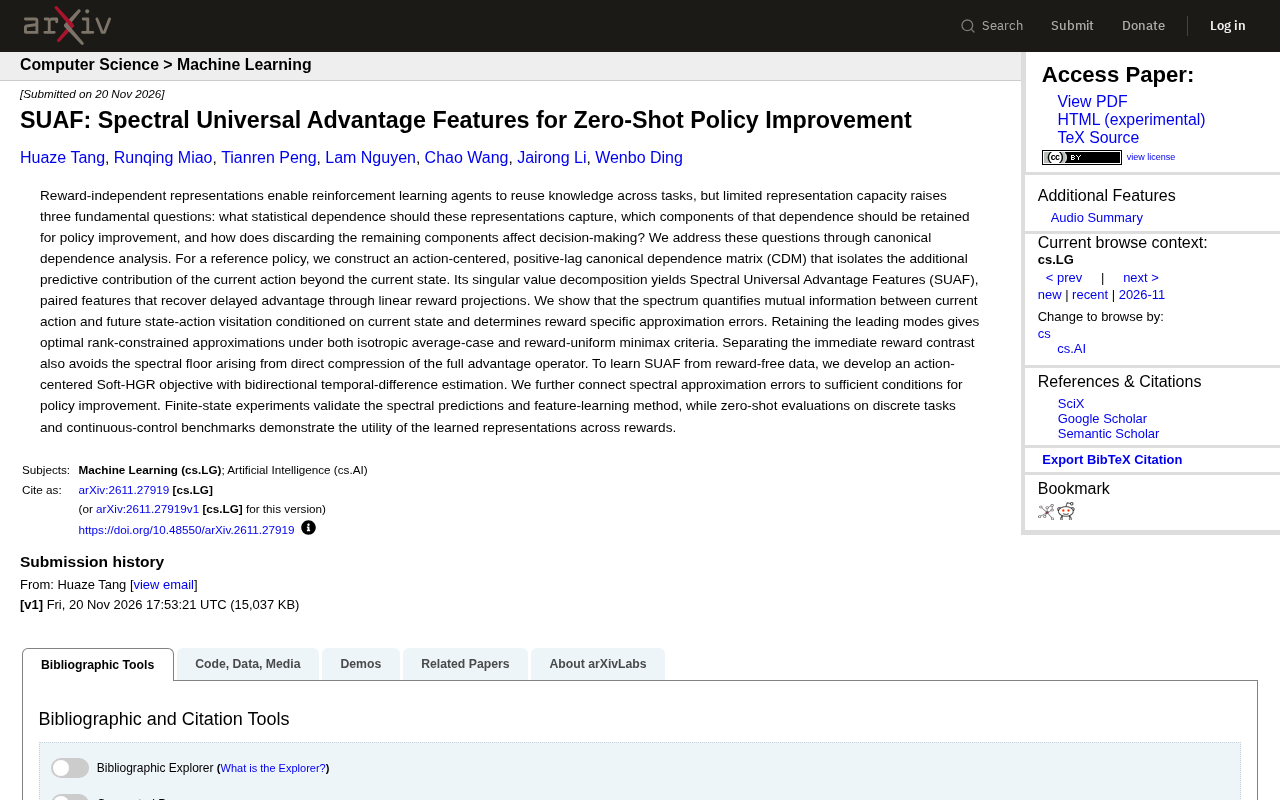
SUAF learns reusable policy-improvement features from reward-free data via spectral decomposition of an action-centered canonical dependence matrix.
This article interprets *SUAF: Spectral Universal Advantage Features for Zero-Shot Policy Improvement*. To address whether reward-independent representations can support zero-shot policy improvement, the authors propose an action-centered Canonical Dependence Matrix (CDM) that isolates the additional predictive contribution of the current action to the future given the current state, and obtain reward-decoupled Spectral Universal Advantage Features (SUAF) via SVD. The spectrum is proven to quantify mutual information between actions and future visitation distributions, with leading modes optimal for rank-constrained approximation under average-case and minimax criteria; separating immediate reward contrast avoids the spectral floor. An action-centered Soft-HGR objective with bidirectional TD estimation learns features from reward-free data, linking spectral error to sufficient conditions for policy improvement. Experiments on finite states and discrete/continuous control validate spectral prediction and cross-reward universality.
Can reinforcement learning agents learn representations that can be reused across tasks without relying on reward signals? This is the core challenge of zero-shot policy improvement. A study titled SUAF: Spectral Universal Advantage Features for Zero-Shot Policy Improvement offers a theoretically deep answer through canonical dependence analysis.

Starting Point: The Capability Boundary of Reward-Independent Representations
Reward-independent representations allow agents to reuse knowledge across tasks, but their capacity is limited, which raises three fundamental questions: What kind of statistical dependence should these representations capture? Which components of that dependence should be retained to serve policy improvement? And how does discarding the rest affect decision-making?
The researchers' entry point is this: for a reference policy, the information that is truly useful for policy improvement is not the entire statistical structure of the state itself, but rather the additional predictive contribution that the current action provides relative to the current state. This perspective shifts the problem from "state representation learning" to a fine-grained decomposition of action-state dependence.
Canonical dependence analysis is a family of methods in multivariate statistics for studying the dependence structure between two sets of random variables. A typical example is canonical correlation analysis (CCA), which finds linear combinations of two sets of variables that maximize their correlation. In the reinforcement learning context, researchers care about the dependence among states, actions, and future visitation distributions, rather than simple state-state correlations. SUAF generalizes this framework to the action-centered case and uses kernel methods (Soft-HGR) to characterize nonlinear dependence, thereby transforming "what should the representation retain" into "which set of canonical directions carries the most action-future mutual information." Understanding this point helps grasp why the paper uses spectral decomposition rather than an ordinary autoencoder to construct features.
Core Method: From CDM to SUAF
Around the above problem, the authors construct an action-centered, positive-lag Canonical Dependence Matrix (CDM). The key design of this matrix is to isolate "the additional predictive contribution of the current action to the future given the current state," rather than vaguely characterizing the joint state-action distribution.
Applying singular value decomposition to the CDM yields Spectral Universal Advantage Features (SUAF): paired features that can recover the delayed advantage through a linear reward projection. The "universal" aspect here is that the features are decoupled from any specific reward function and can therefore be reused under different rewards.
At the theoretical level, the researchers prove that this spectrum (the singular value spectrum) quantifies the mutual information between the current action and the future state-action visitation distribution given the current state, and determines the reward-specific approximation error. Retaining the leading modes yields the optimal rank-constrained approximation under both the isotropic average case and the reward-uniform minimax criterion.
One noteworthy detail: separating out the immediate reward contrast avoids the spectral floor problem that arises when directly compressing the full advantage operator. This explains why the action-centered design is not only intuitively reasonable but also necessary from a spectral analysis perspective.
Positive lag refers to the directional constraint in statistical dependence that "the past influences the future": the matrix only characterizes the predictive contribution of the current action to subsequent state-action visitation, and does not include the reverse influence of the future on the present. In time series and causal inference, ignoring lag direction can easily mistake contemporaneous correlation or reverse causality for exploitable predictive structure. SUAF's CDM adopts positive lag to ensure that the decomposed features correspond to the information truly needed for policy improvement—namely, "how the future will change after taking a certain action"—rather than the stationary correlation of the state sequence itself. This is also the prerequisite for its spectrum to establish a correspondence with delayed advantage.
The spectral floor problem refers to the following: when directly performing low-rank compression on the full advantage operator, the immediate reward contrast term often corresponds to a singular direction with a large numerical value but little relevance to long-term policy improvement. It occupies the position of the leading mode, pushing the truly useful delayed advantage information into the low-singular-value region and forming a "floor" that is difficult to cross. Separating the immediate reward contrast from the operator is equivalent to first subtracting this dominant but uninformative component and then performing spectral truncation on the remainder, so that the retained leading modes truly correspond to reusable delayed structure. This explains the necessity of the action-centered design at the spectral analysis level, not merely as modeling intuition.
Learning SUAF from Reward-Free Data
Theoretical elegance does not guarantee practicality. To actually learn SUAF from reward-free data, the authors propose an action-centered Soft-HGR objective together with bidirectional temporal-difference estimation. Soft-HGR (Soft Kernel Generalized Variance) is a criterion for measuring nonlinear dependence; after action-centering, it corresponds exactly to the statistical dependence structure characterized by the CDM.
Furthermore, the study links spectral approximation error to sufficient conditions for policy improvement—meaning that how many modes the features retain and how large the approximation error is can be directly mapped to the judgment of "whether the policy can still be guaranteed to improve," rather than relying solely on empirical tuning.
Soft-HGR (Soft Kernel Generalized Variance) is a soft-max version of Kernel Generalized Variance (KGV), used to measure nonlinear statistical dependence between two sets of variables. HGR characterizes dependence strength through the generalized eigenvalues of kernel matrices, and its value is related to an upper bound on the mutual information between the two sets of variables; Soft-HGR replaces the hard maximum with softmax, making the objective differentiable and amenable to stochastic gradient optimization, and can output a set of canonical directions ranked by dependence strength. After action-centering Soft-HGR, its optimal solution corresponds exactly to the leading singular directions of the CDM, so it can serve as a computable surrogate objective for estimating SUAF from samples without explicitly constructing the full CDM.
Experimental Validation: From Finite States to Continuous Control
The experiments are organized at three levels. Finite-state experiments verify the correctness of the spectral prediction and the feature learning method—that is, the spectral behavior of the actually learned features is consistent with theoretical predictions. Zero-shot evaluation is then conducted on discrete tasks and continuous control benchmarks, demonstrating the universality of the learned representations under different rewards: the same set of SUAF features can support policy improvement without retraining for new rewards.
The significance of this result is that it elevates "reward-independent representation" from an empirical representation learning trick to a framework backed by spectral theory, with interpretable approximation error, and linked to policy improvement guarantees.
Practical Implications and Limitations
For readers interested in AI applications and frontier research, the value of SUAF lies mainly in two points. First, at the methodological level: using canonical dependence analysis to decompose "the additional contribution of actions" provides an analyzable objective function for representation learning, rather than black-box contrastive learning. Second, at the engineering level: decoupling features from rewards means that in multi-task environments or environments where rewards change frequently, the same representation can be reused, reducing repeated training costs.
That said, current validation is concentrated on finite-state experiments and standard benchmarks. The stability of spectral estimation in real high-dimensional scenarios and the computational cost of the Soft-HGR objective remain questions to be answered before large-scale application. The original paper does not provide quantitative conclusions on these aspects, and readers should remain cautious when referring to them.
One-line Summary
SUAF uses the spectral decomposition of an action-centered canonical dependence matrix to learn policy-improvement features from reward-free data that can be reused across tasks.
Paragraph Summary
This article interprets SUAF: Spectral Universal Advantage Features for Zero-Shot Policy Improvement. To address the question of whether reward-independent representations can support zero-shot policy improvement, the authors propose an action-centered Canonical Dependence Matrix (CDM) that isolates the additional predictive contribution of the current action to the future given the current state, and obtain reward-decoupled Spectral Universal Advantage Features (SUAF) via singular value decomposition. They theoretically prove that this spectrum quantifies the mutual information between actions and future visitation distributions, and that retaining the leading modes yields the optimal rank-constrained approximation under both average-case and minimax criteria; separating the immediate reward contrast avoids the spectral floor problem. For practicality, the authors propose an action-centered Soft-HGR objective and bidirectional temporal-difference estimation to learn features from reward-free data, and link spectral approximation error to sufficient conditions for policy improvement. Finite-state experiments and zero-shot evaluations on discrete/continuous control verify the correctness of the spectral prediction and the cross-reward universality of the features.
Related articles

Prospero: A Lightweight Native AI Coding Tool Built with ImGui
Prospero is a bloat-free native AI coding tool built with ImGui, emphasizing lightweight design, high performance, and low dependencies. This article analyzes its design philosophy, technical choices, and the divergence between platformization and toolization in AI coding tools.

WebRTC Abused: New Variant of Credit Card Skimming Scripts on Shopping Sites
Security researchers found skimming scripts on popular shopping sites using WebRTC data channels to exfiltrate credit card data. This article analyzes the technical原理, differences from traditional Magecart attacks, and defense strategies for e-commerce platforms in third-party script governance and CSP policies.

Single GB10 Card Hits 101 tok/s: Inkling 2 Mini Performance Tested on vLLM
A developer shared on Hacker News running Inkling 2 Mini with vLLM on a single GB10 at 101 tok/s. This article analyzes the technical context, the significance of vLLM with small models on single cards, and caveats for interpreting tok/s metrics.