SubQ Snap Review: Decision Model Benchmarks and the Truth Behind the Price War
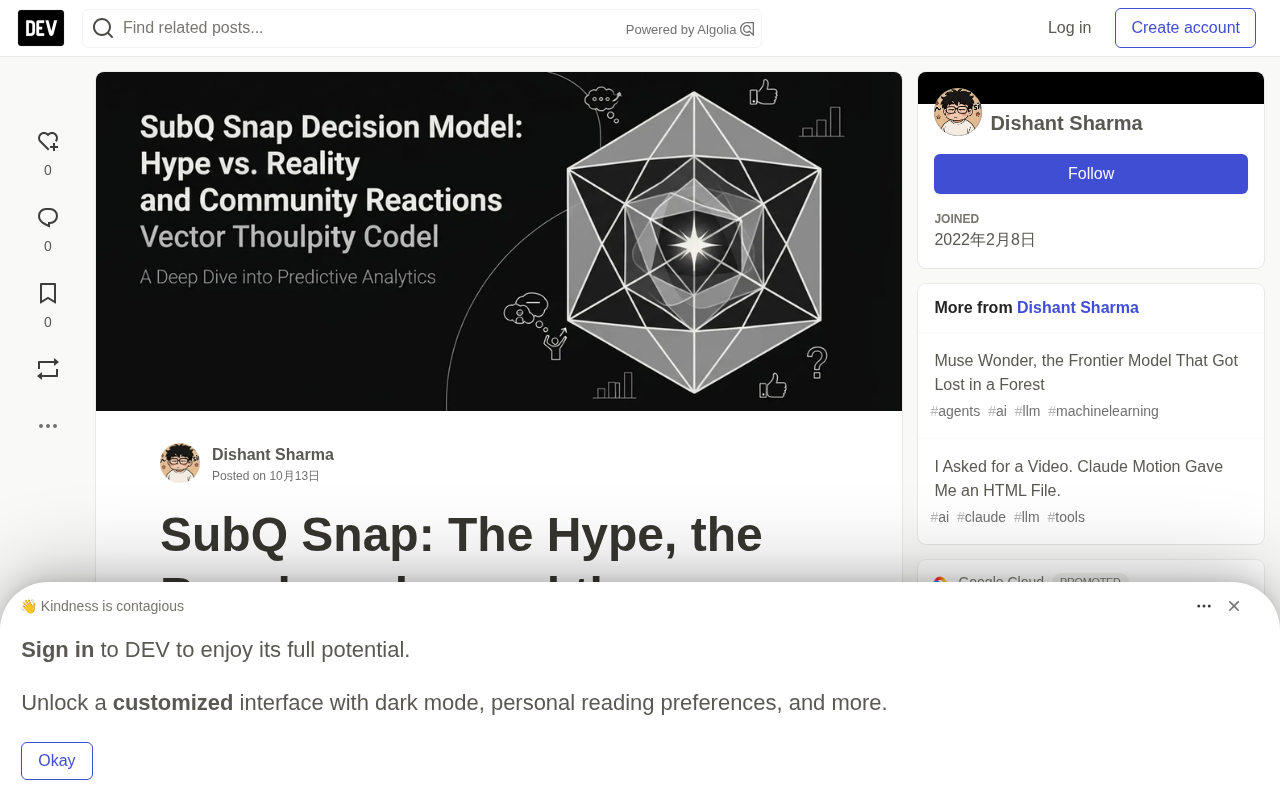
SubQ Snap's launch split signals across platforms; the decision model market is hot but unverified.
This analysis examines the sharply different reactions to Subquadratic's decision model SubQ Snap on Hacker News versus LinkedIn. Snap scores predefined answers rather than generating text, using Subquadratic Sparse Attention to cut attention complexity from quadratic to linear with 384K context and ~1s latency at 5 cents per million input tokens. However, all benchmarks are self-reported, the headline 96.3 score runs on 1M context while the product only supports 384K, and Snap loses to competitors on When2Call. With six decision models launching in three weeks and prices dropping to cents, the author argues routing logic and workflow — not the model — are the real moat.
A model called SubQ Snap has been released. On Hacker News, its launch post sat for hours with just 7 upvotes and 1 comment — and that comment was a rhetorical question: "Doesn't OpenAI's Decision API already support 1M context on Luna?" On LinkedIn, the same launch pulled 220 reactions and 39 comments within 14 hours, with corporate accounts enthusiastically announcing "we released a new model today."
The same product, the same day, two platforms reading completely different signals. This analysis tries to figure out: which side is right.
The conclusion: both are right, and neither is entirely right.
What exactly is a decision model
SubQ Snap comes from research outfit Subquadratic. It doesn't generate text — it only makes choices. You send it context, a question, and a set of allowed answers, and it returns a probability for each answer. No open-ended output.
That constraint is its business logic: no token generation, no per-token billing. Scoring fixed answers is fast, and speed means everything in agent scenarios — which file matters, which tool to call next, whether a test passed. These judgments happen constantly.
Subquadratic lists four responsibilities for Snap: routing, tool selection, verification, and stopping. A clean list — but you could build the same thing today with a regular LLM plus carefully crafted prompts. Nobody mentioned that in the launch materials.
Ironically, the model lost to a competitor on the When2Call test — 67.0 versus 74.6. That test measures exactly "should I call a tool, ask a question, answer, or refuse" — one of the four duties Snap is built for. The guy in charge of deciding whether to act isn't the best at this particular decision.
Decision Model is a category of specialized model distinct from generative LLMs: instead of producing free-form text, it computes a probability distribution over a given set of candidate answers — essentially a constrained classifier/scorer. The paradigm already has industry precedents — OpenAI's Decision API, Perplexity Decider, and others fall into this category. Its commercial value lies in the fact that, since it doesn't generate tokens, inference cost can be priced by input length rather than output length, with extremely low latency (typically milliseconds). The canonical use case is the "what should I do next" step in an agent loop — which sub-agent to route to, which tool to call, whether a result passes verification, whether to stop. Each such judgment needs only one discrete answer, and using a generative LLM to "write out" that answer is both slow and expensive — hence decision models entering as a specialized form factor.
The context wall and the pricing war
The real problem isn't the answer — it's the input. The next correct call might depend on a constraint from forty turns ago, the definition of a function buried deep in a codebase, or a clause on page nine of a contract.
Standard Transformer attention is quadratic: double the context, quadruple the compute. That's why decision models have stayed small. Jev does 64K per request with a 32K state, Microsoft's model runs at 32K — they're making decisions without seeing most of the critical information.
Snap's answer is Subquadratic Sparse Attention (SSA), which drops cost from quadratic to linear, letting it read an entire code repository or contract in one pass. Subquadratic claims 100K tokens returned within 1 second, but there's no hardware specification for that number and no third-party verification. The architecture is genuine research, not a wrapped API.
But the price war is the most glaring part of this market. Six managed decision models launched in three weeks: Jev, Perplexity's Decider, Cloudflare's Clef, OpenAI's Decisions API, Microsoft's Decision-1, plus SubQ Snap. Prices have slid to cents per million input tokens.
| Model | Price per million input tokens | Context |
|---|---|---|
| Perplexity | $0.04 | ~262K |
| Microsoft Decision-1 | $0.042 | 32K |
| Jev | $0.042 | 64K |
| SubQ Snap | $0.05 | 384K |
| OpenAI (gpt-6-luna) | $0.10 | n/a |
| Cloudflare Clef | $0.24 | 64K |
When a market moves at this speed, the model itself isn't the moat. The workflow is. The winner owns the routing logic, not a vendor contract.
Quadratic attention and sparse attention: In a standard Transformer, self-attention computes the relevance of every token to every other token, so for a sequence of length N, both compute and memory are O(N²). When context goes from 32K to 384K, theoretical compute rises roughly 144x — this is precisely the hard constraint that kept decision models at 32K-64K for so long. Subquadratic Sparse Attention (SSA) works by having each token attend only to a subset of key tokens, bringing complexity down to near-O(N) linear. Similar approaches include Longformer, BigBird, FlashAttention (which optimizes the constant factor), and Mamba/SSM. But sparse attention usually comes at some cost in accuracy, and whether it can avoid degradation on long-context downstream tasks is precisely the part of such architectures most in need of independent verification.
The asterisks in the benchmarks
The official charts look great. Decision Index 0.2.1 drops from 61.7 to 57.9, long-document test goes from 74.0 to 48.0 (direction of these numbers to be confirmed). Snap leads on 13 of 16 enterprise tasks, phishing detection jumps from 25.1 to 47.1, code output prediction rises from 57.1 to 73.8.
But every single number comes from Subquadratic itself — no external lab has run Snap. The long-context tests are their own modified versions of RULER and LCR. More critically, that 96.3 — the headline score — is called Decision RULER and runs on 1M token context, while the product itself only supports 384K.
They published a benchmark the product can't actually accept.
These numbers should be treated as a résumé, not an audit report. Everything self-reported, compared against a single opponent, using vendor-modified tests. The day an independent leaderboard runs its own evaluation, the numbers will change.
RULER and LCR are two widely cited benchmarks in long-context evaluation. RULER, proposed by NVIDIA and other institutions, covers synthetic tasks like needle-in-a-haystack, multi-needle retrieval, and variable tracking, testing a model's ability to locate and integrate information across very long contexts; LCR (Long Context Retrieval)-style tests focus on retrieval precision. Vendors "modifying" benchmarks is common practice, but scores from modified versions can't be directly compared to public leaderboards — difficulty, data distribution, and scoring criteria can all differ. This is why the industry emphasizes "third-party reproduction": when an organization runs its own modified RULER to get 96.3, on 1M context (while the product only supports 384K), the reference value of that number drops sharply.
Kidney cats and peptide serums
A funny discovery during research: search "subq snap" on Reddit, and the model doesn't appear at all. What shows up is forums about subcutaneous fluids for cats with kidney failure, reviews of SNAP-8 peptide anti-wrinkle serum, and threads about spring-loaded syringes.
"subq" is the medical abbreviation for "subcutaneous." The company named its product with a medical abbreviation plus a snack brand word, then dropped it into the AI hype storm. For a while, anyone Googling this model saw cat bodily fluids and skincare advice. In a way, that's honest.
Most people don't need a decision model
At least not yet. If your agent makes only a few hundred calls a day, routing with a cheap LLM is good enough. The complexity you add to save a few cents is complexity you'll maintain forever.
And even if you do need one, don't build on a public preview with a waitlist on day one — the model ID literally reads subq-snap-preview. That's not a stability commitment, that's a warning.
The only thing that would make Snap worth taking seriously is a real repository test: an agent reads its own codebase, picks files, checks results, and hands over the bill. A week of that beats any chart in a launch post.
Snap is real engineering, SSA isn't a wrapper, and 384K context returned in 1 second is genuinely interesting. But three weeks ago, everyone else was interesting too. The lead changes hands constantly — being "first" is a memo, not a moat.
One-line Summary
SubQ Snap's launch split signals across two platforms; the decision model market is fiercely competitive but under-verified.
Paragraph Summary
This article analyzes the sharply different reactions to Subquadratic's decision model SubQ Snap on Hacker News versus LinkedIn, arguing both sides are partially right. Snap doesn't generate text — it scores predefined answers, focusing on four judgment types: routing, tool selection, verification, and stopping. It uses Subquadratic Sparse Attention to reduce attention complexity from quadratic to linear, supporting 384K context, ~1 second latency, and 5 cents per million input tokens. But the article notes: all benchmarks are self-reported with no third-party verification, the headline 96.3 score runs on 1M context while the product only supports 384K, and Snap loses to a competitor on When2Call. With six decision models emerging in three weeks and prices falling to cents, the author argues the model itself isn't the moat — routing logic and workflow are — and most teams don't need a decision model yet.
Related articles

Gmod TTT: Boba's Winning Streak and Game Design Insights
An in-depth analysis of Gmod TTT's role system, creative items, and social gameplay mechanics, exploring the relationship between randomness design and game balance through Boba's winning streak phenomenon.

FlexBudget: Fair Comparison of KV Cache Eviction Strategies Under a Unified Compute Budget
AMD engineer proposes FlexBudget at PyTorch Conference: a training-free fair comparison method for KV cache eviction rules using fixed kernels and memory budgets, all in core PyTorch.
