SUDARI: The Pixel Otter Desktop Pet That Responds to Your Work Rhythm
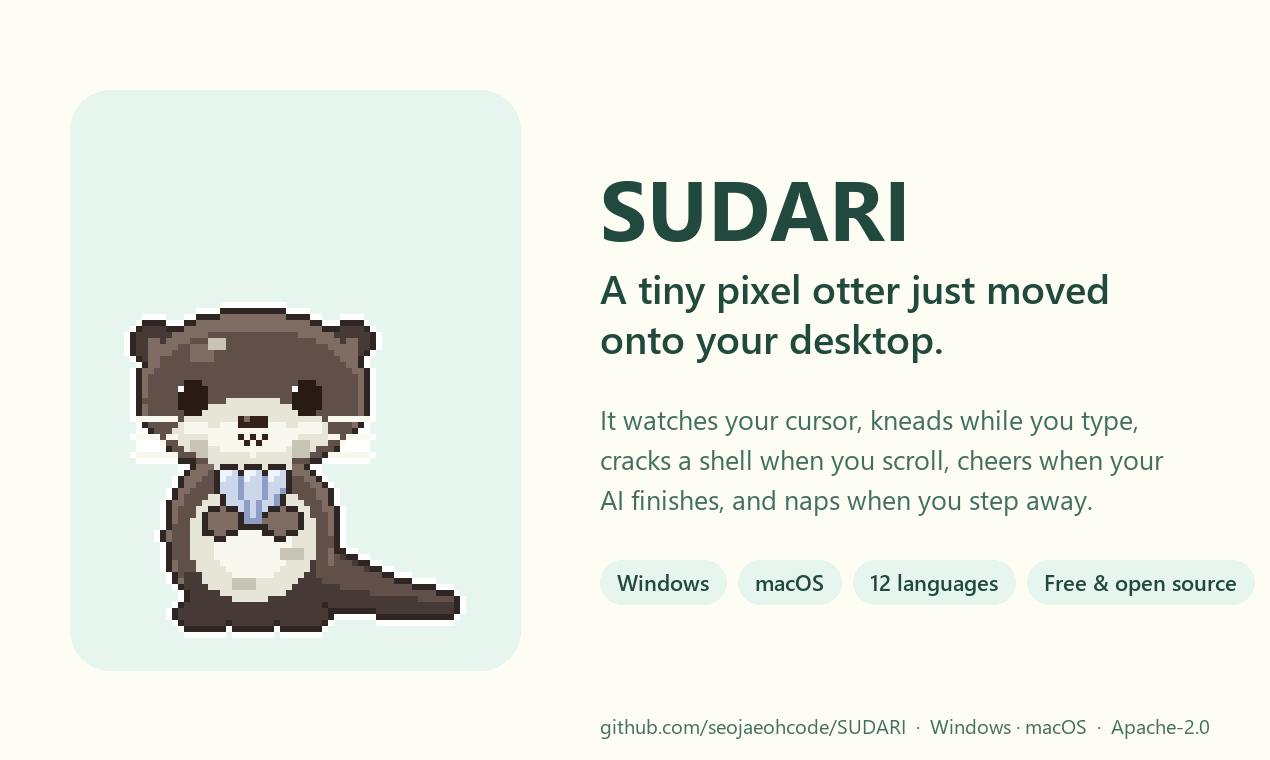
SUDARI is a free, open-source pixel otter desktop pet that reacts to your typing, scrolling, and AI tasks.
SUDARI is an open-source desktop pet project featuring a pixel-art otter that blends companionship with practical utility. It tracks your cursor, taps a mini keyboard as you type, cracks shells while you scroll, and includes a shell-shaped Pomodoro timer, health reminders, and cheers when your AI agent finishes a task. It supports Windows and Mac, 8 coat colors, and 12 languages — completely free, open source, no account required, and zero telemetry.
A Pixel Otter Living on Your Desktop
As productivity tools grow increasingly cold and transactional, an open-source project called SUDARI is taking a different path — placing a pixel-art otter on your desktop and making it react to the way you work. Created by developer Jacob, the project reached #17 on the Product Hunt leaderboard with 64 upvotes, tagged under Productivity, Open Source, Pets, and GitHub.
Unlike most function-driven desktop tools, SUDARI's core appeal is companionship. It's not here to complete a specific task for you — instead, it enriches the long, solitary stretches of work through continuous micro-interactions, adding a bit of warmth and playfulness to your day.
What It Actually Does
What makes SUDARI genuinely interesting is that its behavior is tied to your actual actions. According to the official description, the little otter will:
- Follow your cursor and blink in real time: Its gaze tracks your mouse, and it blinks at random intervals, creating the illusion that it's truly alive.
- Tap a mini keyboard: When you type, the otter kneads a tiny keyboard beside you, its movements synced to your input.
- Crack open a shell while you scroll: Scrolling through a page triggers the otter to crack open a small shell, turning everyday actions into little Easter eggs.
- Shell-shaped Pomodoro timer: A built-in Pomodoro countdown timer that launches a fireworks display when the session ends.
- Health reminders: Gentle nudges to drink water, stretch, and eat — helping combat the fatigue of prolonged sitting.
- Cheer when your AI agent finishes a task: When your AI agent completes a job, the otter applauds for you — a small but thoughtful nod to AI-era workflows.
- Randomly say "I love you": The occasional emotional pick-me-up, delivered at unpredictable moments.
Underpinning all of this are 17 hand-crafted animations paired with a pixel art aesthetic — the attention to detail is genuinely impressive.
The "cheer when AI agent finishes a task" feature deserves a brief explanation. An AI agent refers to an AI program capable of autonomously executing a series of steps to complete complex tasks — such as browsing the web, calling tools, writing and running code, and more — as opposed to a single-turn conversational AI exchange. As tools like Cursor, Claude, and AutoGPT become more widespread, a growing number of developers and creators run agent tasks locally and wait for them to complete. SUDARI listens for this "task completed" event and responds with a celebration, essentially visualizing the abstract progress of an AI workflow as a warm, tangible moment of interaction — giving a long wait a clear emotional anchor point.
The Pomodoro Technique is a time management method developed by Francesco Cirillo in the late 1980s: work is divided into focused 25-minute intervals (called "pomodoros"), followed by a 5-minute break, with a longer break after every four pomodoros. It's widely used to combat procrastination and sustain focus. SUDARI's shell-shaped timer and fireworks animation on completion are a textbook example of blending functional tools with visual reward mechanics — using immediate positive feedback to reinforce the habit of sticking with the method.
Customization and Cross-Platform Support
On the personalization front, SUDARI offers 8 coat colors, letting you pick an otter that matches your aesthetic. Language support spans 12 languages, lowering the barrier for non-English speakers.
Platform-wise, it runs on both Windows and Mac, covering the primary environments of most creators and developers. For users who've integrated AI agents into their daily workflow, the "task completion cheer" feature is a genuinely fitting touch.
Free, Open Source, and Zero Tracking
SUDARI's stance on privacy and cost is worth highlighting on its own: it's completely free and open source, requires no account registration, and collects zero telemetry data. As the team puts it, "It's just an otter."
At a time when desktop apps routinely embed analytics and account binding, this "zero overhead" positioning becomes a genuine differentiator. For privacy-conscious users, and for developers curious about how it works under the hood, being open source means the code is auditable, modifiable, and self-deployable.
Telemetry refers to the mechanism by which applications automatically collect and report usage data — often without users being fully aware — including things like feature click frequency, crash logs, system environment details, and even behavioral pathways. Many free desktop tools rely on telemetry data to improve their products or support their business models, but this also means users' local behavior is, to some extent, continuously recorded. SUDARI explicitly states it collects no telemetry whatsoever, and with the code open and auditable, users can verify this claim themselves rather than simply taking the developer's word for it. For anyone running a background process on a work machine long-term, this matters.
A Few Observations
SUDARI is a quintessential "emotional value" desktop tool. It doesn't aim to improve any hard efficiency metric — instead, it enhances the work experience through companionship and micro-interactions. The value of this kind of product is deeply personal: those who connect with it will find it charming and therapeutic; those who don't may see it as nothing more than an animated widget on their screen.
That said, integrating health reminders, a Pomodoro timer, and AI task feedback into an endearing little character is a genuinely thoughtful approach to fusing practical utility with emotional design. Coupled with its free, open-source, and tracking-free positioning, it holds real appeal for independent developers, creators, and remote workers. Those who want to try it can grab it directly from the open-source repository.
Related articles
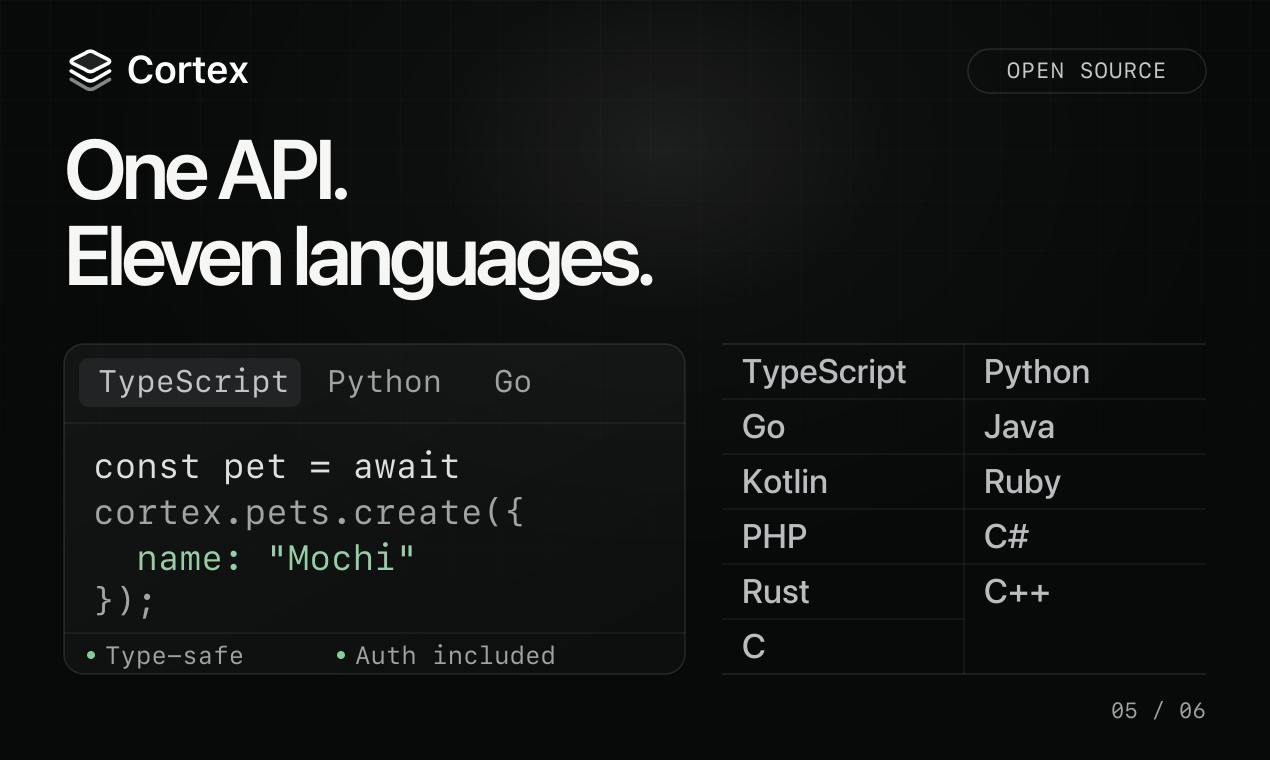
Cortex: Convert API Specs into Docs, SDKs, and MCP Servers in One Click
Cortex is an open-source tool that converts OpenAPI, GraphQL, gRPC and more into interactive docs, typed SDKs in 11 languages, and MCP servers for AI agents.

ABrush: An AI Studio Built for Digital Artists
ABrush is an AI studio for digital artists, ranked #4 on Product Hunt. It embeds leading AI models into existing workflows to remove repetitive tasks, speed up iteration, and keep artists in control.
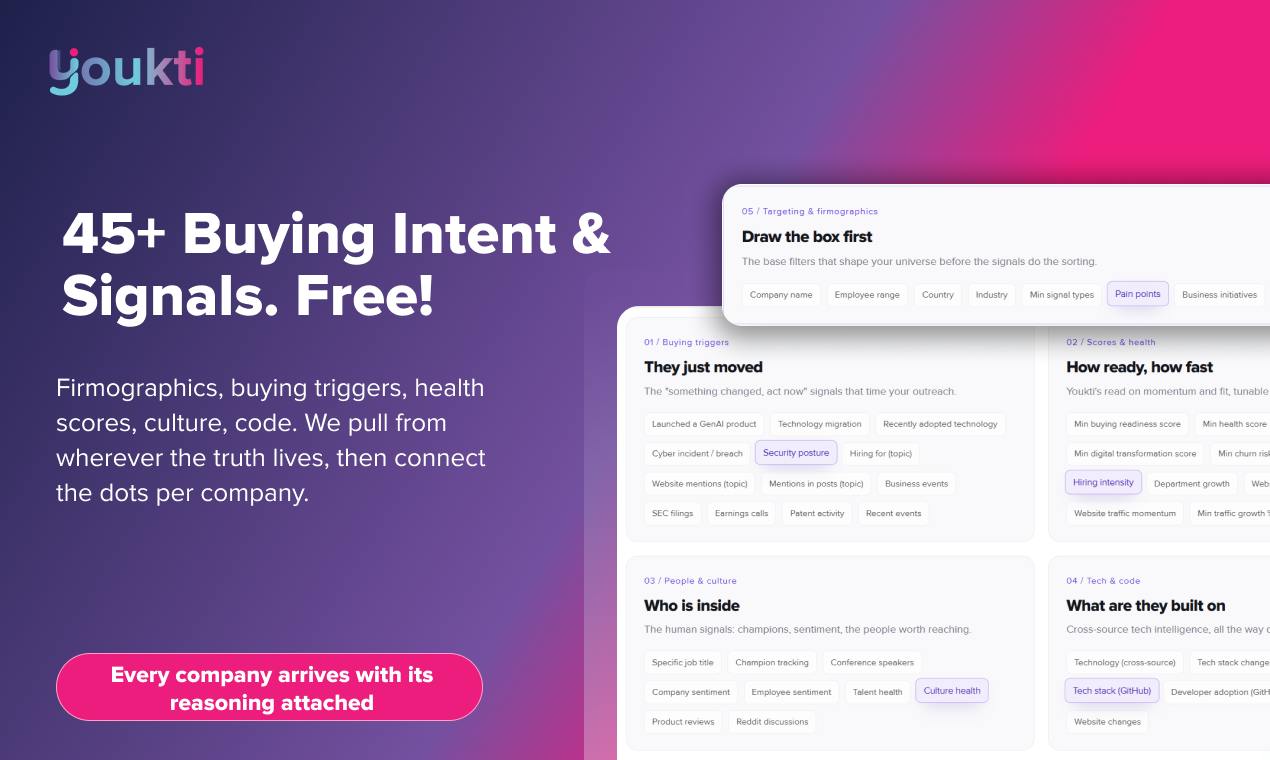
Youkti: An AI That Remembers Every Deal and Tells Your Sales Team What to Do Next
Youkti is an AI sales assistant that hit #2 on Product Hunt. It remembers every account, conversation, and deal — then tells your team exactly what to do next. Contact data, buying signals, and intent data are all free.