SUN Web & API: One-Click Audio Generation from Prompts and PDFs

SUN Web & API generates scenario-based audio from prompts or PDFs via web and API.
SUN Web & API is an audio generation product on Product Hunt that lowers the barrier to generating audio. Users can enter prompts or upload PDFs on the web, choose voice, language, and length to create podcasts, audio courses, audiobooks, stories, meditation, or music; developers can integrate the capability via API. PDF as a first-class input is its underestimated entry point, testing document parsing and content restructuring. The product positioning is clear and the entry point is simple, but audio quality, document parsing robustness, and community content volume remain key challenges.
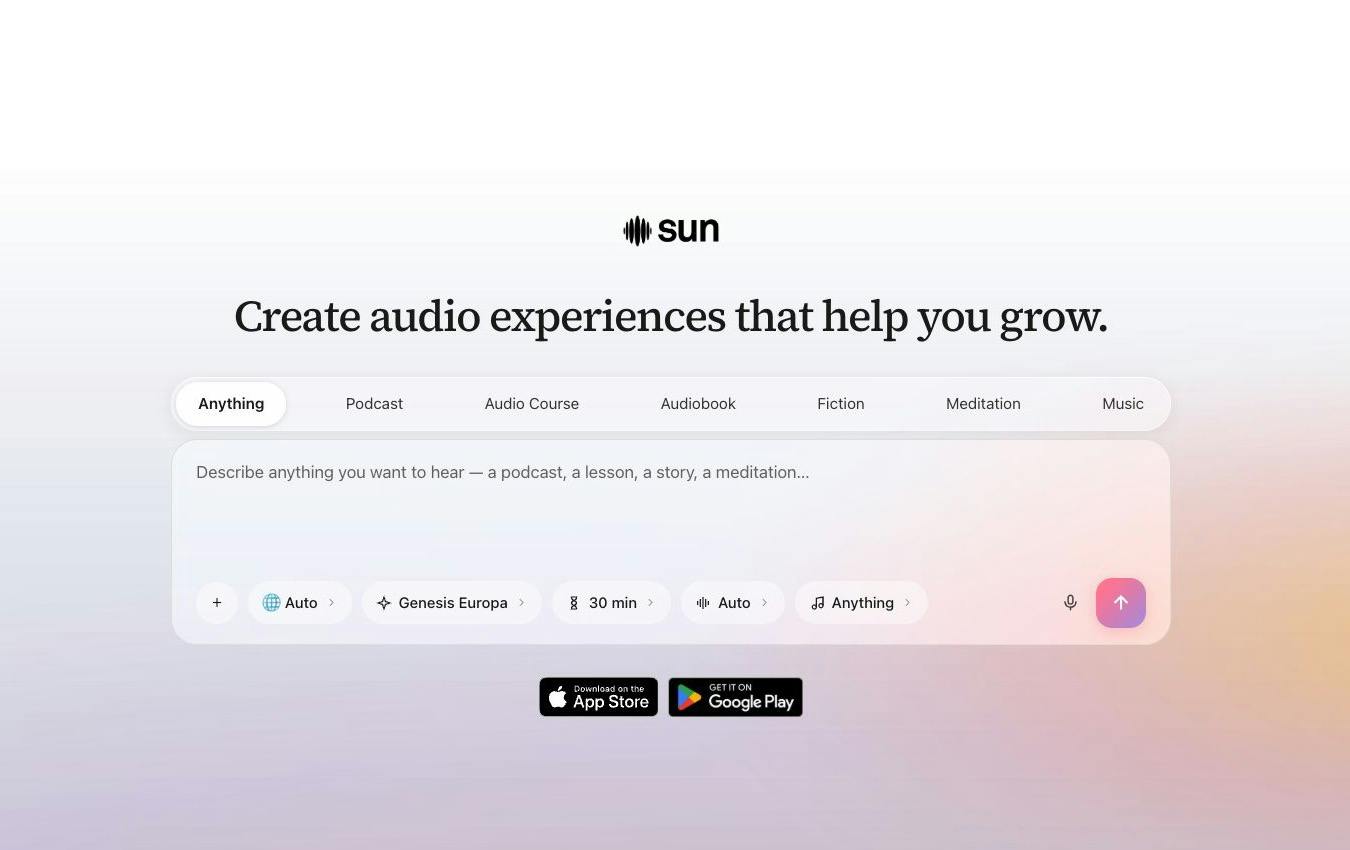
On Product Hunt, a product called SUN Web & API tries to answer a question: if you lower the barrier to "generating audio" as much as possible, what should it look like? Its tagline is straightforward—"Turn prompts and PDFs into audio, on the web or via API." In other words, you drop in a prompt or a PDF, and it spits out audio. It looks simple, but the scenarios it targets actually cover podcasts, audio courses, audiobooks, stories, meditation guides, and even music.
The product has 71 upvotes and ranks #15, falling under the API, Education, and Artificial Intelligence categories, with Artin Bogdanov as the maker. The numbers aren't explosive, but the positioning is clear: it's not just a standalone tool, but an audio generation entry point aimed at both ordinary users and developers.
From Web to API: Two Usage Paths
The core of SUN's launch is the parallel "Web experience + API" dual track. On the web, users can directly enter a prompt or upload a PDF, then choose voice, language, and length to generate the desired audio content. The output formats mentioned in the official description include podcasts, audio courses, audiobooks, stories, meditation, and music—covering multiple dimensions from knowledge transfer to atmosphere creation.
The API side is more interesting. Developers can embed audio generation capabilities into their own applications without having to build an entire speech synthesis pipeline from scratch. The product categories include both Education and API, indicating that its target is not just C-end experimentation but also B-end batch production and integration needs. For teams working on online education, content platforms, or assistive tools (such as accessible reading), the PDF-to-audio capability has direct practical applications.
The API mentioned in this article refers to an Application Programming Interface, a set of conventions that allows different software systems to call each other's functions. For an audio generation product, providing an API means developers don't need to understand the underlying speech synthesis model—they simply send requests according to the documentation (such as passing in text or files, specifying voice and language parameters) to obtain generated audio files in their own applications. This model decouples "capability" from "interface": C-end users use it through the web, while B-end teams embed the same capability into education platforms, reading tools, or content management systems via the API, thereby covering batch generation and automated workflow needs.
PDF to Audio: An Underestimated Entry Point
Turning PDFs into audio sounds like an extension of "text-to-speech," but the actual experience differs in structure. A PDF may contain chapters, paragraphs, heading hierarchies, and even figure captions. If the generator simply reads line by line, the result will be very stiff. SUN treats PDFs as a first-class input, implying that it has done work on document parsing and content restructuring—at least at the product level, it wants users to get audio that is "listenable" rather than a stream of text that is "read out loud."
The real demand for this capability is not small: students want to convert course materials into audio to listen to during their commute, professionals want to turn industry reports into podcast-style summaries, and creators want to quickly turn manuscripts into audiobook samples. SUN unifies these scenarios into one entry point, using the three parameters of "choose voice, language, and length" to contain complexity—a pragmatic approach.
The technical difficulty of PDF-to-audio lies mainly in document structure parsing. A PDF is essentially a layout description format, not a semantic document format—it records the coordinate positions of text on the page, not the logical hierarchy of paragraphs and headings. Therefore, converting a PDF into audio suitable for listening requires first performing layout analysis (identifying blocks such as headings, body text, footnotes, tables, and figure captions), then reordering the reading sequence, and finally entering the text-to-speech stage. If the parsing step goes wrong, the read content may appear out of order, tables may be read cell by cell, and headers and footers may be mixed into the body text. This is why "reading a PDF aloud" seems simple but is actually much more complex than plain text TTS.
Scenario-Based Attempts at Audio Generation
There is one word worth noting in the official description: "explore public audio." This means SUN is not just a generation tool but also has a bit of community or discovery flavor—users can browse public audio content. For an audio generation product, this step is moving toward a "content pool" direction rather than staying at "single generation."
The span of generation types is also worth mentioning. Podcasts and audio courses lean toward information density, audiobooks and stories lean toward narrative, and meditation and music lean toward emotion and companionship. These formats actually have different requirements for speech: the former needs clarity and rhythm, while the latter needs tone and atmosphere. SUN allowing users to choose voice and length is, to some extent, handing the power of "tuning" back to users rather than using one set of presets to rule them all.
Opportunities and Challenges for This Type of Product
From a product positioning perspective, SUN is stepping on a heating intersection: the growth of audio content consumption plus the democratization of AI generation capabilities. Its advantage lies in a simple entry point—prompt or PDF, choose one; at the same time, it provides an API so the capability can spill over into other products. This "light frontend + heavy backend" combination is suitable for rapid scenario validation.
The challenges are also obvious. The quality of audio generation depends heavily on speech naturalness and content understanding, and "PDF to audio" especially tests the robustness of document parsing. In addition, the public audio exploration feature needs content volume and recommendation mechanisms to support it, otherwise it can easily become an empty shell. The initial heat of 71 votes shows it has been seen, but the real test is whether the first batch of user-generated audio is "worth listening to until the end."
For those following AI audio tools, SUN is worth adding to the watchlist. It strings together the three keywords of prompts, PDFs, and API. The idea isn't new, but the combination is direct enough. Whether it can stand firm among the many speech synthesis products depends on how finely tuned those three parameters—voice, language, and length—really are behind the scenes.
Text-to-speech (TTS) is the core underlying technology of audio generation, and its quality evaluation usually focuses on several dimensions: naturalness (whether rhythm, pauses, and intonation are close to a real person), intelligibility (whether pronunciation is accurate and clear), voice consistency (whether the voice remains stable in long texts), and emotional expressiveness (whether the tone can be adjusted according to the content). In recent years, TTS models based on neural networks have made significant progress in these dimensions, but long-document reading still easily suffers from flat prosody, misreading of polyphonic characters, and improper handling of numbers and proper nouns. For products like SUN, the frontend interaction can be extremely minimal, but whether users are ultimately satisfied still depends on how the underlying speech model performs on real documents.
One-line Summary
SUN Web & API takes prompts or PDFs as input and provides scenario-based audio generation through both web and API channels.
Paragraph Summary
SUN Web & API is an audio generation product on Product Hunt, with the core idea of lowering the barrier to "generating audio." Users can enter prompts or upload PDFs on the web, choose voice, language, and length, and generate audio content such as podcasts, audio courses, audiobooks, stories, meditation, or music; developers can integrate this capability into education, content platforms, and other applications via the API. The article argues that PDF as a first-class input is its underestimated entry point, testing document parsing and content restructuring capabilities; while the "browse public audio" feature suggests the product is extending toward a content pool. The product positioning is clear and the entry point is simple, but audio quality, document parsing robustness, and community content volume remain its main challenges.
Related articles

RePlan-VLA: Progress-Aware Replanning Breakthrough for Long-Horizon Robotic Manipulation
The RePlan-VLA framework converts VLA models' short-horizon capabilities into reliable long-horizon execution through progress-aware adaptive replanning, improving success rates by 21.9% and 10.4% on RoboCasa365 and CALVIN, and validating real-world deployment on a Franka Research 3 robot.

Geometric Bridge Flow Matching: A New Breakthrough in Blind Rigid Motion Correction
Geometric bridge flow matching enables blind rigid motion correction in head CBCT, achieving 37.1 dB PSNR and 0.27 mm RPE on simulated data in ~9.1 minutes, outperforming existing methods.

Google Releases Gemini 4 Hydrogen: 2.5x Faster Without Sacrificing Intelligence
Google releases the lightweight Gemini 4 Hydrogen: 2.5x faster task completion, AA Intelligence Index of 54 beating its flagship sibling, 7.3s single-step on Agent Arena faster than Claude and GPT rivals, four thinking levels with pay-as-you-need pricing, now available across AI Studio and more.