Superagent Open-Source AI Coding Assistant: A Fresh Approach to Giving Agents a Computer

Superagent: an open-source Mac app that gives AI coding agents a full computer to operate.
Superagent is an open-source AI coding assistant positioning itself as "Claude Code for the rest of us." It equips AI agents with a real browser, iOS simulator, file system, task board, and scheduled routines — moving beyond text generation to autonomous environment operation. Built as a native Mac app with iPhone pairing, it features git worktree isolation per conversation, end-to-end encryption, and requires no account or subscription fees.
When a Coding Assistant Gets Its Own "Computer"
An open-source AI coding assistant called Superagent has launched on Product Hunt with the tagline "Claude Code for the rest of us," quickly capturing developer attention. The product currently ranks #7 on the leaderboard with 89 upvotes, spanning categories including Mac, Developer Tools, and Artificial Intelligence.
Claude Code, referenced here, is a command-line coding assistant from Anthropic built on their Claude large language model. It can understand an entire project's code context and directly execute complex tasks like code modifications, file operations, and debugging right in the terminal. Claude Code is renowned for its powerful code comprehension and generation capabilities and is considered by many professional developers to be one of the strongest AI coding tools available today. However, its primary interface is the command-line terminal, which creates a high barrier to entry and isn't friendly to developers unfamiliar with terminal operations. Superagent targets precisely this pain point.
Superagent's core philosophy is simple yet disruptive: Collaborating with a coding Agent should feel like using a great Mac app, not operating a cold, impersonal terminal. The "coding Agent" referred to here is an AI system capable of autonomously perceiving its environment, making decisions, and taking actions. Unlike traditional code completion or Q&A-style AI, an Agent possesses goal-oriented autonomous capabilities — it can decompose a complex development task into multiple sub-steps, sequentially invoke various tools to execute them, and dynamically adjust its subsequent strategy based on feedback from execution results. This ability means an Agent can not only "talk" but also "do." Yet most powerful coding Agents today still rely on the command line as their primary interface, making them unfriendly to non-expert users.
Giving the Agent a Real "Computer"
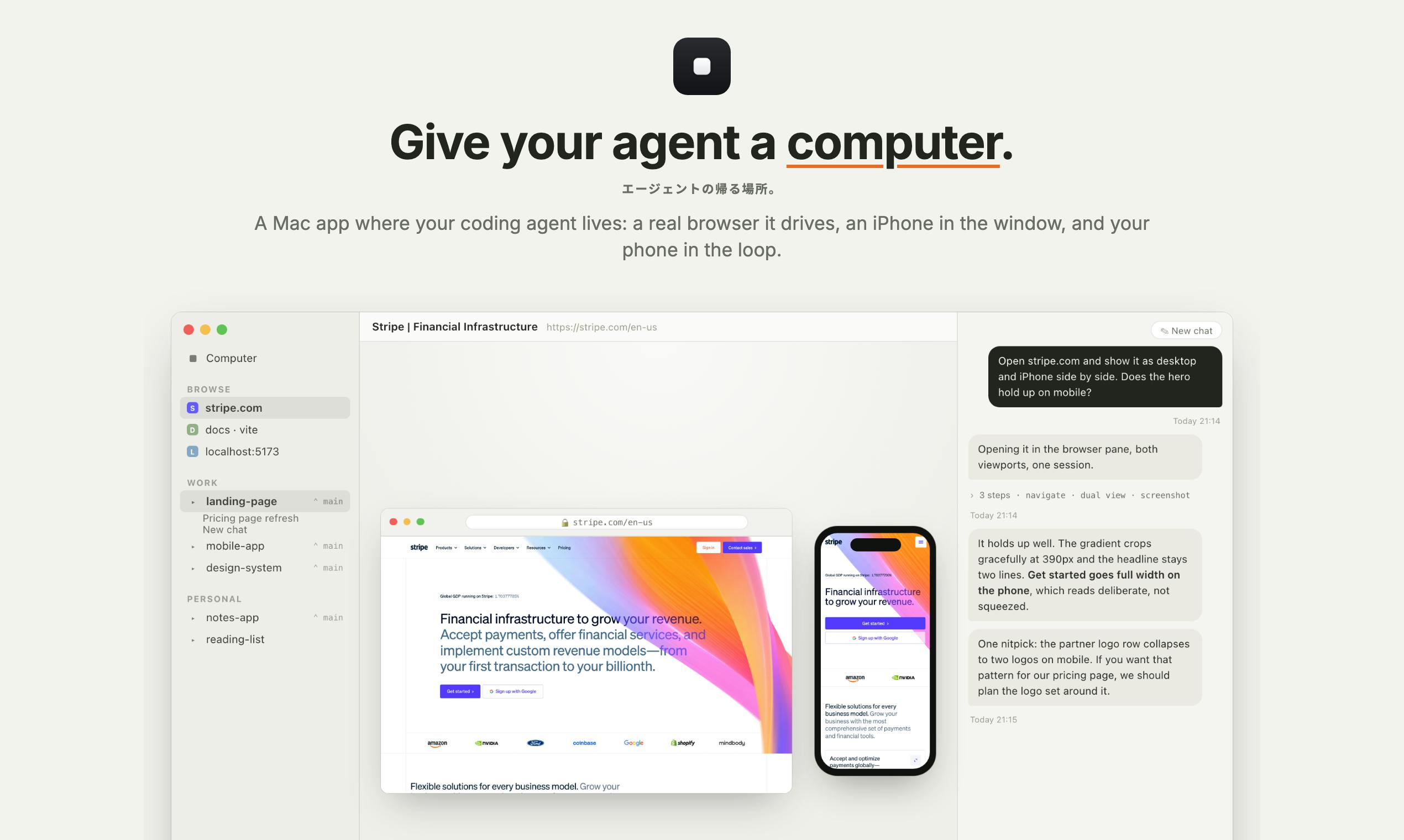
Superagent's most striking design feature is equipping the AI Agent with a complete, operable "computing environment." This isn't merely a conversational tool that generates code text — it gives the coding Agent genuine hands-on capabilities:
- Real Browser: The Agent can drive a browser using your already logged-in sessions, executing tasks directly within your account environment. This means the Agent can operate web pages like a real user — logging into admin panels, testing web application interaction flows, scraping page information, or even performing actions on third-party platforms. Traditional AI coding tools can typically only generate code snippets or offer operational suggestions, whereas Superagent lets the Agent directly "hands-on" complete verification and testing in the browser.
- iOS Simulator: The Agent can tap, swipe, and interact with the iOS Simulator, simulating real mobile interactions. The iOS Simulator is a core component of Apple's Xcode development toolkit, allowing developers to simulate the complete iPhone and iPad runtime environment on a Mac for testing applications without connecting physical devices. It can simulate different screen sizes, system versions, and hardware characteristics, making it an indispensable part of the iOS development testing workflow. Superagent's ability to let the Agent directly control the simulator means AI can autonomously perform mobile app UI testing and interaction verification, dramatically reducing developers' manual testing workload.
- File System Access: Direct reading and writing of your local files, eliminating the need for manual copy-pasting.
- Task Board: The Agent maintains a work board that tracks task progress in real time. This design borrows from the Kanban method commonly used in agile development, visually presenting task status so users can see at a glance what the Agent is currently working on, what's been completed, and what's still pending.
- Routines: Support for timer-based automated task execution. Developers can set up scheduled tasks — such as automatically running test suites at regular intervals, periodically checking code quality, or automatically executing deployment workflows — turning the Agent into a tireless automation assistant.
This "give the Agent a computer" approach essentially upgrades AI from a passive code suggester to an executor capable of autonomously operating software and hardware environments, covering the full development spectrum from web to mobile. This design philosophy also echoes the "Tool Use" research direction in the AI field — enabling large language models to not only generate text responses but also complete real-world operations by calling external tools and APIs, fundamentally expanding the boundaries of AI capability.
Product Design Centered on User Experience
Sidebar Conversations and Focus Mode
Unlike many AI coding tools that require frequent window switching, Superagent places conversations in a sidebar that supports group management. These conversations feature several key characteristics:
- Groupable: Convenient for managing multiple parallel tasks.
- Persistent: Conversations are preserved after app restarts.
- Non-focus-stealing: The Agent works in the background without interrupting your current workflow.
For developers who frequently switch between multiple projects, this design significantly reduces the mental burden of context switching. Cognitive science research shows that frequent context switching causes an "attention residue" effect, where the brain continues to focus on the previous task after switching, reducing processing efficiency on the current one. Superagent's background working mode that doesn't steal focus allows developers to maintain deep concentration on their current task while the Agent quietly completes assigned work in another group.
Isolation via Git Worktree
A noteworthy engineering detail: Each conversation runs on an independent git worktree. Git Worktree is an advanced Git version control feature that allows developers to simultaneously check out multiple independent working directories from the same repository, with each worktree corresponding to a different branch. Unlike traditional branch switching methods (git checkout or git switch), using worktrees doesn't require stashing current work-in-progress changes before working on multiple tasks in parallel — each working directory maintains its own independent file state.
This means different tasks are isolated from each other. An Agent's operations on one branch won't pollute the main workspace or conflict with other tasks. In practice, this solves a common pain point: when a developer simultaneously has the Agent handling a new feature development and a bug fix, both tasks proceed in completely independent file spaces without interfering with each other. Once completed, code reviews and merges can be performed separately, keeping the entire workflow clear and manageable.
For scenarios involving parallel development of multiple features or fix tasks, this isolation mechanism ensures both safety and improved development efficiency.
Mobile-First and Privacy-First
Your Work Follows Your iPhone
Superagent supports pairing your iPhone with the desktop app. Once paired, your work seamlessly flows between devices, with end-to-end encryption (E2EE) throughout. End-to-end encryption is a strict communication security mechanism: data is encrypted on the sending device and decrypted only on the receiving device. No intermediate node in the transmission chain — including Superagent's own servers (if any), network carriers, or any other third party — can read the plaintext content. This is fundamentally different from many AI tools that upload data to the cloud for processing, ensuring that developers' code and project information remain under encryption protection during cross-device transmission.
Developers can continue checking progress and issuing commands while on the go — AI coding is no longer confined to the desk. This mobile-first design adapts to the modern developer's work rhythm — reviewing Agent-generated code changes during a commute, issuing new development instructions between meetings — making even fragmented time productive.
No Account, No Server, No Extra Bill
Superagent makes clear commitments on privacy and cost: No account registration required, no dependence on vendor servers, and no additional subscription fees (No second bill). This stands in stark contrast to the many cloud-subscription, usage-based AI coding tools on the market. Currently, mainstream AI coding tools like GitHub Copilot, Cursor, and others typically require monthly subscription fees ranging from $10 to tens of dollars per month, and code data must be uploaded to the cloud for processing. Superagent's "No second bill" promise means developers only need to cover the API call costs of their chosen large language model (such as OpenAI or Anthropic's API), with no additional subscription fees for the tool itself.
More critically, Superagent is fully open source. Open source means not only transparent, auditable code — any developer or security researcher can inspect the source code to verify there's no data collection, backdoors, or other security concerns — but also that developers can customize and extend functionality to their own needs, avoiding vendor lock-in. Vendor lock-in is a classic issue in enterprise software: once deeply dependent on a closed-source tool, migration costs escalate sharply over time. An open-source architecture fundamentally mitigates this risk.
The "Democratization" Trend in AI Coding Tools
Superagent's positioning and naming directly benchmarks against Anthropic's Claude Code. It attempts to answer a core question: How can powerful coding Agents move beyond the terminal to reach a broader audience of everyday developers?
From a product perspective, Superagent represents several important directions in the evolution of AI coding tools:
- From Text Generation to Environment Operation: Agents no longer just write code — they can actually drive browsers, simulators, and file systems. This shift marks AI coding tools transitioning from an "assisted coding" phase to an "autonomous execution" phase. Early AI coding tools (like GitHub Copilot) primarily offered line-level or function-level code completion suggestions; next-generation tools (like Cursor, Windsurf) began supporting multi-file editing and project-level code refactoring; the direction Superagent represents takes this further by giving Agents complete environment interaction capabilities, forming a closed loop of "perceive-decide-execute-feedback."
- From Command Line to Native App Experience: Lowering the barrier to entry so users unfamiliar with the terminal can get started. This point is crucial for the mainstream adoption of AI coding tools. According to Stack Overflow's Developer Survey, a significant portion of developers worldwide don't come from a computer science background — they may be data analysts, product managers, designers, or practitioners in other tech-adjacent roles. The intuitive interaction of a native Mac application dramatically lowers the threshold for these users to engage with AI Agents.
- From Cloud Subscriptions to Local Open Source: Giving users more control over privacy protection and usage costs. This trend also reflects the broader tech community's growing emphasis on data sovereignty — particularly when handling internal enterprise code and sensitive projects, locally-run open-source tools provide security guarantees that cloud-based solutions cannot match.
As an emerging open-source AI coding assistant, Superagent still needs time to prove its stability, Agent execution accuracy, and performance on complex real-world projects. Current AI Agent technology still faces several challenges: error accumulation in long-sequence tasks (small errors in early steps can gradually amplify as the Agent executes multiple consecutive operations), context management during multi-tool coordination, and adaptability in non-standardized development environments. However, its product philosophy of "giving the Agent a computer" and "built for everyone" offers a noteworthy differentiated direction in the crowded AI coding space.
For developers looking to experience powerful coding Agents with local execution, privacy-first principles, and no extra costs, Superagent is an open-source tool worth trying.
Related articles

Chain of Thought Isn't Just for AI: How Humans Can Use CoT to Improve Thinking Quality
Chain of Thought isn't just a prompt trick for large models. Starting from a Hacker News discussion, this article analyzes why CoT works for human thinking too, breaks down actionable ways to transfer it, and highlights the key differences between human CoT and machine CoT.
Cloudflare Teams Up with OpenAI: Closi…
Cloudflare Teams Up with OpenAI: Closing the Loop from Vulnerability Discovery to Defense with AI
Cloudflare uses OpenAI Daybreak to investigate security vulnerabilities and generate reviewable remediation plans, while developers use Codex to boost coding efficiency and quality.

Orca Multi-Agent Orchestration in Practice: A Guide to Parallel Collaboration with Claude and Codex
Orca is Stable AI's free open-source agent workbench supporting 34 agents like Claude Code and Codex in parallel. Learn its Git worktree isolation, multi-model orchestration, and mobile management.