SuperAntigravity: An Enhancement Solution Integrating SuperClaude into Google Antigravity IDE

SuperAntigravity integrates multiple AI enhancement capabilities into Google Antigravity IDE
SuperAntigravity is an open-source project that uses Shell scripts to integrate two AI enhancement systems — SuperClaude and Superpowers — into Google Antigravity IDE, improving the AI programming experience. Leveraging techniques like Prompt Engineering, it enhances code generation and project analysis capabilities, reflecting the industry trend toward cross-platform AI capability integration and the growing importance of community enhancement layers in IDE ecosystem competition.
Project Overview
SuperAntigravity is an open-source project designed to integrate the enhancement capabilities of Superpowers and SuperClaude into Google Antigravity IDE, providing developers with a more powerful AI-assisted programming experience. The project has earned 446 stars on GitHub — modest in scale, but it has attracted significant attention within specific developer communities.
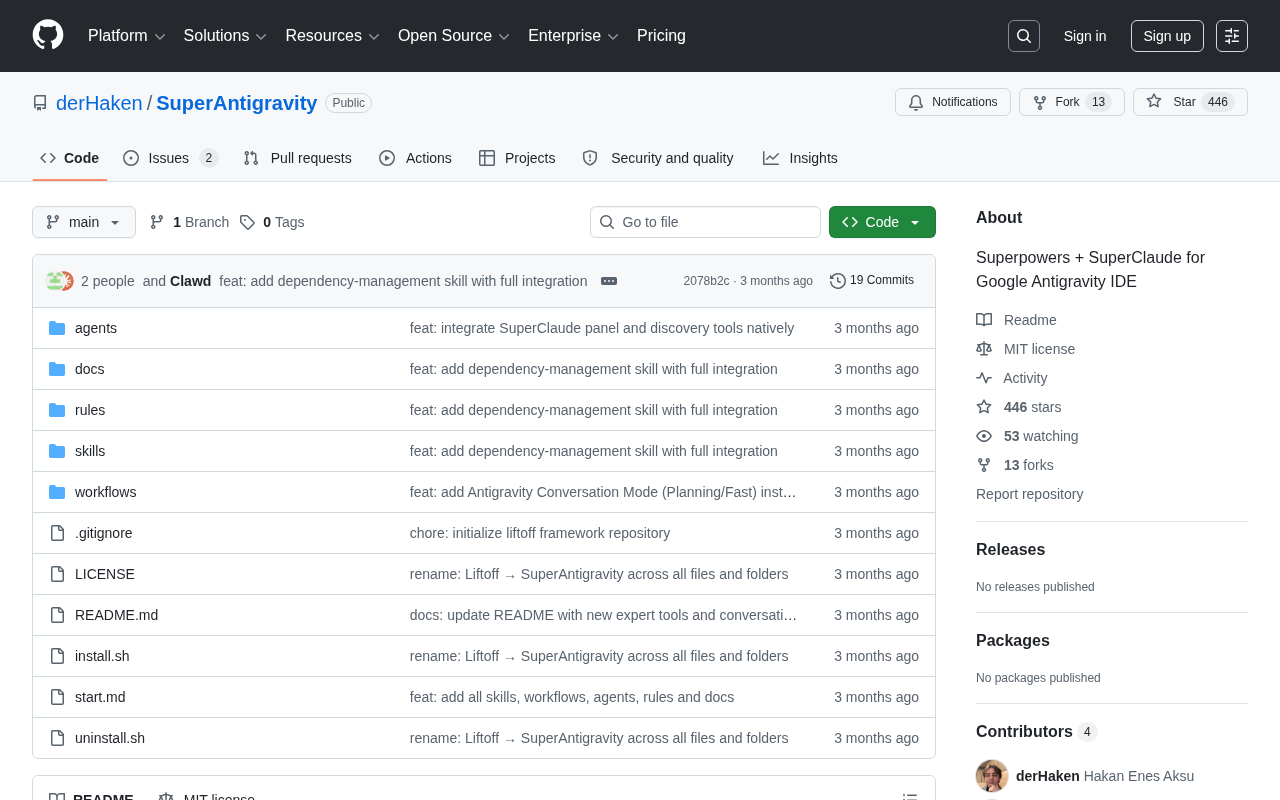
The project is primarily written in Shell scripts, which means it is essentially a set of configuration and integration tools rather than a standalone application. Shell scripts can run on Unix/Linux/macOS systems without any additional runtime environment, making them naturally suited for file system operations, environment variable configuration, and process management. For a "glue layer" tool like SuperAntigravity, the transparency and portability of Shell scripts matter far more than execution performance — which also explains why many mature developer tools (such as nvm and oh-my-zsh) likewise choose Shell as their primary implementation language. Its core value lies in seamlessly bridging multiple AI enhancement tools into Google's Antigravity IDE environment.
What Is Google Antigravity IDE?
Google Antigravity IDE is an integrated development environment launched by Google, focused on AI-assisted development. As AI-native IDEs like Cursor, Windsurf, and GitHub Copilot rise to prominence, the developer tools market is undergoing a profound transformation — these next-generation tools no longer treat AI as an add-on plugin, but instead design their underlying architecture around AI interaction, supporting multi-file context understanding, natural language code generation, and intelligent refactoring. Google Antigravity IDE was launched against this competitive backdrop, aiming to deeply integrate the strengths of Google's own Gemini model with the IDE experience, directly competing with Microsoft's GitHub Copilot ecosystem, and serving as a key strategic play in Google's AI programming tools portfolio.
That said, the native Antigravity IDE still has room for improvement in certain advanced features and customization capabilities — which is precisely the context that gave rise to the SuperAntigravity project.
The Fusion of SuperClaude and Superpowers
Core Capabilities of SuperClaude
SuperClaude is a community-developed configuration framework for enhancing Claude AI's capabilities. Its core technical approach involves carefully crafted System Prompts — a critical engineering technique in large language model applications. System prompts serve as "hidden pre-instructions" in a conversation, defining the model's role, behavioral boundaries, output format, and domain expertise preferences before any user input. Research shows that high-quality Prompt Engineering can improve model performance on specific tasks by 30%-50%, which is exactly where the core value of the SuperClaude framework lies. Combined with workflow templates and behavioral rules, SuperClaude significantly improves Claude's performance in programming scenarios:
- Enhanced accuracy in code generation and contextual understanding
- More structured project analysis and architectural recommendations
- Optimized code iteration efficiency across multi-turn conversations
Extended Capabilities from Superpowers
Superpowers is another enhancement toolkit focused on equipping AI programming assistants with more practical capabilities. It typically includes advanced file operations, project management, code review, and other extended features, elevating AI assistants from simple code completion tools to genuine development partners.
SuperAntigravity's innovation lies in unifying these two enhancement systems and adapting them to the Google Antigravity IDE ecosystem, creating a "1+1>2" enhancement solution.
Technical Implementation and Usage
The project is built around Shell scripts, a technology choice with clear advantages:
- Lightweight deployment: No complex dependency management needed — Shell scripts run directly in most development environments
- Easy customization: Developers can quickly modify configurations to suit their specific needs
- Transparent and auditable: All logic exists as plaintext scripts, allowing users to clearly understand every step the tool takes
Judging by the project's Fork count (13), developers have already begun secondary development and customization based on this project, indicating that its architecture is well-designed for extensibility.
Industry Trends in AI Programming Tools
The emergence of SuperAntigravity reflects several important trends in the current AI programming tool ecosystem:
IDE Competition Enters the "Enhancement Layer" Phase
With the emergence of AI-native IDEs like Cursor, Windsurf, and Google Antigravity, the competitive focus is shifting from "whether AI features exist" to "how powerful AI features are." Community-driven enhancement tools are becoming a critical component of each IDE ecosystem's competitiveness. Official tools, in pursuit of stability and generality, often cannot rapidly iterate on advanced features, while community projects can quickly respond to professional user needs with minimal coordination costs — SuperAntigravity is a quintessential example of this "official tool + community enhancement layer" collaborative model.
Cross-Platform AI Capability Integration Becomes Essential
Developers are no longer satisfied with the capabilities of a single AI model — they want to leverage the strengths of multiple AI systems within a single IDE. SuperAntigravity brings Claude's enhanced capabilities into Google's IDE, representing a typical case of this cross-platform integration demand. Behind this trend lies developers' rational pursuit of the "optimal tool combination": different AI models excel at different sub-tasks such as code generation, architecture analysis, and documentation writing. Development environments that can flexibly orchestrate multi-model capabilities will become a core competitive advantage for efficient engineers.
Community Innovation Fills Gaps Left by Official Tools
Official tools tend to prioritize stability and universality, while community projects can quickly address the personalized needs of advanced users. Projects like SuperAntigravity fill the gap between official tools and the demands of professional users.
Conclusion
Although SuperAntigravity is a relatively niche open-source project, it represents an important direction in AI programming tool development: leveraging community efforts to integrate multiple AI enhancement capabilities and break through the limitations of a single platform. For developers currently using Google Antigravity IDE, this project is worth watching and trying out. As the AI programming tool ecosystem continues to evolve, similar enhancement and integration solutions are likely to become standard components in every developer's toolbox.
Key Takeaways
- SuperAntigravity integrates two enhancement systems — Superpowers and SuperClaude — into Google Antigravity IDE to improve the AI programming experience
- The project is implemented in Shell scripts, offering lightweight deployment, easy customization, and transparent auditability
- System Prompt Engineering is the core technical approach of enhancement frameworks like SuperClaude, capable of significantly improving model performance on specific tasks
- It reflects the industry trend of AI programming tools evolving from single-model approaches toward cross-platform AI capability integration
- Community-driven enhancement tools are becoming a vital component of AI-native IDE ecosystem competitiveness
- The project has earned 446 stars and 13 Forks, demonstrating positive engagement from the developer community
Related articles
 Product Reviews
The Programmer's Desk Setup Guide: Building a Workspace That Feels Like Home
Discover how programmers build productive, comfortable workspaces. From multi-monitor setups to ergonomic design, explore the desk philosophy that drives focus and flow.
 Product Reviews
Qoder vs Cursor Real-World Comparison: Which $20/Month AI IDE Is Better?
Hands-on comparison of Qoder vs Cursor AI IDEs: Agent autonomy, human interaction count, and architecture decisions. Qoder needed only 2 interactions vs Cursor's 8.
 Product Reviews
Cursor Cloud Agent Demo: Eliminating Bottlenecks Across the Entire Software Development Lifecycle
Deep analysis of Cursor's Cloud Agent demo showing how cloud VMs, automated test artifacts, and a full-chain control plane systematically eliminate human bottlenecks across the software development lifecycle.