Superhands: Making AI Agents Follow Your Design System

Superhands argues design deliverables should be system rules, not specific outputs, so AI agents can enforce them consistently.
Superhands on Product Hunt proposes that "design deliverables are systems, not outputs," advocating translating design systems into guidance AI agents can understand and injecting it into all the team's AI tools. Its core mechanism is "fix the system once instead of chasing every output": designers define specs for color, typography, spacing, etc., and form a feedback loop by reviewing agent outputs and directly correcting the system. Positioned as middleware between design systems and AI tools, it addresses the loss of consistency caused by AI generation. Early data: 73 upvotes, 3 comments, ranked #10—moderate community attention. The article sees this as reflecting an industry trend of design systems evolving from static documentation to runtime constraints, though integration depth and rule-following reliability remain to be validated by the market.
From Outputs to Systems: A Paradigm Shift in Design Deliverables
As AI tools sweep through design workflows, a fundamental question has surfaced: what should designers actually deliver? Every interface screenshot, or the underlying rules that drive those interfaces? Superhands, ranked #10 on Product Hunt, offers a clear answer—design deliverables are systems, not outputs. It advocates transforming design into guiding principles that AI agents follow across every tool the team uses.
This idea directly targets the pain points of current AI-assisted design. When designers use Midjourney to generate concept art, Figma AI to fill in interfaces, and Cursor to generate front-end code, each tool may produce a different style, forcing designers into a loop of "chasing every output to fix it." Superhands' solution: write the rules once, and let agents enforce them everywhere.
Core Mechanism: Fix Once, Apply Everywhere
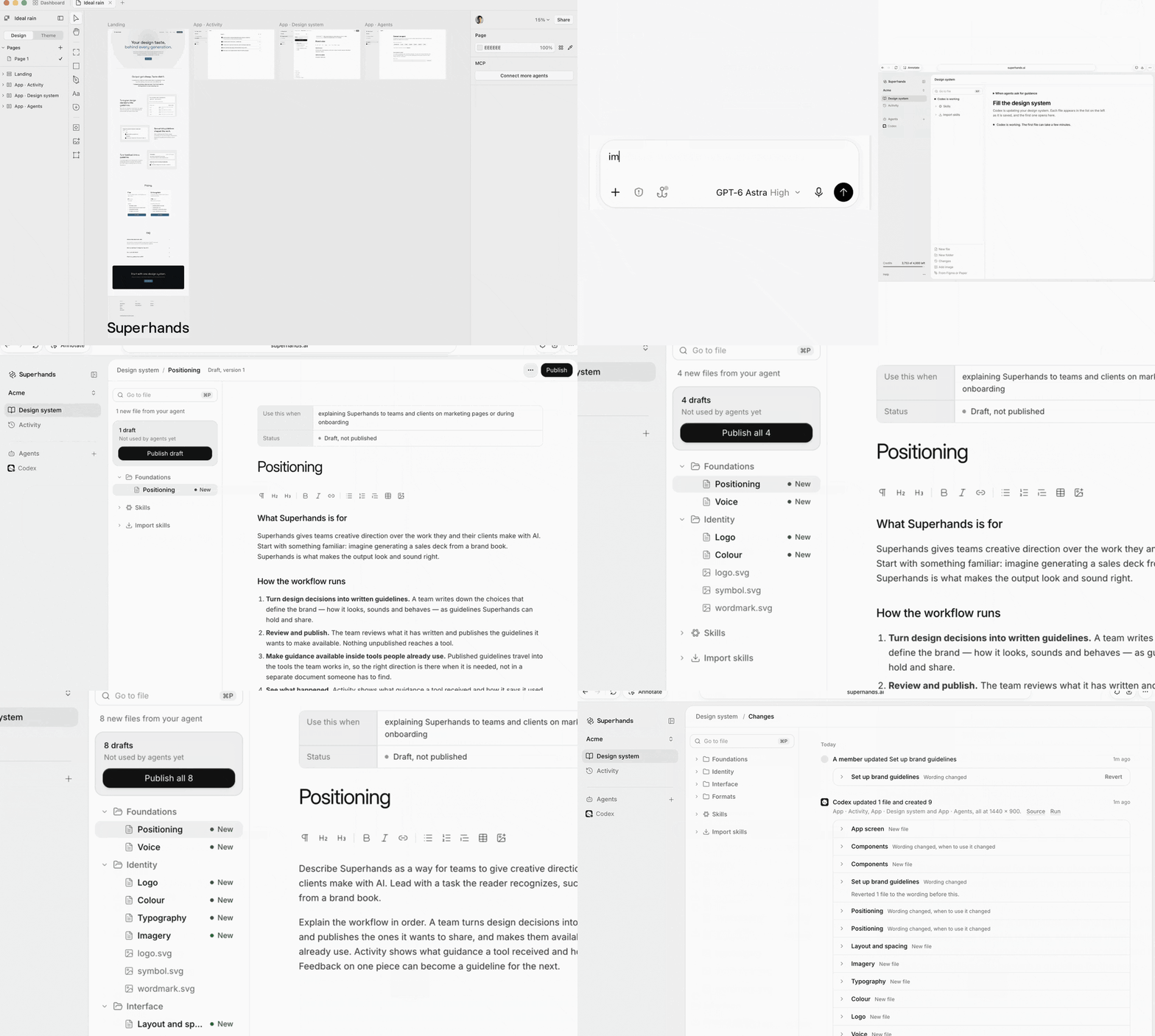
Superhands' product logic can be summed up in one sentence: fix the system once instead of chasing every output. Designers define their design system in Superhands—including colors, typography, spacing, component behavior, interaction patterns, and more—and these rules are then translated into guidance that AI agents can understand and injected into the various AI tools the team uses.
According to its Product Hunt page, users can see what the agent produced and directly correct the system. This means the feedback loop moves up from "editing individual design files" to "editing generation rules." For example: if AI-generated buttons always have the wrong corner radius, the traditional approach is to annotate and fix each screenshot one by one, whereas Superhands' approach is to update the "corner radius spec" in the system, so all subsequent generations automatically comply.
This mechanism relies on two key capabilities: explainable display of agent outputs (letting designers see what the AI actually did) and a system-level correction entry point (letting designers change something once and affect all downstream outputs). Although the product page does not disclose the specific technical implementation, based on the description it looks more like a middleware layer between design systems and AI tools rather than yet another design editor.
Design System is a set of reusable design decisions, typically including specifications for color, typography, spacing, component libraries, and interaction patterns. Traditional design systems mostly exist as Figma libraries, Storybook components, or documentation sites, relying on designers and developers to follow them manually. The "machine-readable" design system that Superhands emphasizes means transforming the above specifications from human-oriented descriptive documentation into structured rules that AI agents can parse (such as JSON tokens, semantic constraints, or prompt templates). This transformation is the prerequisite for "fix once, apply everywhere": only when rules are machine-readable can the middleware layer inject them into different AI tools and have them take effect as constraints during generation. This also explains why design systems need to become more semantic—machines don't understand "slightly larger corner radius," but they can understand "border-radius: 8px."
Why Is It Needed Now?
AI coding and AI design tools are rapidly proliferating, but teams face a hidden cost: loss of consistency. Every AI tool has its own "interpretation bias," and the same design language may produce different results in Figma, GitHub Copilot, and various chatbots. Designers' time is heavily consumed by "alignment" rather than creation.
Superhands' positioning hits exactly this gap. It does not try to replace existing design tools or AI tools, but serves as a "rules hub." For teams that already have a design system, this is a natural extension—turning the design system from static documentation into executable agent instructions. For teams that have not yet built a system, it also provides a forcing mechanism: to use AI for efficient output, you must first clarify the rules.
AI Agent in this context refers to AI programs that can receive instructions and autonomously execute multi-step tasks, such as assistants that generate interface code or design files based on prompts. Unlike single-turn Q&A AI, agents typically have tool-calling capabilities and can complete specific operations in environments such as Figma, Cursor, and chatbots. Superhands' core idea is to inject design rules as "system prompts" or a "constraint layer" into these agents so that they follow the same set of specifications on every generation. However, different agents may interpret the same rules differently and each has its own context window and reasoning approach, so the middleware layer needs to take on the responsibility of rule translation and consistency verification. This is also one of the main technical challenges the product faces.
Early Signals and Limitations
Superhands received 73 upvotes and 3 comments on Product Hunt, ranking #10 for the day. This is above average among new products, indicating that the concept has attracted attention, but community discussion is limited. Key information such as maker Grant MacLennan's background, specific pricing, and the list of integrated tools was not elaborated on the page.
What is certain at present is that the product is categorized under Design Tools, Developer Tools, and Artificial Intelligence, targeting product teams that use both design systems and AI tools. Potential challenges include: how to deeply integrate with mainstream AI tools, how to ensure consistent interpretation of design rules across agents, and how to make it easy for designers without a technical background to define "machine-readable" rules.
The New Role of Design Systems
Behind Superhands is a broader trend: design systems are evolving from "reference documentation" to "runtime constraints." In the past, design systems were specification manuals for people to read; now, they need to become constraints that AI agents can parse and execute. This requires design systems themselves to be more structured and semantic, and it also requires the toolchain to provide a translation layer.
For design teams, this means a shift in focus: from producing specific pages to governing rule quality. Superhands' concept of "the design system as the deliverable" may become a standard configuration for design collaboration in the AI era. But whether it can deliver on its promise depends on integration depth and the reliability of agents following the rules—both of which remain to be validated by the market.
Runtime Constraint, as opposed to static documentation, refers to restrictions that take effect in real time during system operation or content generation. Traditional design systems are "post-hoc reference"—designers produce first, then check against the specification; runtime constraints are "in-process enforcement"—rules are forcibly applied at the same time as AI generation. This shift requires the toolchain to provide a translation layer that converts design tokens, component behavior, and interaction patterns into instructions that agents can execute. Its reliability depends on two factors: first, the degree of structure in the rules themselves; second, the agent's ability to follow constraints. If constraints are too loose, consistency cannot be guaranteed; if too tight, they may limit the creative output of AI. The middleware model represented by Superhands is an attempt to find a balance between the two.
Related articles

Prompt Engineering for Beginners: From Writing Prompts to Engineering Thinking
Starting from the essence and four functions of prompts, this article systematically explains the six-step process, four success criteria, learning value, and practical limitations of prompt engineering to help you build a complete understanding.

Anthropic Launches Nasdaq IPO: AI Giant's Listing and Risk Disclosures
Anthropic officially launches its Nasdaq IPO under ticker ANT, with market valuation expected to potentially exceed SpaceX's record. The prospectus devotes nearly 100 pages to AI risks, while first-half revenue grew over 14x but net losses widened sharply, reigniting the AI bubble debate.

Rust cURL Clone Uses 4,832 unsafe Blocks—Is the Memory Safety Myth Broken?
A Rust cURL clone uses 4,832 unsafe keywords, challenging Rust's memory safety narrative. We analyze what unsafe really means, compare Fil-C, and examine rewrite motives.