Superintelligence Must Serve Humanity: Core Principles and Open Ecosystems in AI Development
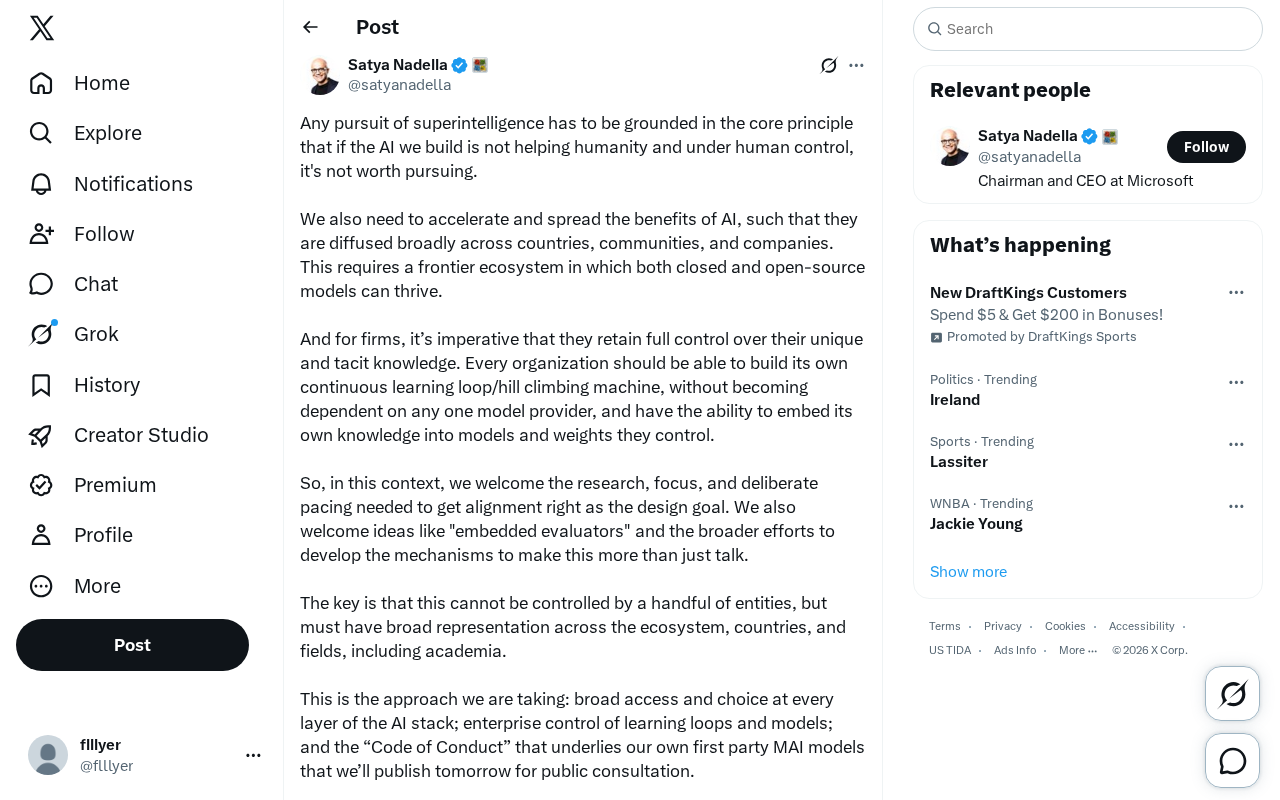
Superintelligence must serve humanity and stay controllable — open ecosystems and broad governance prevent dangerous concentration of power.
This piece outlines a coherent philosophy for responsible AI development: superintelligence is only worth pursuing if it serves humanity and remains under human control. The author advocates for an open ecosystem where closed-source and open-source models coexist to diffuse AI's benefits broadly. For enterprises, owning their tacit knowledge and continuous learning loops — free from vendor lock-in — is essential. On governance, embedded alignment mechanisms must move from rhetoric to engineering practice, and no small group of entities should monopolize AI's direction. Publishing a first-party model Code of Conduct for public consultation is highlighted as a key step toward accountable, widely representative AI governance.
The Baseline for Superintelligence: Human Benefit as a Prerequisite
Discussions around superintelligence continue to intensify, but one fundamental principle is being repeated with growing conviction: if the AI we build cannot help humanity and cannot remain under human control, it is not worth pursuing. This position has been articulated publicly by senior figures in the tech industry, placing "human benefit" and "human control" ahead of technological ambition.
This is not an empty slogan. As model capabilities increasingly approach — or even surpass — human cognitive levels, the questions of "who does it serve" and "who controls it" shift from philosophical debate to engineering constraints. Treating safety and alignment as design goals rather than afterthoughts is becoming the defining line between responsible and irresponsible AI development.
Accelerating Diffusion: Spreading the Benefits of AI Widely
Ensuring AI is "safe" is only part of the picture. How to broadly distribute AI's value across different countries, communities, and enterprises is another critical thread. The core argument is clear: the benefits of AI must be accelerated and diffused so they "permeate widely," rather than concentrating in the hands of a few players.
Achieving this requires an open frontier ecosystem — one where both closed-source and open-source models can coexist and thrive. This stance is noteworthy: it neither dismisses the value of commercial closed-source models nor ignores the unique role of open source in lowering barriers, fostering innovation, and preventing monopolization. A genuinely healthy AI landscape typically requires both approaches running in parallel, not an either-or choice.
What Enterprises Actually Need: Owning Their Knowledge and Learning Loops
For enterprises, the most pressing concern is retaining full control over their unique knowledge and tacit experience. A compelling concept emerges here: every organization should be able to build its own continuous learning loop — or "hill climbing machine" — that belongs entirely to them.
Avoiding Lock-In to a Single Model Provider
The operative word is "independence." Enterprises should not find themselves locked in to one model provider, losing bargaining power and technological autonomy simply by using their services. The ideal state is one where an organization can embed its own knowledge into models and weights that it controls. This means data sovereignty, controllability over model weights, and the ability to switch freely between vendors will become core considerations in enterprise AI procurement.
For organizations evaluating their AI strategy, this provides a practical framework: do not hand over your company's most valuable tacit knowledge to a black box you cannot control.
Alignment Mechanisms: From Rhetoric to Practice
On the governance and safety front, there is an expressed openness to deliberate pacing in order to get alignment right. This stands in contrast to the "speed at all costs" mindset that exists in some corners of the industry — treating alignment as a design goal means being willing, when necessary, to trade some speed for controllability.
Specific ideas such as embedded evaluators are also raised, alongside broader efforts to ensure these mechanisms move beyond talk. This point is particularly important: one of the longstanding criticisms of AI safety has been that there are many promises and little execution. Verifiable, embeddable evaluation mechanisms are the critical step toward translating governance principles into engineering practice.
Governance Cannot Be Monopolized by a Few
A consistent theme throughout is that the direction of AI cannot be controlled by a handful of entities — it must achieve broad representation across the entire ecosystem, across nations, across sectors, and including academia.
This touches on one of the sharpest tensions in current AI governance: technical capability and narrative power are concentrating in an extremely small number of large institutions. If the definition of superintelligence, its constraints, and the distribution of its benefits are all determined unilaterally by these institutions, then "serving humanity" risks becoming code for serving particular interests. Broad representation — including independent academic participation — is a necessary counterweight to this concentration.
The Path Forward: Layered Openness and a First-Party Model Code of Conduct
The argument concludes with concrete direction that can be summarized across three levels:
- Full-stack openness and choice: Provide broad access and options at every layer of the AI stack to avoid single-point lock-in.
- Enterprise control over learning loops: Let organizations own their continuous learning cycles and their models.
- A "Code of Conduct" for first-party models: Establish behavioral norms for proprietary first-party models and release them for public consultation.
Notably, this Code of Conduct supporting first-party models will be published openly for public review. The act of submitting a governance document to public deliberation is itself a concrete expression of the "broad representation" principle — pulling AI governance out of closed internal decision-making and into a more open arena of discussion.
Conclusion: A Contested Question of Who Controls AI
This set of principles sketches a relatively complete philosophy of AI development: safety and controllability are the baseline, broad diffusion of benefits is the goal, open ecosystems and enterprise autonomy are the means, and widespread governance is the safeguard. It diverges both from pure accelerationism — chasing capability ceilings at any cost — and from conservative retrenchment. Instead, it seeks a balance among capability, safety, and openness.
The real test lies in execution: whether embedded evaluators can actually be deployed in practice, whether a public Code of Conduct can genuinely incorporate external feedback and be revised accordingly, and whether open-source and closed-source models can truly flourish together. The answers to these questions will determine whether superintelligence ultimately serves all of humanity — or concentrates in the hands of a few.
Related articles

Codex vs. Claude Code: A Beginner's Guide to AI Coding Agents
Codex vs. Claude Code: which AI coding agent should you use? This guide compares both tools and walks beginners through GPT account setup, virtual number platforms, US App Store switching, and subscription cost-saving tips.

Pi-chat in Practice: Connecting External Tools to AI Agents via MCP Protocol
Learn how to integrate external tools into AI Agents using MCP protocol with Pi framework. Covers pi-mcp-adapter setup, .mcp.json config, Extension Factory initialization, and a live 12306 train ticket query demo.

AI Large Model Engineering Careers Decoded: Algorithm Research vs. Engineering Deployment — Which Path Is Right for You?
AI large model jobs split into algorithm research and engineering deployment. Learn the skill requirements, core competencies like RAG and Multi-Agent, and why Harness architecture is the 2026 interview differentiator.