SuperLocalMemory: A Local-First Memory Brain for AI Agents

Qualixar launches SuperLocalMemory, a local-first agent memory system with reliable verification and cross-platform support.
SuperLocalMemory is a local-first agent memory system re-released on Product Hunt by Qualixar. It supports Claude Code, Codex, Cursor, ChatGPT, and any MCP or CLI agent. Its core feature is a "never bluffs" recall mechanism that distinguishes supported, related, and no-answer states, with verification via Laya or Jev. It integrates Google EmbeddingGemma 2 for natural-language retrieval of images and PDFs, uses AGPL-3.0, and emphasizes local storage, governance, and mesh connectivity while balancing privacy, speed, and accuracy.
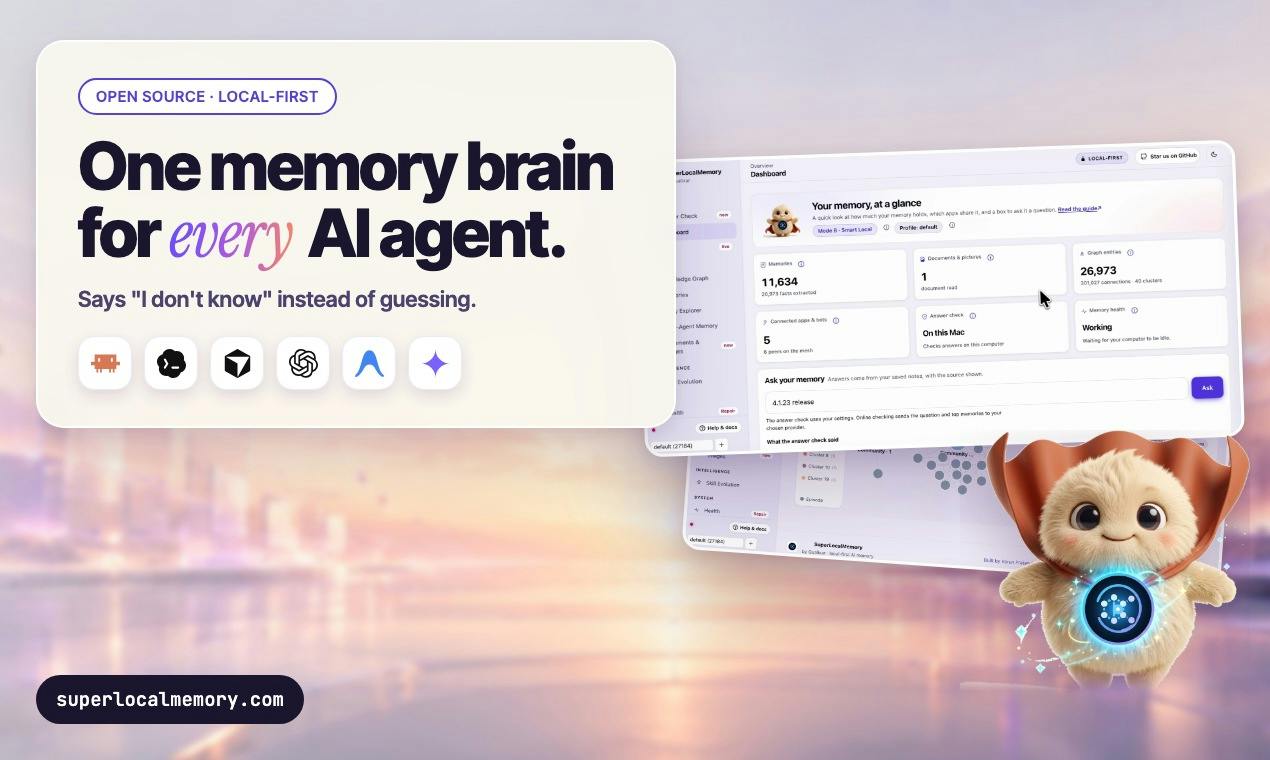
In today's world of increasingly pervasive AI agents, how to give them reliable, persistent, and controllable memory has become a key focus for developers. Recently, SuperLocalMemory, launched by the AI reliability engineering lab Qualixar, made a fresh appearance on Product Hunt. This so-called "local-first" agent memory brain aims to provide a unified memory solution for Claude Code, Codex, Cursor, ChatGPT, and any MCP or CLI agent.
What Is SuperLocalMemory?
SuperLocalMemory's positioning is quite clear: building a local-first memory layer for various AI agents. According to the official description, the project is backed by four arXiv papers and was completely rewritten before being re-released. It supports mainstream AI coding tools such as Claude Code, Codex, Cursor, and ChatGPT, as well as any agent compatible with the MCP protocol or CLI.
Unlike other memory solutions on the market, SuperLocalMemory emphasizes a "never bluffs" principle. Its recall function clearly distinguishes three states: supported, related, or no answer. This design directly addresses a pain point in current AI memory systems—many solutions confidently deliver incorrect recollections, while SuperLocalMemory attempts to verify reliability through Laya (local Mac side) or Jev (online side), ensuring the dependability of memories.
MCP protocol (Model Context Protocol) was proposed by Anthropic at the end of 2024 as an open standard designed to let AI models connect to external data sources and tools in a unified way. Before MCP, each AI tool often needed to develop separate integration code for each data source, creating fragmentation and adaptation costs; MCP defines standard server and client interfaces so models can dynamically discover and invoke external capabilities, such as reading local files, querying databases, or calling third-party APIs. The phrase "any MCP-compatible agent" in the text refers precisely to AI applications that implement a client for this protocol, allowing them to plug in compliant memory services like a USB drive. Understanding MCP is key to understanding why SuperLocalMemory can be cross-platform and universal without needing separate adaptation for each AI tool.
CLI agents refer to AI agent programs that interact through a command-line interface, where users enter commands in a terminal and the agent executes tasks in the local environment and returns results. Compared with graphical-interface AI tools, CLI agents are lighter, easier to script, and easier to integrate with developers' existing workflows (such as Git and build tools). Because CLI agents usually run locally, they naturally fit SuperLocalMemory's local-first storage strategy, and are therefore listed alongside MCP agents in the text as the two major access forms.
Core Technical Highlights
Multimodal Retrieval Capabilities
SuperLocalMemory integrates Google's EmbeddingGemma 2 model, allowing users to find images and PDF files through descriptions. This means you no longer need to remember file names or exact keywords; you can simply describe the content in natural language, and the system will locate the relevant files. For developers who need to handle large amounts of documents and image materials, this feature can significantly improve work efficiency.
EmbeddingGemma 2 is a text and multimodal embedding model released by Google based on the Gemma series, belonging to the category of "embedding models." The role of an embedding model is to convert content from text, images, or PDFs into high-dimensional vectors, bringing semantically similar content closer together in vector space. Unlike generative large models, embedding models are not responsible for generating text, but are specifically used for retrieval, clustering, and similarity matching. After SuperLocalMemory integrates EmbeddingGemma 2, users' natural language descriptions are encoded into vectors, which are then compared with the vectors of locally stored images and PDFs, thereby locating target files without relying on exact keywords or file names. This ability to "find things by meaning" is the core of what distinguishes its multimodal retrieval from traditional full-text search.
Local-First and Governance Mechanisms
The project uses the AGPL-3.0 open-source license and emphasizes a local-first architecture. All memory data is stored locally by default, giving users complete data control. At the same time, the system has "governed" and "mesh-connected" characteristics; the former ensures compliance and controllability of memories, while the latter supports memory sharing and collaboration across multiple devices or agents.
AGPL-3.0 (GNU Affero General Public License version 3) is a strong copyleft open-source license that can be understood as the "network version" of GPL. Ordinary GPL requires source code disclosure when distributing modified versions of software, but there is a loophole: if the software is provided only as a network service without distributing binaries, the source code need not be disclosed. AGPL-3.0 specifically closes this loophole—as long as users interact with the modified software over a network, the provider must disclose the source code to users. For a memory system like SuperLocalMemory, choosing AGPL-3.0 means that any vendor that turns it into a cloud service and offers it externally must contribute code back to the community, thereby drawing a clear boundary between open source and commercial exploitation.
"Governed" in the context of AI memory refers to imposing rules and audit capabilities on the writing, reading, modification, and deletion of memories, ensuring that memories comply with privacy policies, permission constraints, and compliance requirements. It differs from simple access control in that it covers lifecycle management of memories, such as which agents can write memories, which memories need periodic review, and how to trace the source of a given memory. "Mesh-connected" refers to multiple devices or agents sharing memories through a peer-to-peer network rather than relying on a single central server; each node is both a consumer and a provider of memories, achieving collaboration while maintaining local control.
Cross-Platform Compatibility
SuperLocalMemory is not tied to a specific AI platform. Whether it is Anthropic's Claude Code, OpenAI's Codex, the Cursor editor, or ChatGPT, all can connect to this memory system. For developers using multiple AI tools, this means maintaining a consistent memory experience across different tools, avoiding repeated training and context loss.
The Team and Philosophy Behind It
SuperLocalMemory is built by Qualixar. According to information on its Product Hunt page, Qualixar calls itself an "AI reliability engineering lab" and has launched 10 open-source products. Team members include developers such as Garima Singh. Judging from the product naming and feature design, the team clearly treats "reliability" as its core competitiveness—at a time when AI hallucination issues are widely criticized, a memory system that "never bluffs" indeed hits real needs.
The project received 84 votes and 7 comments on Product Hunt, ranking 19th. Although its popularity is not top-tier, considering that it targets the relatively vertical field of developer tools, this level of attention is already impressive.
Why Does Memory Reliability Matter?
Current memory solutions for AI agents can be roughly divided into two categories: one relying on cloud-based vector databases, and the other purely local storage. The former has privacy and latency issues, while the latter often lacks verification mechanisms. SuperLocalMemory attempts to find a balance between the two—local-first ensures privacy and speed, while the Laya/Jev verification mechanism ensures accuracy.
This design approach deserves attention. As AI agents take on increasingly complex tasks, the accuracy of memory will directly affect output quality. A memory system that can "honestly say no" is more practically valuable than one that is always confident but frequently wrong.
Vector databases are database systems specifically designed to store and retrieve vector embeddings, and they are the underlying infrastructure for most current cloud-based AI memory solutions. Their working principle is: text or multimedia content is converted into vectors through an embedding model and stored in the database; during querying, the question is also converted into a vector, and approximate nearest neighbor (ANN) algorithms quickly find the several memories that are semantically closest. The advantage of vector databases is that they can handle massive amounts of unstructured data and support semantic search, but cloud-based solutions mean memory content must be uploaded to third-party servers, bringing privacy exposure and network latency issues; at the same time, retrieved "similar" content is not necessarily "correct," and there is a lack of verification mechanisms for memory truthfulness. SuperLocalMemory's choice of local-first combined with Laya/Jev verification is precisely intended to avoid these two types of flaws.
Use Cases and Getting Started Tips
SuperLocalMemory is suitable for the following scenarios: developers who need to share context across multiple AI coding tools, teams with high data privacy requirements, and researchers who need to process large amounts of images and PDF materials.
If you are a user of MCP or CLI agents, you can obtain installation guidance from its GitHub repository. The project uses the AGPL-3.0 license, and individuals and small teams can freely use and modify it. It should be noted that the local-first architecture means you need to manage storage and backups yourself, which may require an adjustment period for users accustomed to cloud synchronization.
Overall, SuperLocalMemory represents a "pragmatic" approach to agent memory—not pursuing breadth and completeness, but focusing on reliability and controllability. On the rapidly evolving track of AI memory, this attitude itself has value.
One-line Summary
Qualixar launches SuperLocalMemory, a local-first agent memory system focused on reliable verification and cross-platform compatibility.
Paragraph Summary
SuperLocalMemory is a local-first agent memory system re-released on Product Hunt by the AI reliability engineering lab Qualixar. It supports Claude Code, Codex, Cursor, ChatGPT, and any MCP or CLI agent. Its core feature is a "never bluffs" recall mechanism that clearly distinguishes supported, related, and no-answer states, and verifies through Laya or Jev. The system integrates Google's EmbeddingGemma 2 model and supports retrieving images and PDFs through natural language descriptions. The project uses the AGPL-3.0 license and emphasizes local storage, governance, and mesh connectivity, balancing privacy, speed, and accuracy. Backed by four arXiv papers, the product targets multi-tool developers, privacy-sensitive teams, and document researchers, and currently has 84 votes and ranks 19th.
Related articles

Chain of Thought Isn't Just for AI: How Humans Can Use CoT to Improve Thinking Quality
Chain of Thought isn't just a prompt trick for large models. Starting from a Hacker News discussion, this article analyzes why CoT works for human thinking too, breaks down actionable ways to transfer it, and highlights the key differences between human CoT and machine CoT.
Cloudflare Teams Up with OpenAI: Closi…
Cloudflare Teams Up with OpenAI: Closing the Loop from Vulnerability Discovery to Defense with AI
Cloudflare uses OpenAI Daybreak to investigate security vulnerabilities and generate reviewable remediation plans, while developers use Codex to boost coding efficiency and quality.

Orca Multi-Agent Orchestration in Practice: A Guide to Parallel Collaboration with Claude and Codex
Orca is Stable AI's free open-source agent workbench supporting 34 agents like Claude Code and Codex in parallel. Learn its Git worktree isolation, multi-model orchestration, and mobile management.