SuperMailbox: A Unified Inbox with AI Access to Email via MCP
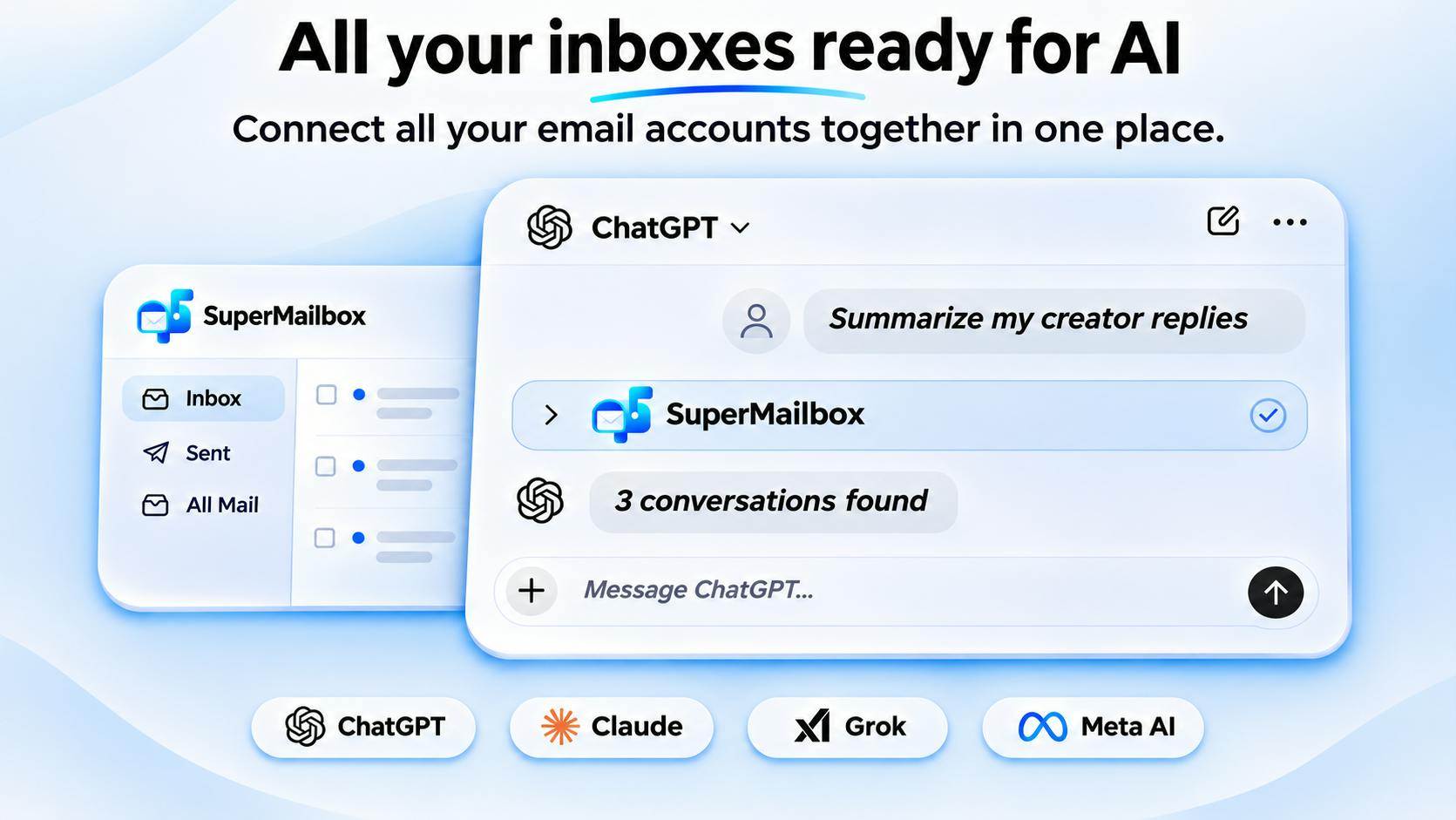
SuperMailbox aggregates multiple mailboxes and uses MCP to let AI read and write email directly.
SuperMailbox is a multi-mailbox management tool launched on Product Hunt, built around "one inbox, ready for AI." It aggregates Gmail, iCloud Mail, Outlook, Yahoo Mail, Fastmail, and any IMAP account into a unified inbox, and offers email rules and team shared access. It supports cross-language semantic search and connects ChatGPT and Claude via MCP to summarize threads and draft replies, with AI permissions managed separately. Pricing starts at $4.99/month with a 7-day free trial.
Managing multiple mailboxes has long been a pain point for productivity tools, and the addition of AI has opened up new possibilities in this space. SuperMailbox, launched on Product Hunt, is built around the idea of "one inbox, ready for AI." It aims to aggregate Gmail, iCloud Mail, Outlook, Yahoo Mail, Fastmail, and any other IMAP accounts into a single inbox, while letting AI assistants like ChatGPT and Claude read and act on email directly through the MCP protocol.
One Inbox for Multiple Accounts
SuperMailbox's core feature is email aggregation. Users can connect Gmail, iCloud Mail, Outlook, Yahoo Mail, Fastmail, and any IMAP account to a single inbox, eliminating the hassle of switching between multiple clients. For users juggling a personal mailbox, a work mailbox, and a team shared mailbox, this unified entry point can significantly reduce the cost of context switching.
The product also offers email rules and team shared access. That means it's not just a personal productivity tool—it also accounts for small-team collaboration scenarios, where members can share access to a mailbox and automatically sort or process email through rules.
IMAP (Internet Message Access Protocol) is the standard protocol email clients use to read messages from a server, as opposed to SMTP, which is primarily used for sending. Its key characteristic is that email stays on the server and client-server state stays synchronized in both directions, so the same account shows consistent read status and folder structure across phone, computer, and web. Although services like Gmail and Outlook offer proprietary APIs, most also expose IMAP interfaces, which allows third-party clients to connect to nearly all mainstream mailboxes through a single generic implementation. However, IMAP implementations differ across providers—Gmail's label system, Outlook's folder semantics, and OAuth authorization methods are all inconsistent—so aggregation products need to adapt to each one individually. This is why multi-mailbox clients are not as simple to build as they appear.
Semantic Search: Find Email by Meaning Across Languages
Traditional email search relies on keyword matching, which makes it hard to retrieve a message once you can't recall the exact wording or the email was written in another language. SuperMailbox offers semantic search that supports cross-language lookup by "meaning." For example, if you describe the content of an English email in Chinese, the system can still understand and locate the relevant message.
The logic behind this feature is to vectorize email content and replace literal matching with semantic similarity. For users with large volumes of email and frequent cross-language communication, this is far more practical than character-by-character search.
Semantic search relies on "vectorization" and embedding models. The system splits each email's body into paragraphs, uses an embedding model to convert each paragraph into a high-dimensional vector, and places semantically similar text closer together in vector space. At query time, the user's search terms are also converted into vectors, and the system uses measures such as cosine similarity to find the closest email fragments. Because multilingual embedding models map sentences expressing the same meaning in different languages to nearby positions, querying English email in Chinese becomes possible. The trade-off is that an index must be pre-built and continuously updated, which carries non-trivial storage and compute costs at large email volumes. Vector retrieval also tends to underperform keyword search on exact matches (such as order numbers or names), so real-world products often combine the two.
AI Access via MCP: Thread Summaries and Draft Replies
What sets SuperMailbox apart most is its support for connecting ChatGPT, Claude, or other compatible AI assistants through MCP (Model Context Protocol). Once connected, AI can summarize email threads and draft replies, handing repetitive reading and writing work to the model.
Even more noteworthy is the permission design. The product sets up separate permissions for AI access, letting users selectively control which email content the AI can reach. In a highly sensitive context like email, managing AI permissions separately from user permissions is essential—after all, letting a third-party model read your entire inbox is still something many people need to consider carefully.
MCP (Model Context Protocol) is an open protocol introduced by Anthropic in late 2024, aimed at establishing a standardized way to connect AI models with external data sources and tools. You can think of it as "the USB-C port of the AI world": previously, every AI assistant needed a separate integration to connect to an application; with MCP, an application only needs to implement a server once, and any MCP-compatible client (such as Claude Desktop, ChatGPT's relevant plugin ecosystem, or various IDE assistants) can call it directly. MCP uses a client-server architecture, where the server exposes capabilities such as "tools," "resources," and "prompt templates," and the client calls them on demand after user authorization. For sensitive data like email, the significance of MCP is that permission boundaries can be explicitly defined—an application can expose only specific folders or specific operations rather than handing the entire account to the model.
Pricing and Positioning
SuperMailbox's subscription plans start at $4.99 per month, with a 7-day free trial. This price point is entry-level among productivity tools, clearly intended to lower the barrier to trying it out.
In terms of positioning, it targets knowledge workers squeezed between multiple mailboxes and AI tools: on one hand they need to manage multiple accounts in a unified way, and on the other they want AI to genuinely participate in email workflows rather than just "write me a paragraph." The introduction of MCP turns AI from an external tool into part of the inbox, which is the key difference from an ordinary email client.
That said, both email aggregation and AI access involve substantial privacy and security concerns. Whether SuperMailbox can strike a balance between convenience and data security will determine whether it can win over users who are sensitive about email privacy.
One-line Summary
SuperMailbox aggregates multiple mailboxes and uses MCP to let AI read and write email directly.
Paragraph Summary
SuperMailbox is a multi-mailbox management tool launched on Product Hunt, built around "one inbox, ready for AI." It aggregates Gmail, iCloud Mail, Outlook, Yahoo Mail, Fastmail, and any IMAP account into a unified inbox, and offers email rules and team shared access. The product supports cross-language semantic search, locating email by meaning rather than keywords. Its most distinctive feature is connecting AI assistants like ChatGPT and Claude via the MCP protocol, letting models summarize email threads and draft replies, with AI access permissions set separately from user permissions. Subscription pricing starts at $4.99 per month with a 7-day free trial. The article argues that its success will depend on whether it can balance convenience with email privacy and security.
Related articles

Nothing CMF Buds 2A Drops to $17.89 on Black Friday: A New Low for ANC Earbuds
Nothing CMF Buds 2A wireless earbuds Black Friday deal: just $17.89 on Amazon, about $11 off retail and a record low. ANC earbuds at an entry-level price.

When AI Creation Gets Accused of "Spitting": Hacker News Heats Up Over the Glaude Controversy
A Hacker News post, "Spitting in the Face of Glaude," sparks debate on AI creation transparency and attribution ethics. This analysis examines the blurred creator identity behind the controversy and offers practical advice for AI content production.

Akai Embraces Custom Firmware: MPC Sample 1.4 Lets Users AI-Program Their Sampler
Akai embraces the modding community with MPC Sample 1.4 firmware, supporting vibe-coded custom firmware and effects. We analyze the impact of this open strategy on music hardware and AI-assisted programming.