Supernatural VR Fitness Returns: Independent Rebirth, Massive Course Library in Early Access

Abandoned by Meta, VR fitness app Supernatural spins off independently and returns in Early Access.
Once facing abandonment after Meta announced it would stop content updates, the VR fitness app Supernatural has now spun off from Meta and relaunched independently, relisted on the Meta Horizon Store as an Early Access preview. The new version offers thousands of remastered courses and some brand-new ones from day one, with plans to add more music and VR fitness courses in the future. The article analyzes the opportunities and challenges of independent operation: the team gains greater autonomy in content updates and music licensing, but must also establish its own business model and cope with resource constraints. This "spin-off without leaving the ecosystem" approach offers new ideas for other VR apps' survival amid Meta's content strategy adjustments, and confirms the real demand and user stickiness in the VR fitness market.
From Abandoned to Independently Reborn: Supernatural's Dramatic Turnaround
The VR fitness app Supernatural, which Meta had once announced would stop receiving content updates, is now making a fresh start as an independent entity. According to RSS sources, the app has been spun off from Meta and relisted on the Meta Horizon Store as an Early Access preview. This shift marks a reprieve for the beloved VR fitness game—avoiding abandonment and instead being operated independently by the original team.
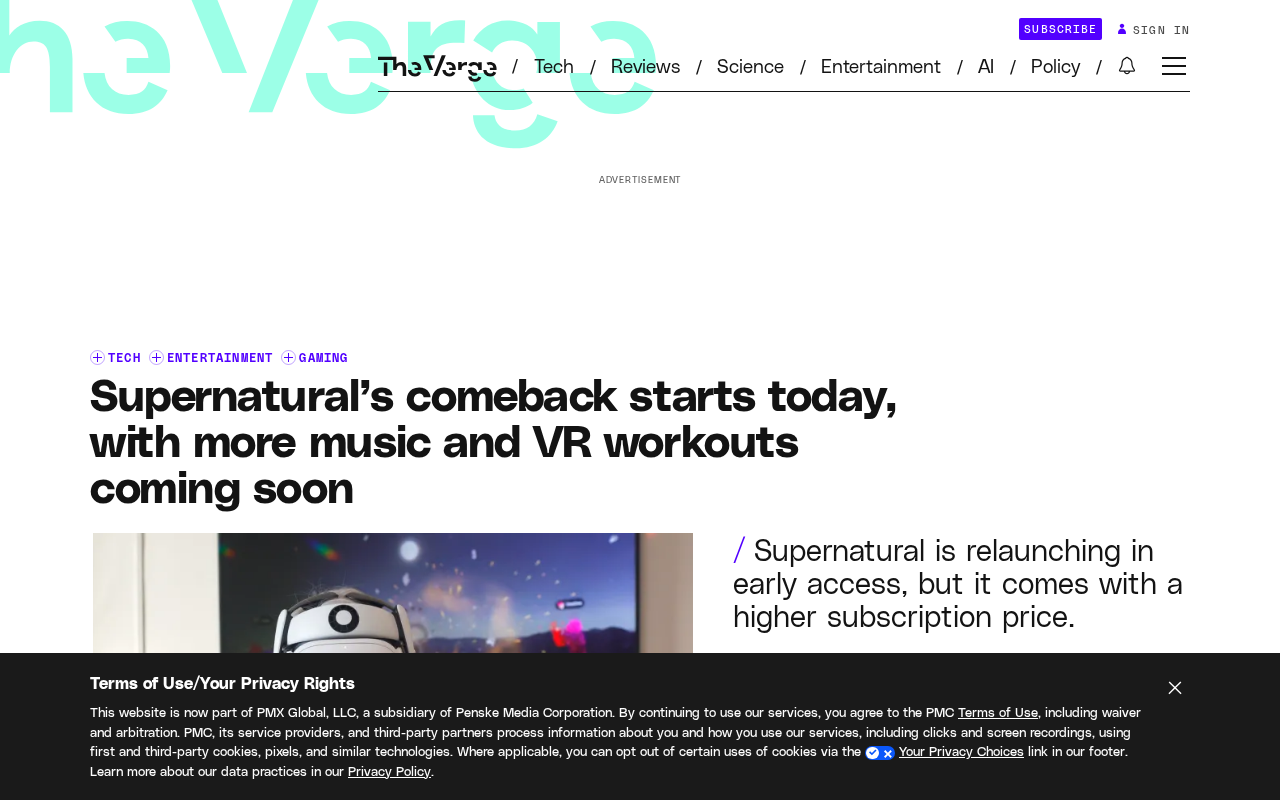
Meta had previously stated it would stop creating new content for Supernatural, a decision that disappointed many loyal users. However, the spun-off Supernatural not only retains the core experience but also brings thousands of "remastered" courses plus some brand-new ones, available from day one. For VR fitness enthusiasts, this is undeniably exciting news.
Content Upgrade: Thousands of Remastered Courses and New Experiences
According to the original report, the new Supernatural offers a massive amount of content even in Early Access. Thousands of courses have been "remastered," meaning the original music, coaching cues, and movement choreography may have been optimized for visual quality or interaction. At the same time, some brand-new courses are also live, ensuring a fresh experience for existing users.
While the report doesn't detail the technical specifics of the "remastering," it's reasonable to infer that the independent team can now update the content library more flexibly, free from the constraints of parent company strategy shifts. The Early Access model also suggests the development team wants to iterate quickly based on user feedback—crucial in a highly interactive app like VR fitness.
Early Access is a common release model on digital distribution platforms (like Steam, Meta Horizon Store): an app launches in an unfinished or feature-incomplete state, and players can purchase or try it early while giving feedback and suggestions to developers. For developers, Early Access allows early validation of market demand, builds a user community, and enables gradual product refinement through continuous updates. In highly interactive apps like VR fitness, Early Access is especially valuable because issues like motion recognition, course pacing, and comfort are hard to catch through internal testing alone—they require real users across different devices and fitness levels to use the app long-term.
Future Roadmap: More Music and VR Fitness Courses Coming
The title explicitly mentions "more music and VR fitness courses coming soon." Music has always been one of Supernatural's core selling points, with courses typically built around specific music genres or artists. After going independent, the team may have greater autonomy in music licensing partnerships, potentially bringing in a richer music library.
The expansion of VR fitness courses is also worth anticipating. As Early Access progresses, users can expect more courses targeting different fitness goals and difficulty levels. For users who rely on VR as their daily exercise routine, continuous content updates are key to maintaining long-term engagement.
Music licensing is one of the core costs and barriers for rhythm-based fitness apps. Supernatural's courses are choreographed around specific music genres or artists, and using commercial music requires dual authorization: recording rights (from record labels) and publishing rights (from publishers), typically limited to specific platforms, regions, and timeframes. Previously, as a Meta product, licensing negotiations may have been handled centrally by the parent company; after the spinoff, the independent team must bear licensing costs and renewal negotiations itself. This is both a challenge and an opportunity—the team can select tracks more flexibly based on course needs, without being bound by the parent company's overall music strategy.
Challenges and Opportunities of Independent Operation
Spinning off from Meta means Supernatural needs to establish an independent business model and distribution channels. The Early Access preview is a common market-testing strategy that both collects feedback and gradually builds a user community. However, the independent team also faces resource constraints and market competition pressure.
Fortunately, this return has garnered attention from the existing user base. Reports indicate the app has reappeared on the Meta Horizon Store, showing that the partnership with the Meta platform hasn't been completely severed but rather transformed into a more independent publishing model. This "spin-off without leaving the ecosystem" approach may serve as a reference for other apps facing similar fates.
Meta Horizon Store is the app store Meta operates for its Quest series VR headsets and is the primary channel for Quest users to obtain apps. An app remaining on the store after spinning off from its parent company means both parties retain a publishing-level partnership: the independent team handles content development and operations, while Meta provides platform distribution and payment systems, taking a standard platform cut. This model is not uncommon in the gaming industry—teams divested from large companies continue publishing on the original platform as independent entities, preserving user reach while gaining autonomy over content decisions.
Significance for the VR Fitness Ecosystem
Supernatural's return is more than the revival of a single product. It reflects that real demand still exists in the VR fitness market and that users show strong stickiness to high-quality content. Against the backdrop of Meta adjusting its content strategy, independent developers or small teams gaining autonomy through spinoffs may become a new path for VR apps to survive.
For users, the most direct impact is: they can continue exercising in a familiar app and look forward to more music and course updates. The performance during Early Access will determine whether Supernatural can thrive sustainably after going independent.
One-line Summary
Abandoned by Meta, VR fitness app Supernatural spins off independently and returns in Early Access.
Paragraph Summary
Once facing abandonment after Meta announced it would stop content updates, the VR fitness app Supernatural has now spun off from Meta and relaunched independently, relisted on the Meta Horizon Store as an Early Access preview. The new version offers thousands of remastered courses and some brand-new ones from day one, with plans to add more music and VR fitness courses in the future. The article analyzes the opportunities and challenges of independent operation: the team gains greater autonomy in content updates and music licensing, but must also establish its own business model and cope with resource constraints. This "spin-off without leaving the ecosystem" approach offers new ideas for other VR apps' survival amid Meta's content strategy adjustments, and confirms the real demand and user stickiness in the VR fitness market.
Related articles

Workbuddy for Absolute Beginners: How a Desktop AI Agent Fits Into Real Workflows
A beginner's guide to the Workbuddy desktop AI agent: installation, claiming credits, file management, and building automated workflows—compared with CodeX for fit and cost, helping professionals shift from AI question-askers to AI managers.

OpenAI's New Agent Stack: Computer Use, Decisions API, and Ultra-Fast Workflows
OpenAI Dev Day unveiled a new agent stack: Computer Use outperforms humans, Decisions API delivers ultra-low-latency classification via Luna, Agents API opens the same Computer Use capabilities, and GPT-6.1 Sol costs only one-seventh of Astra. Core updates, benchmark data, and developer insights.

Liang Wenfeng Open-Sources DeepInfo Inference Framework, Takes On U.S. Ban
DeepSeek open-sources its DeepInfo inference framework after its models, featuring GPU/CPU cross-pipelining, small-model prediction with large-model verification, and full Huawei Ascend and NVIDIA chip support—facing the U.S. federal ban head-on. This article analyzes its significance for AI deployment and open-source strategy.