Superpowers Plugin Review: Giving Claude Code a Complete Software Development Methodology

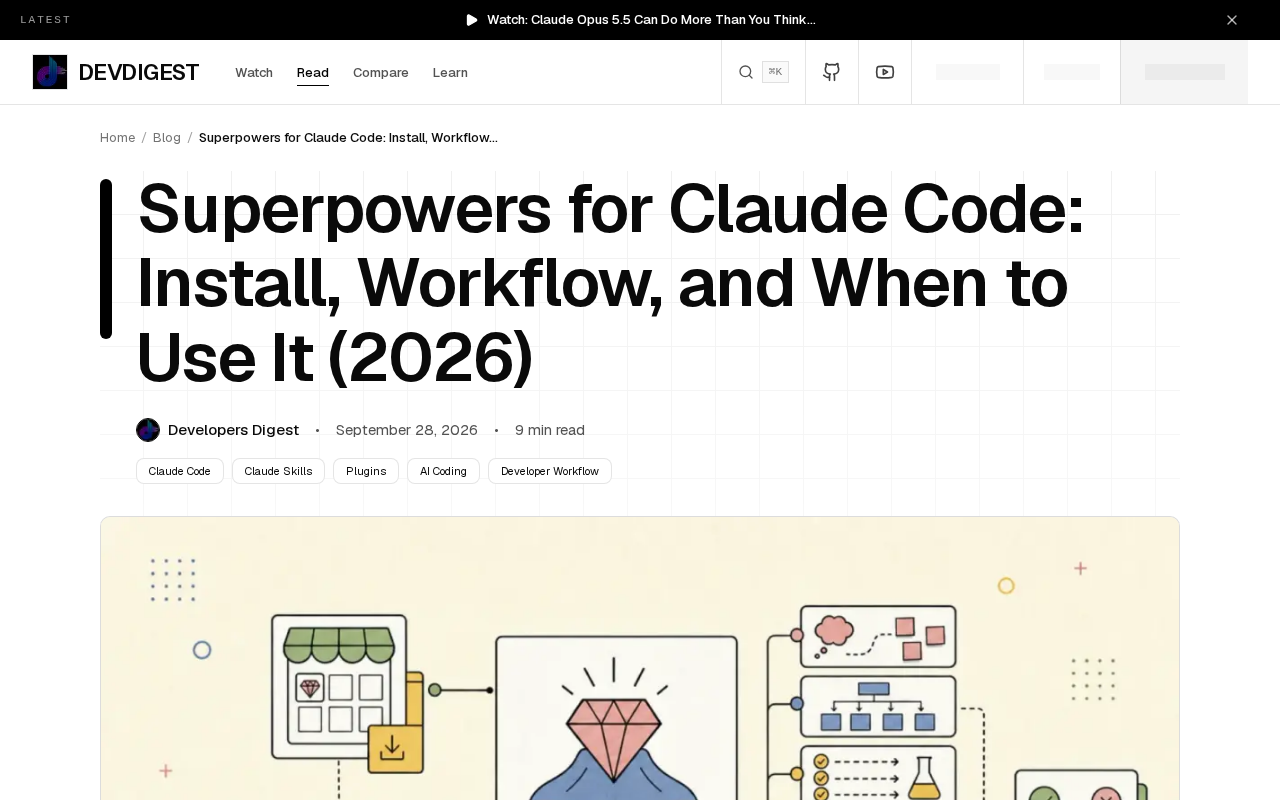
Superpowers gives Claude Code a complete engineering methodology, from brainstorming to code review.
Superpowers is an MIT-licensed Claude Code skill plugin that packages brainstorming, planning, TDD, subagent execution, and code review into callable skill modules — upgrading AI coding from passive generation to disciplined collaboration. Its core value is filling the gaps developers most often skip: requirement clarification and test verification. Distributed via the Claude Code marketplace, it's free for personal and commercial use. The full workflow adds conversation overhead, making it best suited for complex features, production code, and team projects; for quick prototypes or one-off scripts, invoking individual skills on demand is more efficient.
What Is Superpowers
Superpowers is an open-source skill plugin licensed under MIT, with a clear mission: to transform Claude Code from a passive code-generation assistant into an AI equipped with a structured software development methodology. From brainstorming and planning, to test-driven development (TDD), subagent execution, and code review, Superpowers compresses the workflow of a mature engineering team into a single installable plugin.
For developers who use Claude Code regularly, the biggest pain point is rarely that the model can't write code — it's the lack of consistent engineering discipline. Requirements get fuzzy before you start, tests get skipped, and changes go unreviewed. Superpowers aims to fill these gaps with a set of pre-built skills that enforce each stage of the process.
Core Skills Breakdown
The real value of Superpowers lies in how it breaks the development process into composable skill modules, each corresponding to a critical stage in software engineering.
Brainstorm and Plan
Before a single line of code is written, the Brainstorm skill helps you and Claude explore vague requirements together, expanding ideas and clarifying multiple possible implementation paths. The Plan skill then converges that discussion into a concrete, actionable development plan. This upfront step may seem like extra overhead, but for complex features it significantly reduces the likelihood of costly mid-project rework.
Test-Driven Development (TDD)
TDD is where Superpowers most clearly demonstrates its engineering rigor. It guides Claude to write tests first, then implementation — ensuring every new piece of code has an explicit verification standard. For teams that care about code quality, this replaces the optimistic assumption of "AI-generated code is ready to ship" with the more disciplined stance of "AI-generated code must pass tests."
Test-Driven Development is a programming practice built around the "Red-Green-Refactor" cycle: write a failing test first (Red), write the minimum code needed to make it pass (Green), then refactor under the safety net of that test (Refactor). The key insight is that tests themselves serve as a precise specification of requirements — which matters especially in AI-generated code, where the output is usually syntactically valid but may not match actual business intent. Traditionally, the biggest barrier to TDD is the time cost of writing tests upfront. Superpowers removes that friction by having Claude automatically generate test cases, turning TDD from a discipline you have to force yourself to maintain into a process the plugin runs automatically.
Subagent Execution and Review
Subagent execution allows tasks to be split across multiple subagents working in parallel or in a divided-responsibility model — ideal for larger-scale changes. The Review skill then performs a code review at the end, acting as an automated first-pass quality gate. Together, these two stages close the loop from execution to acceptance.
The subagent pattern draws from multi-agent system design: a complex task is decomposed into subtasks, distributed to independent agent instances that process them in parallel or in sequence, and the results are aggregated by a coordinator. In the context of Claude Code, this mechanism can work around single-session context window limitations while allowing each subagent to stay focused on its specific responsibility (e.g., one handling the data layer, another the interface layer), reducing cross-cutting concerns. This aligns closely with the software engineering principle of separation of concerns. That said, coordinating subagents introduces its own complexity, so this feature works best when module boundaries are clear and the inputs and outputs of each subtask can be well-defined — rather than in tightly coupled codebases.
How to Install
Superpowers is distributed through the official Claude Code marketplace, and the installation process is straightforward. Simply find the plugin in the official marketplace and install it — after that, all of its skills are available within Claude Code. Because it's MIT-licensed, both personal and commercial projects can freely use and modify it, which lowers the bar for adopting it in production work.
After installing, it's worth running through the complete workflow on a small task first to get a feel for how each skill is triggered and what its output looks like, before gradually applying it to your main development work.
When It's Worth Using
Superpowers brings methodology, but it also brings overhead. Brainstorming, planning, writing tests, reviewing — each of these steps consumes additional conversation turns and time. Deciding when to use it is fundamentally a trade-off between the benefits of structure and the cost of process.
For the following scenarios, the investment in this workflow typically pays off:
- Complex or long-lived features: High requirement uncertainty and code that needs to evolve over time — the upfront brainstorm and plan save a significant amount of rework later.
- Production code with high quality requirements: The guarantees from TDD and review far outweigh what a single quick-generation pass can offer.
- Multi-person collaboration: The structured plan and review outputs serve as documentation the team can actually communicate around.
For quick prototypes, one-off scripts, or exploratory experiments, the full workflow can slow you down. In those cases, invoking individual skills on demand is a better fit.
Closing Thoughts
Superpowers represents a way of thinking about AI programming that upgrades it from a "generation tool" to an "engineering collaborator." It doesn't try to make Claude Code write faster — it tries to make it write more consistently and reliably. Whether to adopt it depends on how much engineering discipline your project demands. When quality and maintainability are the priorities, the extra overhead this open-source methodology introduces becomes a worthwhile investment.
Related articles

Felix Rieseberg Personal Homepage
Felix Rieseberg's personal homepage sparks attention on Hacker News. This article covers the Slack engineer's technical background, the rise and fall of nativefier, and the value of a developer homepage as a tech calling card.

@ai-sdk/vue 3.0.306 Patch Release Syncs with [email protected] Update
@ai-sdk/vue 3.0.306 released, synced with [email protected]. A routine patch release for the Vercel AI SDK ecosystem with no public API changes; the Vue adapter layer stays version-aligned with the core package.

Gemini 4 Argon API Launches: The Era of Million-Token Output Begins
Google launches Gemini 4 Argon with sparse MoE architecture, up to 1M output tokens, and a 68.90% Vals Index score, available across API, AI Studio, and the Gemini app.