Superpowers Tutorial: Giving AI Coding Agents a Complete Development Workflow

Superpowers wraps a complete software development workflow around AI coding agents to reduce rework in complex projects.
The article introduces Superpowers, a workflow framework for AI coding agents like Codex Cloud Code. It addresses pain points such as agents skipping intermediate steps and writing code directly—causing guessed requirements, refactoring before the approach is settled, and hard-to-track regressions—by explicitly orchestrating requirements clarification, solution design, task breakdown, TDD development, independent review, and final acceptance into the workflow, so agents know the order of each step and the completion criteria. It breaks down the value of each stage and covers the tutorial path from zero installation and configuration to core Skills and a full real-project demonstration, plus a toolkit with the workflow, a Skills quick reference, prompts, and an acceptance checklist.
Building a demo with AI coding agents like Codex Cloud Code is no longer difficult—throw a requirement at it and pages, APIs, or even a project skeleton can be up and running in no time. But once the project gets complex, trouble begins: it starts writing before the requirements are clarified, the overall approach isn't settled yet but a pile of code has already been changed, new features look fine but old functionality quietly breaks, and in the end the Agent says "done" while you still have to verify everything from scratch yourself.
This "skip the intermediate steps and just start coding" pattern multiplies rework costs in complex projects. Superpowers is designed to solve exactly this problem: it wraps a complete software development workflow around coding agents—clarify requirements first, then define the approach and break down tasks, write tests before implementing during development, and finish with independent review and final verification. The Agent thus knows what to do first at each step, and knows what level of completion actually counts as truly done.
Why AI Coding Agents Need a Workflow
AI coding tools' capabilities are expanding rapidly, but "can write code" and "can deliver reliable features" are two different things. The pain points highlighted in the original video are typical: when requirements are vague, the Agent fills in the blanks on its own; when the approach isn't settled, it's already refactoring; and once changes spread out, regression issues become hard to track.
Fundamentally, this shares the same root cause as problems in human team collaboration: without staged deliverables and checkpoints, quality control can only rely on a one-off final acceptance. Superpowers' approach is to explicitly orchestrate proven software engineering practices—requirements clarification, solution review, TDD, code review—into the Agent's workflow, so that "the steps that should be there" are no longer skipped.
TDD (Test-Driven Development) is the core practice repeatedly mentioned in this article: write test cases for the feature to be implemented first, then write code to make the tests pass, and finally refactor and optimize. It's especially important for AI coding agents because test cases turn "is the feature done?" from a subjective judgment into an automatically executable objective standard: after writing code, the Agent can run the tests itself, keep fixing on failure, and only consider it delivered on success. This directly answers the question of "what level of completion counts as truly done." Compared to having the Agent write the implementation directly and then verifying manually, TDD front-loads the acceptance criteria, significantly reducing cases of "looks fine but actually defective," and exposes regression issues early.
Breaking Down Superpowers' Complete Workflow
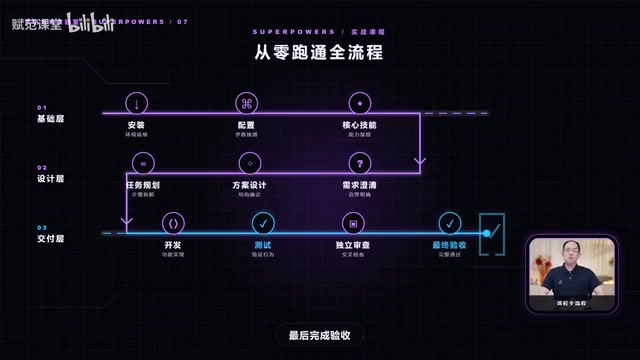
According to the video, Superpowers defines a staged software development workflow for coding agents like Codex Cloud Code, with stages in order: requirements clarification, solution design, task breakdown, TDD development, independent review, and final acceptance.

The value of this workflow isn't how novel the stages are, but that it turns "what counts as done" into explicit criteria the Agent can judge. In the requirements stage, it first probes what hasn't been made clear; in the solution stage, it first determines the overall approach; in the task stage, it breaks big goals into verifiable small units; in the development stage, it writes tests before implementing features; and finally it goes through independent review and final verification. The more complex the project, the more rework these front-loaded constraints save.

Regression refers to previously working functionality being accidentally broken after modifying or adding code. This is especially insidious in the AI coding agent scenario: the Agent often changes multiple files at once, with a large scope and fast speed, making it hard for humans to trace line by line which changes affected which existing logic. The article's description of "new features look fine but old functionality quietly breaks" is exactly this situation. The standard defense against regression is an automated test suite—rerun all tests after every change, and any failing old test case counts as a regression. This is also why Superpowers orchestrates TDD and final verification into the workflow: without tests as a safety net, the Agent's rapid iteration only amplifies risk.
Skills are modular units in Superpowers that carry specific workflow capabilities—think of them as encapsulated reusable instruction sets or operating specifications, e.g., "how to clarify requirements," "how to break down tasks," and "how to perform code review" each correspond to a Skill. The Agent invokes the corresponding Skill at different stages of the workflow, thereby acting according to established specifications rather than relying on ad-hoc prompts. The value of this design lies in composability and reusability: the same set of Skills can be reused across projects and agents, and it's easy to iterate on a single stage without affecting the overall workflow. The tutorial specifically mentions "core Skills," indicating they are the parts you must master first when getting started with Superpowers.
From Zero Installation to Running Your First Project
The tutorial covers the path from scratch: installation, configuration, core Skills, then going through requirements clarification, solution design, task planning, and on to development, testing, review, and final acceptance. The author also demonstrates the entire process with a real project—starting from a single requirement, observing how Superpowers clarifies the requirement, settles on an approach, breaks out tasks, and then implements the feature step by step.
For those who want to get started, such an end-to-end demonstration is more useful than scattered feature introductions: you can see what the inputs and outputs of each stage look like, and judge whether this workflow fits the type of project you have on hand.
Companion Resources and Getting-Started Tips
The video author has put together a Superpowers project实战 toolkit, including the complete development workflow, a core Skills quick reference,实战 prompts, and a project acceptance checklist. According to the video, you can get it by replying with a keyword in the comments.
If you plan to try it in your own projects, start with a small but complete feature, run the full loop from requirements clarification to acceptance once, and then gradually extend the workflow to more complex modules. The workflow itself has a learning curve, but compared to repeated rework late in complex projects, this investment is usually worth it.
One-line Summary
Superpowers wraps a complete software development workflow around AI coding agents to reduce rework in complex projects.
Paragraph Summary
The article introduces Superpowers, a workflow framework for AI coding agents like Codex Cloud Code. Addressing pain points such as agents skipping intermediate steps and writing code directly—leading to guessed requirements, refactoring before the approach is settled, and hard-to-track regressions—it explicitly orchestrates requirements clarification, solution design, task breakdown, TDD development, independent review, and final acceptance into the workflow, so agents know the order of each step and the completion criteria. The article breaks down the value of each stage and covers the tutorial path from zero installation and configuration to core Skills and a full real-project demonstration, along with a toolkit containing the workflow, a Skills quick reference,实战 prompts, and an acceptance checklist, recommending you first run a small feature through the full loop before expanding.
Related articles

Switch 2 Accessory Review: Nitro Deck 2 Is a Few Millimeters Short of Perfect
CRKD Nitro Deck 2 review: this Hall Effect stick accessory for Switch 2 and the original Switch continues the original's legacy, but falls a few millimeters short of perfect due to size fit issues.

Apollo Economist: AI Delivers Zero Financial Return for Most Companies
Apollo Chief Economist Torsten Slok says AI has delivered near-zero financial return to U.S. companies outside tech. We analyze the adoption gap and investment implications.

Instagram Officially Launches on Apple TV, Ushering in the Era of Reels on the Big Screen
Instagram officially launches its Apple TV app, letting users watch Reels short videos and livestreams on the big screen. This article analyzes the evolution of Instagram's TV strategy, product challenges, and the impact on creators and users.