Superrelay: A Unified AI Customer Support Inbox for Multi-App Teams

Superrelay aggregates multi-channel support into a unified inbox, with an AI agent that cites sources and asks before acting—and never charges per ticket.
Superrelay is a customer support consolidation tool gaining attention on Product Hunt. It aggregates chat, email, WhatsApp, Slack, and in-app messages into a single inbox for teams maintaining multiple apps. Its AI agent cites sources and asks before acting, and it supports GitHub-synced docs plus CLI and MCP for coding agents to read tickets. It explicitly promises "never priced per ticket," though specific pricing details are undisclosed and its maturity still needs more user validation.
Multi-app development teams often struggle with fragmented support channels: chat, email, WhatsApp, Slack, and in-app messages each operate in their own silo, and per-ticket pricing models cause costs to skyrocket as teams scale. Superrelay, ranked fourth on Product Hunt, aims to solve all of this with a single inbox, introducing an AI agent that cites its sources and asks before acting. It explicitly promises "never priced per ticket," which is particularly appealing to SaaS teams weary of pay-as-you-go costs.
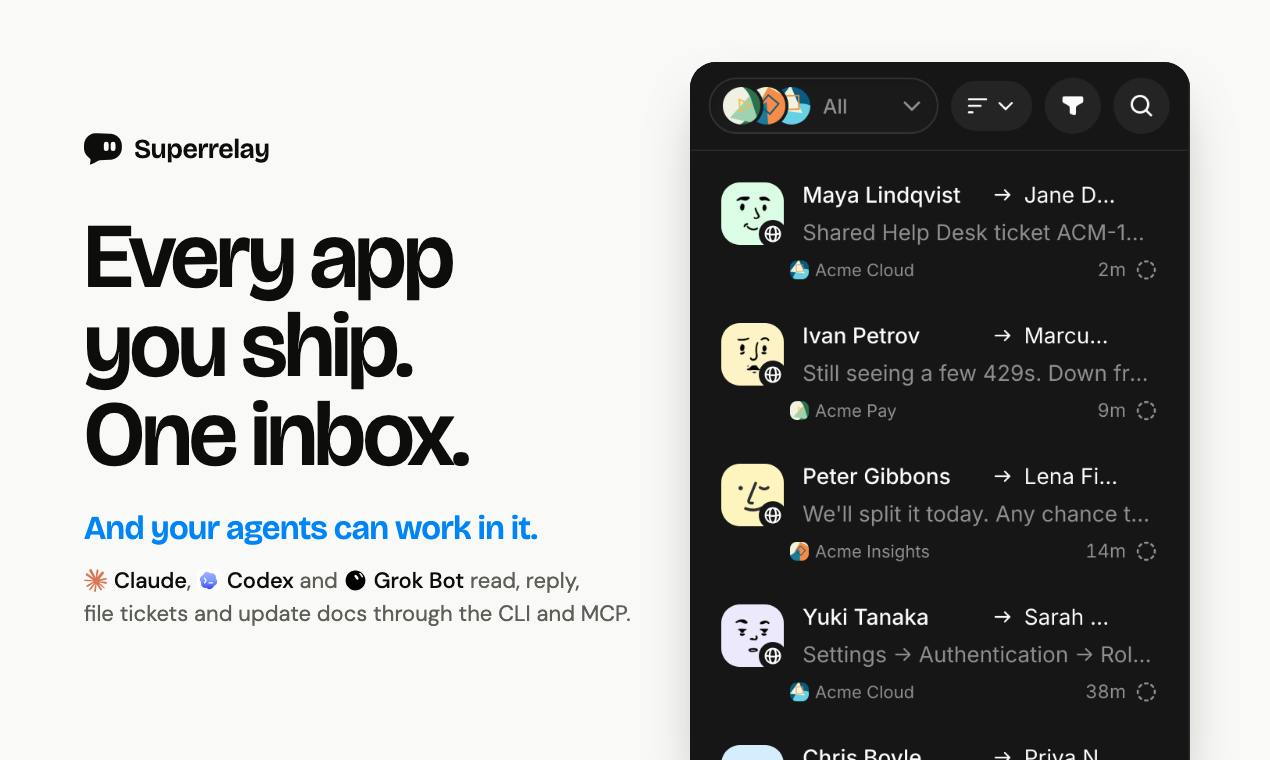
One Inbox, All Support Channels Aggregated
At its core, Superrelay is a unified support workspace that brings chat, email, WhatsApp, Slack, and in-app messages from all the apps a team publishes into a single interface. For teams maintaining multiple products simultaneously, there's no more switching between backends—all user feedback and issues can be handled in one place.
This aggregation isn't just a UI-level consolidation. According to the Product Hunt page, it supports cross-channel conversation management, enabling support staff to respond to inquiries from different sources in a consistent manner. With 103 upvotes and 13 comments, the product gained notable attention during its early launch.
AI Agent: Cites Sources, Asks Before Acting
Superrelay's built-in AI agent has two notable features: it cites sources, and it asks before acting. This means when the AI answers user questions, it indicates where the information comes from, increasing credibility; and before executing potentially impactful actions (such as changing ticket status or sending specific replies), it seeks confirmation first to avoid mistakes.
This design approach addresses common enterprise concerns about AI customer support: black-box answers and unauthorized automated behavior. By requiring the AI to cite sources and adding a confirmation step, Superrelay attempts to strike a balance between automation and controllability.
GitHub-Synced Docs and CLI/MCP for Coding Agents
Superrelay syncs documentation with GitHub, ensuring knowledge base content stays consistent with code repositories. For technical product teams, this means updates to product documentation are directly reflected in customer support, reducing information lag.
More uniquely, it offers a CLI and MCP (Model Context Protocol), allowing coding agents to read tickets directly. This feature connects the customer support system with development workflows: AI coding assistants can read user-submitted issues to help locate and fix bugs. For teams already using AI programming tools, this bridges the gap from user feedback to code fixes.
MCP (Model Context Protocol) is a protocol standard proposed and open-sourced by Anthropic in late 2024, designed to establish a unified connection between large language models (LLMs) and external data sources and tools. You can think of it as the "USB-C port for AI applications": previously, every AI assistant needed custom integrations to access a system (such as a database, ticketing system, or code repository); MCP defines a standard client-server communication specification that lets any MCP-compatible AI agent discover and invoke external tools in a consistent way. In Superrelay's case, offering MCP means coding agents (such as Claude Code, Cursor, and other MCP-supporting programming assistants) can directly read ticket contents without additional adapters, incorporating user feedback into the context of code fixes. This differs from traditional REST APIs—MCP exposes not only data but also "capabilities" (such as searching tickets or updating status), enabling AI to autonomously plan and execute multi-step operations.
Pricing Strategy: Never Priced Per Ticket
"Never priced per ticket" is Superrelay's most distinctive pricing claim. Traditional customer support systems often charge by ticket volume or seat count, and costs can rise sharply as the business grows. Superrelay promises not to charge per ticket, attempting to attract teams with highly variable or continuously growing ticket volumes through its cost structure.
However, the Product Hunt page does not disclose specific pricing details, so the actual cost advantage still needs to be evaluated based on team size and usage.
Per-ticket pricing is a common billing model for customer support ticketing systems: enterprises incur a fee each time a ticket is created or resolved. Typical examples include Zendesk's early per-seat pricing, Intercom's per-active-contact pricing, and some domestic ticketing systems that charge on a tiered per-ticket basis. The problem with this model is that costs are directly tied to business volume—during promotional seasons, product outages, or periods of user growth, ticket volume can double overnight, causing monthly bills to spike unpredictably; for teams with highly variable ticket volumes, budget planning becomes extremely difficult. In contrast, per-seat or flat-fee pricing keeps costs relatively fixed. Superrelay's promise of "never priced per ticket" essentially decouples pricing from support workload, so teams don't need to worry about marginal costs as ticket volume grows and can be more willing to encourage users to submit feedback. That said, not charging per ticket doesn't mean it's free—whether it uses seat-based subscriptions or usage tiers still requires checking its official pricing page to determine the actual cost structure.
Integration Approach for Multi-App Teams
Superrelay's positioning is clear: serving teams that publish multiple apps simultaneously. The unified inbox reduces channel switching, the AI agent improves response efficiency, and GitHub sync plus CLI/MCP target technical teams. According to Product Hunt, the product was developed by Geon George and is categorized under Customer Success, SaaS, and Artificial Intelligence.
For teams looking for a customer support consolidation solution, Superrelay offers a direction worth watching. But its actual performance—especially AI answer accuracy and stability across multi-app scenarios—still needs more user feedback to verify. The early data of 13 comments and 103 votes is not yet sufficient to judge the product's maturity.
One-line Summary
Superrelay aggregates multi-channel customer support into a unified inbox, with an AI agent that cites sources and asks before acting—and never charges per ticket.
Paragraph Summary
Superrelay is a customer support consolidation tool gaining attention on Product Hunt. Its core offering is aggregating chat, email, WhatsApp, Slack, and in-app messages into a single inbox, aimed at teams maintaining multiple apps. Its built-in AI agent emphasizes controllability: citing sources when answering and seeking confirmation before taking actions. The product also supports GitHub-synced documentation and provides CLI and MCP for coding agents to read tickets directly, bridging the gap from user feedback to code fixes. On pricing, it explicitly promises "never priced per ticket," attempting to attract SaaS teams with highly variable ticket volumes through its cost structure. However, specific pricing details are not disclosed, and AI accuracy and multi-app stability still need more user validation—the early data of 103 votes and 13 comments is not yet sufficient to judge maturity.
Related articles

Has AI Surpassed the Median Economist? A Debate on Perceiving Capability
A YouTube discussion argues AI's comprehension in soft fields like economics has surpassed the median professional economist, but people resist acknowledging it due to the lack of hard metrics. The article analyzes this perception gap and its industry implications.

Banks No Longer Profitable? The Industry Shift Sparking Debate on HN
Hacker News debates the claim that "banks are no longer profitable." This article analyzes the real picture of profit divergence in banking, explains failure and seizure mechanisms, and examines the structural pressures on bank profitability from interest rates, deposit competition, and technology costs.

Govee Smart Outdoor Lights 30% Off for Black Friday: 50-Foot Model Drops to All-Time Low
Govee Black Friday sale: 50-foot Permanent Outdoor Lights 2 drops to $125.99, matching its all-time low; 100-foot model drops to $179.99, a $100 discount. We analyze value and buying advice.