Surging Demand for Qwen3-Max Cloud Deployment: Analyzing Ollama Cloud Model Availability Trends

Developer demand for Qwen3-Max on Ollama Cloud signals the convergence of cloud inference and Chinese LLM globalization.
A Reddit post asking about Qwen3-Max availability on Ollama Cloud reveals two major AI infrastructure trends: local inference tools extending to cloud hosting, and Chinese LLMs like Qwen and GLM becoming integral to global developer workflows. The article explores Qwen3-Max's capabilities, Ollama's evolution from local to cloud, and practical deployment paths for developers.
The Industry Signal Behind a Reddit Question
Recently, a developer posted on Reddit asking: "Will Ollama Cloud offer the Qwen 3.x Max model, similar to how it provides the GLM series?" This seemingly simple question actually reflects an important trend in the AI developer community — local inference tools are rapidly extending into cloud-hosted services, and Chinese large language models are becoming a focal point for global developers.
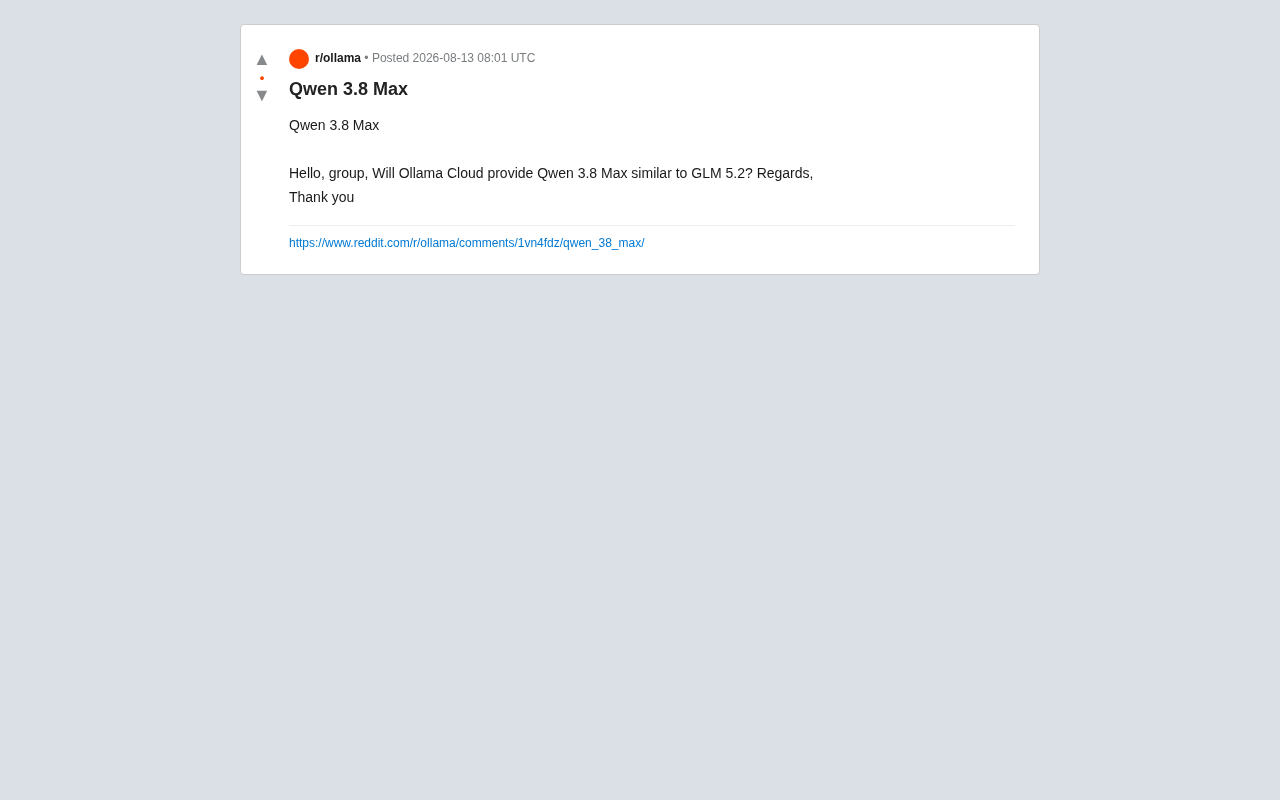
Interestingly, the version numbers "Qwen 3.8 Max" and "GLM 5.2" mentioned in the post likely contain typos or informal community naming. Currently, Alibaba Cloud's flagship model in the Tongyi Qianwen series is Qwen3-Max, while Zhipu AI's GLM series continues its own iteration cycle. This kind of naming confusion itself illustrates a key point: the pace of LLM iteration has become so rapid that many developers struggle to keep up with specific version numbers.
Qwen3-Max: Alibaba's Flagship Large Language Model
Model Positioning and Core Capabilities
Qwen3-Max is the top-tier model in Alibaba's Tongyi Qianwen (Qwen) series, designed to handle the most complex reasoning, coding, and multilingual tasks. Compared to the open-source Qwen3 series (such as Qwen3-32B, Qwen3-235B, etc.), the Max version is typically offered as a closed-source API service with larger parameter counts and stronger overall capabilities.
The Tongyi Qianwen (Qwen) series was developed by Alibaba Cloud's DAMO Academy. Since its initial release in 2023, it has undergone multiple major iterations. The Qwen3 series adopts a Mixture of Experts (MoE) architecture — for example, Qwen3-235B has 235 billion total parameters but only activates approximately 22 billion during inference. This sparse activation mechanism maintains high performance while effectively controlling inference costs. Qwen3 also introduced a "thinking mode" toggle feature, allowing users to flexibly switch between deep reasoning (thinking mode) and fast response mode to adapt to tasks of varying complexity.
A notable advantage of the Tongyi Qianwen series is its comprehensive product matrix: it offers both locally deployable open-source models (under the Apache 2.0 license) and commercial API services through the Alibaba Cloud Bailian platform. The Apache 2.0 license is one of the most permissive licenses in the AI open-source space — it allows anyone to freely use, modify, and distribute model weights, including for commercial purposes, without requiring derivative works to be open-sourced. By comparison, Meta's Llama series previously used custom licenses that imposed additional restrictions on large-scale commercial use. Qwen's choice of Apache 2.0 significantly reduces legal concerns for enterprise adoption, enabling a large number of industry-vertical models and applications built on Qwen. While this sacrifices direct model licensing revenue, it indirectly drives consumption of Alibaba Cloud's computing services by expanding the ecosystem.
This "open-source + closed-source" dual-track strategy has earned Qwen extremely high adoption rates in the global developer community — on platforms like Hugging Face, Qwen-derived models consistently rank among the most downloaded.
Why Developers Want to Use Qwen3-Max on Ollama
Ollama is an open-source local LLM runtime framework released by Matt Williams and others in 2023. By wrapping underlying inference engines like llama.cpp, it simplifies the process of downloading, quantizing, and running large models into a Docker-like command-line experience — developers only need to execute commands like ollama run qwen3:8b to automatically download and launch a model. Ollama supports macOS, Linux, and Windows, and includes a built-in model registry (Ollama Library) that currently hosts hundreds of models in various quantized versions. Its OpenAI-compatible API interface design allows many applications built on the ChatGPT API to seamlessly switch to local models.
As one of the most popular local LLM runtime tools, Ollama's core value lies in simplifying model download, deployment, and invocation workflows. The desire to use Qwen3-Max directly within the Ollama ecosystem reflects several real needs:
- Unified API interface: No need to integrate different APIs for each model separately
- Data privacy considerations: Local or controlled cloud deployment prevents sensitive data leakage
- Cost predictability: Managing multi-model invocation costs through a unified platform
Ollama Cloud: A Strategic Extension from Local Inference to Cloud Hosting
The Underlying Logic Behind Cloud Services
Ollama originally built its reputation on local execution, but as model parameter counts continue to balloon, model files of hundreds of gigabytes have exceeded the hardware capacity of average developers. This involves a key technical concept — model quantization. Quantization converts model weights from high-precision floating point (e.g., FP16/BF16, 2 bytes per parameter) to low-precision representations (e.g., INT4, 0.5 bytes per parameter). The GGUF format used by Ollama supports various quantization schemes like Q4_K_M and Q5_K_S, each offering different trade-offs between model size and inference quality. For example, a 235B parameter model requires approximately 470GB of storage in FP16, which can be compressed to roughly 60-80GB after 4-bit quantization — still far exceeding the capacity of consumer GPUs (typically 8-24GB VRAM), despite the significant reduction.
Ultra-large models like Qwen3-Max and GLM flagship versions are virtually impossible to run smoothly on personal computers.
This is precisely why cloud-hosted services like Ollama Cloud exist — they attempt to migrate compute-intensive large model execution to the cloud while preserving Ollama's unified experience. Developers can use familiar commands and interfaces to invoke massive models that their local hardware cannot support.
Practical Considerations for Model Availability
Regarding the question of "when will Ollama Cloud offer Qwen3-Max," it's important to understand that model availability typically depends on several key factors:
- Licensing agreements: Closed-source commercial models (like Qwen-MaxAd, GLM flagship) require partnership and licensing arrangements with model providers
- Technical adaptation: Different models' inference frameworks and quantization schemes require targeted integration
- Market demand: Platforms prioritize models with strong community demand
Based on community feedback, the strong demand for the Qwen series itself is a significant driver for its availability. The GLM series is already available on some platforms, providing a precedent for Qwen's inclusion.
China's LLMs Are Expanding Their Global Influence
The deepest significance of this question from an overseas community lies in the fact that Qwen, GLM, and other Chinese LLMs have become deeply integrated into global developers' daily toolchains.
The GLM (General Language Model) series is developed by Zhipu AI, incubated at Tsinghua University. It was originally based on an Autoregressive Blank Infilling pre-training paradigm, architecturally distinct from the pure decoder-only GPT approach. Its flagship GLM-4 series excels in Chinese understanding, multimodal processing, and long-context handling (supporting 128K context windows). Zhipu AI's business model also adopts a parallel open-source and closed-source strategy, providing API services through the Zhipu Open Platform (BigModel) while releasing some models as open source.
In the past, overseas developers' default choices were typically models from OpenAI, Anthropic, or Meta. Now, when a Reddit user actively asks whether a tool supports Qwen and GLM, it marks a transformation of Chinese AI models from "being known" to "being relied upon."
Several key factors support this shift:
- Performance parity or superiority: In multiple benchmarks, flagship versions of Qwen and GLM have approached or matched international top-tier levels
- Successful open-source strategy: Qwen's extensive open-source model releases have lowered barriers to entry and built a broad developer base
- Significant cost advantages: Compared to some international closed-source models, Chinese LLM APIs offer more competitive pricing
Practical Deployment Paths for Developers Using Qwen3-Max
If you're also looking for ways to use Qwen3-Max, here are several realistic paths currently available:
Official API Channel: You can directly invoke the Qwen-Max series through the Alibaba Cloud Bailian platform (DashScope) — this is the official pathway for accessing the latest and most complete capabilities. The Bailian platform is Alibaba Cloud's one-stop LLM service platform, supporting text generation, multimodal understanding, code generation, mathematical reasoning, and more. It also offers advanced features such as model fine-tuning, knowledge base augmentation (RAG), and agent orchestration. Its pricing follows a per-token billing model, with Qwen-Max typically priced far below international counterparts like GPT-4o, making it an important choice for cost-sensitive developers.
Local Deployment of Open-Source Models: If privacy and cost are primary concerns, you can choose from the Qwen3 open-source versions already available on Ollama (such as Qwen3-8B, Qwen3-14B, etc.). While not Max-level, they're sufficient for most common tasks. After GGUF quantization, the 8B parameter version requires only 5-8GB of memory to run, and the 14B version needs approximately 10-16GB — entirely feasible for individual developers with mid-to-high-end GPUs.
Monitor Platform Updates: Regarding whether Ollama Cloud will offer Qwen-Max, it's advisable to keep an eye on official announcements and community developments. Given the level of demand, the availability of such flagship models is only a matter of time.
Conclusion
A brief community question actually maps to two major threads in AI infrastructure evolution: the cloudification of LLM runtime tools and the globalization of Chinese large language models. Whether it's Ollama expanding from local to cloud, or Qwen and GLM becoming standard options for overseas developers, it all demonstrates that AI technology adoption is breaking down geographical and platform boundaries. For developers, maintaining an open attitude toward diverse model ecosystems and choosing the tool combinations best suited to their specific scenarios remains the optimal strategy for navigating rapid change.
Related articles

Chain of Thought Isn't Just for AI: How Humans Can Use CoT to Improve Thinking Quality
Chain of Thought isn't just a prompt trick for large models. Starting from a Hacker News discussion, this article analyzes why CoT works for human thinking too, breaks down actionable ways to transfer it, and highlights the key differences between human CoT and machine CoT.
Cloudflare Teams Up with OpenAI: Closi…
Cloudflare Teams Up with OpenAI: Closing the Loop from Vulnerability Discovery to Defense with AI
Cloudflare uses OpenAI Daybreak to investigate security vulnerabilities and generate reviewable remediation plans, while developers use Codex to boost coding efficiency and quality.

Orca Multi-Agent Orchestration in Practice: A Guide to Parallel Collaboration with Claude and Codex
Orca is Stable AI's free open-source agent workbench supporting 34 agents like Claude Code and Codex in parallel. Learn its Git worktree isolation, multi-model orchestration, and mobile management.