Surviving the AI Layoff Wave: The Workplace Hype Truths Exposed by a Satirical Video
A satirical video exposes the absurd reality of AI workplace hype, fear-driven decisions, and zero-sum thinking.
TikTok creator Mo Bitar's satirical video exposes AI workplace dysfunction: a fabricated "Ralph Loop" concept can secure budgets and promotions in companies lacking technical judgment, while "automating colleagues" becomes a self-preservation strategy. Behind the satire lie three realities—AI capabilities are widely overestimated, fear drives corporate AI decisions, and tech hype erodes workplace ethics. The article calls for building genuine AI literacy, guarding against "AI Theater," and rebuilding a human-centered approach to technology.
A Satirical Video Uncovers the Truth About AI in the Workplace
TikTok creator Mo Bitar recently posted a video titled The Unethical Guide to Surviving AI Layoffs, using razor-sharp satire to paint a picture of the AI-era workplace that is both absurd and deeply unsettling.
The video was shared and commented on by prominent developer Simon Willison, quickly sparking widespread discussion across the tech community. Simon Willison is the co-creator of the Django web framework and the author of open-source projects like Datasette. He has long been known for his in-depth tracking and commentary on the real-world applications of AI tools. His blog and social media accounts represent one of the few voices in the tech world that consistently offers honest assessments of AI capabilities. When he chose to share and comment on Mo Bitar's video, it sent a clear signal: this seemingly entertainment-oriented content touches on deep issues that the technical community genuinely cares about.
On the surface, it's a guide on "how to leverage AI hype to keep your job." In reality, it precisely targets some of the most uncomfortable phenomena in today's AI industry.
The Fabricated "Ralph Loop": How a Nonexistent Term Can Get You Promoted
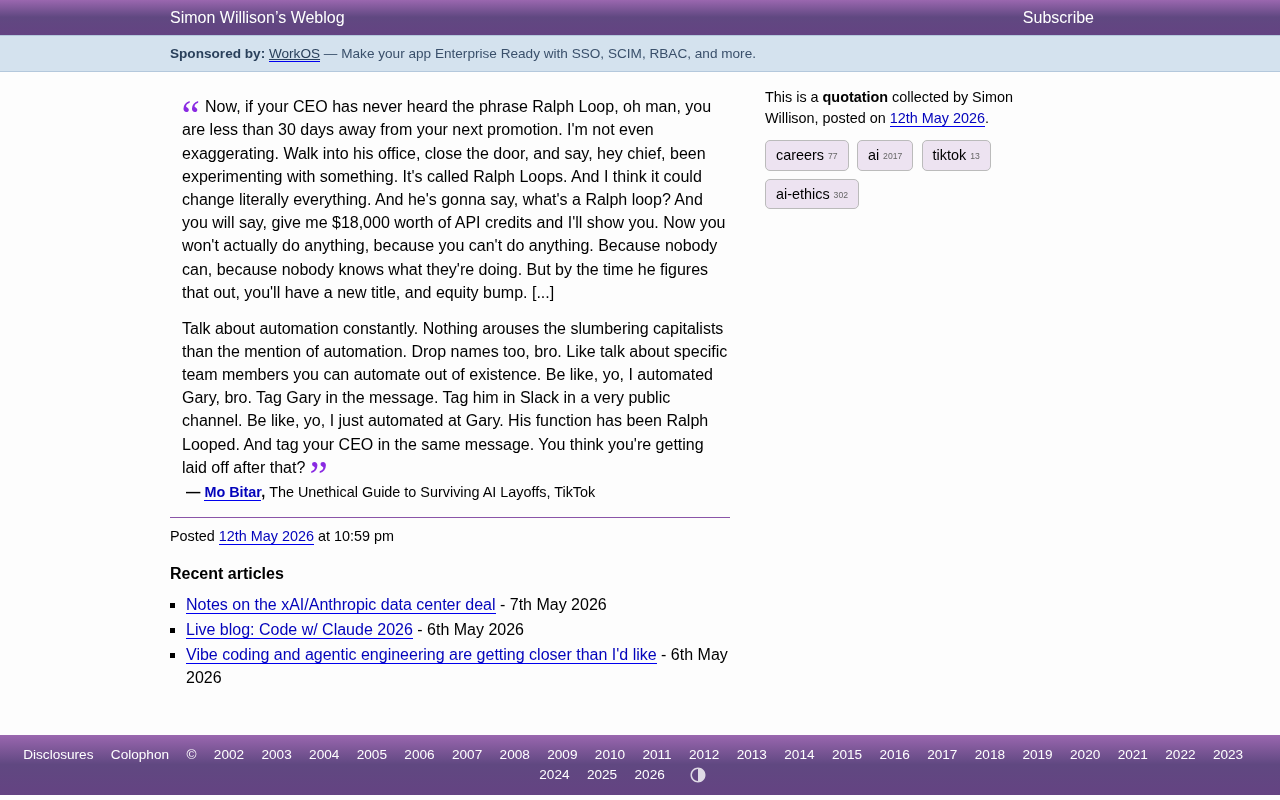
The most brilliant segment of the video is the "Ralph Loop" concept. Mo Bitar suggests: walk into the CEO's office, close the door, and tell them you've been researching something called the "Ralph Loop" and you think it could change everything.
When the CEO asks "What's the Ralph Loop?", you simply say: "Give me $18,000 in API credits, and I'll show you."
This number isn't arbitrary. In current AI development practice, API costs for calling large language models like GPT-4 and Claude can indeed accumulate to staggering amounts quickly. For a mid-sized enterprise AI application, spending thousands to tens of thousands of dollars monthly on API fees during the development and testing phase is not uncommon. More critically, many companies lack an effective framework for evaluating ROI when approving these budgets—they often cannot distinguish between a genuinely valuable AI experiment and one that simply burns money on a proof of concept.
And then? You won't do anything. Because you can't do anything. Because nobody can do anything. Because nobody actually knows what they're doing.
But by the time the CEO realizes this, you'll already have a new title and equity incentives.
This passage is so incisive because it reveals an uncomfortable reality: in the AI field, information asymmetry has become an "asset" that can be exploited. Information Asymmetry is a classic concept in economics, systematically articulated by Nobel laureate George Akerlof in his famous "Market for Lemons" theory. In the AI industry, this asymmetry is particularly pronounced: the actual capability boundaries of large language models, the severity of hallucination problems, and the enormous gap between prototype and production deployment—these critical pieces of information can often only be accurately assessed by frontline technical staff. Meanwhile, decision-makers receive information that has been filtered through vendor marketing, consulting firm packaging, and media amplification, resulting in a systematic bias between their perception of AI and technical reality.
A large number of managers lack the ability to judge the actual capabilities of AI technology, and this cognitive gap is being exploited in various ways—some well-intentioned, others decidedly not.
"Automate Gary": When Colleagues Become Your Layoff Leverage
The second half of the video cuts even deeper. Mo Bitar "advises" people to constantly talk about automation, because "nothing awakens a sleeping capitalist quite like mentioning automation."
He even "suggests" @-mentioning specific colleagues in public Slack channels, announcing "I just automated Gary. His function has been replaced by the Ralph Loop," while also @-mentioning the CEO.
"Do you think you're getting laid off after that?"
The satirical force of this passage is almost suffocating. It doesn't depict a fictional dystopia but rather a distorted version of what's already happening in some workplaces—people racing to prove they can use AI to replace others, thereby proving their own indispensability. This is an extreme manifestation of zero-sum thinking: pushing colleagues toward the layoff list in order to protect yourself.
Viewing AI's introduction to the workplace as a zero-sum game (where one party's gain necessarily means another's loss) is not a new phenomenon. Every major technological shift in history has triggered similar workplace anxiety and internal competition. During the Luddite movement of the 19th century, textile workers smashed machines to protect their jobs; when personal computers became widespread in the 1980s, "knowing how to use a computer" briefly became political capital in the workplace. However, the zero-sum game of the AI era has a uniquely dangerous dimension: unlike previous technological tools, AI is narratively framed as being able to "replace" rather than "assist" human workers. This escalates workplace competition from "who's better at using the tool" to "who can prove that others can be replaced by the tool."
Three Layers of Reality Behind the AI Hype Satire
Layer One: AI Capabilities Are Widely Overestimated
The current market is flooded with overpromises about AI capabilities. From "AI will replace all programmers" to "AI makes everyone a 10x engineer," these narratives have created an enormous expectations bubble.
The "10x Engineer" is itself a long-contested concept in the software industry, originally stemming from research cited by Fred Brooks in The Mythical Man-Month, suggesting that the best programmers might be ten times more productive than average ones. In the AI era, this concept has been repackaged as "AI makes everyone a 10x engineer," implying that AI coding assistants (like GitHub Copilot, Cursor, etc.) can boost an ordinary developer's output by an order of magnitude. However, multiple empirical studies and frontline developer feedback indicate that while AI coding tools can indeed significantly improve efficiency with boilerplate code and simple tasks, their contribution to complex system design, debugging, and maintenance—core engineering activities—is far less significant than advertised, and can sometimes even reduce overall efficiency by introducing hard-to-detect bugs.
Mo Bitar's "Ralph Loop" is the perfect metaphor for this AI bubble—a completely fabricated concept that can sail through an anxiety-filled corporate environment without resistance.
Layer Two: Fear-Driven AI Decision-Making Culture
Many companies' AI strategies are not based on rational assessment but on the fear of "falling behind." This fear cascades from top to bottom: CEOs fear being questioned by the board, middle managers fear being seen as "not getting AI," and rank-and-file employees fear being replaced by AI. In this atmosphere, any term that sounds sufficiently cutting-edge becomes a universal pass.
This phenomenon can be explained by the organizational behavior theory of "Institutional Isomorphism." Sociologists DiMaggio and Powell proposed in 1983 that organizations in uncertain environments tend to mimic the behavior of other organizations, even when such behavior doesn't suit their own circumstances. In the current wave of AI adoption, "mimetic isomorphism" is particularly evident: companies rush to announce AI strategies not because they've conducted rigorous needs assessments, but because competitors and industry benchmarks are doing the same. AI adoption rate reports published by McKinsey, Boston Consulting Group, and others further intensify this anxiety—nobody wants to be part of the "hasn't adopted AI yet" segment in the statistics.
Layer Three: The Moral Cost of Tech Hype
When "automating colleagues" becomes a workplace strategy, the moral dimension of technological progress is completely abandoned. AI should be a tool for enhancing human capabilities, not a weapon for office politics.
How Should We Respond to AI Layoff Anxiety?
The value of this video lies not in the "advice" it offers (which is obviously ironic), but in forcing us to confront several key questions:
- Companies need to build AI literacy: Decision-makers must possess basic technical judgment, or they will become prey to hype
- Beware of the "AI Theater" phenomenon: Distinguish between genuine AI applications and purely performative deployments. "AI Theater" borrows from Bruce Schneier's concept of "Security Theater"—measures that look like they're enhancing security but are actually ineffective, such as certain perfunctory airport screening processes. In the AI realm, "AI Theater" refers to companies deploying AI tools primarily to demonstrate externally that "we're using AI" rather than solving actual business problems. Typical manifestations include: embedding unnecessary chatbot interfaces in products, frequently mentioning AI keywords during earnings calls to boost stock prices, and creating titles like "Chief AI Strategy Officer" without substantive technical roadmaps. Multiple industry surveys show that a significant proportion of corporate AI projects never reach production or fail to generate measurable business value.
- Rebuild a human-centered view of technology: AI introduction should aim to enhance team capabilities, not use headcount reduction as a KPI
- Maintain an honest technical culture: Encourage teams to candidly discuss AI's actual capabilities and limitations
In an era where everyone is talking about AI, the scarcest quality may not be technical ability but honesty—honesty about technological capabilities, honesty about one's own understanding, and basic respect for colleagues.
Mo Bitar used absurdist comedy to deliver a serious lesson in workplace ethics. After the laughter subsides, it's worth deep reflection for anyone navigating the AI wave in their career.
Key Takeaways
- Mo Bitar's satirical video exposes the pervasive hype in the AI field—fabricated terms and concepts can pass unchallenged in companies lacking technical judgment
- The "automate your colleague" satire reveals the zero-sum mentality in AI-era workplaces: people racing to prove they can replace others with AI to secure their own positions
- Corporate AI decisions are often driven by fear rather than rationality, and management's technical knowledge gap is being exploited in various ways
- The video calls for building genuine AI literacy and an honest technical culture, warning against the trend of weaponizing AI tools for office politics
Related articles
 Expert Opinions
Rethinking Scaling Laws: Parameters Are Not the Only Answer
Deep analysis of Scaling Law evolution from Kaplan to Chinchilla to the MoE era, exploring why blindly stacking parameters is a mistake, and how GLM-5.3 proves scaling has multiple knobs.
When AI Treats Humans as Subagents: Ro…
When AI Treats Humans as Subagents: Role Reversal and Hidden Risks in Human-AI Collaboration
Exploring the paradigm shift where humans become "subagents" in AI Agent architectures. Analyzes human node design in LangChain and AutoGen, and the risks of ceding control and cognitive atrophy.
 Expert Opinions
The Lazy Person's Productivity Theory: Why Being 'Lazy' Actually Drives Peak Performance
Explore the engineering philosophy behind 'lazy people are most productive': how constructive laziness drives automation, AI tools amplify efficiency, and systems thinking eliminates wasted effort.