Swarm Mode Tested: AI Coding Assistant EvoX Jumps from 26% to 71% Accuracy

EvoX Agent's swarm mode boosts coding accuracy from 26% to 71% by isolating agents and merging results with code.
EvoX Agent by EvoMap introduces a swarm mode that splits complex tasks across parallel agents, each with a clean context window, and merges results using code rather than another model — directly addressing context bloat in single-agent and orchestrator architectures. Benchmarks show accuracy jumping from 26% to 71% on the same model. Its self-evolving skills system saves successful execution paths as genes and capsules locally, reportedly cutting token usage by ~31%. Automatic multi-model switching and local model support round out the feature set, making it a compelling parallel option for developers already using Claude Code or Codex.
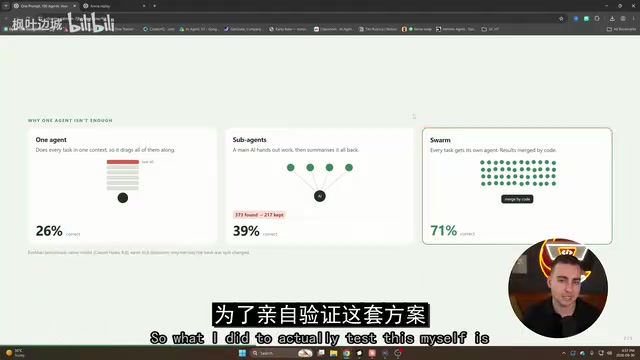
Same model. Same 563 problems. A single agent working alone solved only 26% of them — but when a swarm of agents tackled the same tasks in parallel, accuracy shot up to 71%. The model itself didn't change at all; the only difference was how the work was broken up. That's the core pitch behind EvoX Agent, an AI coding assistant, and the data point an overseas reviewer kept coming back to throughout their hands-on video.
This article is based on that reviewer's full walkthrough of EvoX Agent — from installation to a live swarm demo — breaking down what makes this new coding and productivity agent from EvoMap genuinely different.
What Is EvoX Agent
EvoX Agent is a coding and productivity agent built by EvoMap, currently available on Mac and Windows. At the baseline level, it does what Claude Code and Codex do — read codebases, write code, run commands, fix tests. All of that is present and performs as expected.
What sets it apart are three specific features:
- Swarm Collaboration: The source of that 26%-to-71% data point.
- Self-evolving Skills: After completing each task, it saves effective approaches as reusable skills, so similar work in the future is faster and cheaper.
- Automatic Multi-model Switching: Cheap models for simple tasks, powerful models for hard ones — no need to manually swap between them.
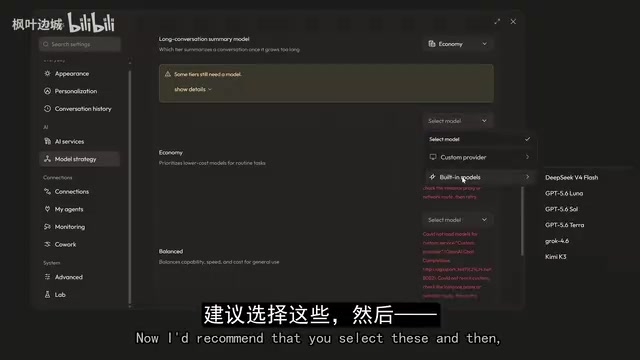
In the Model Strategy settings, users can configure model switching by difficulty: budget tier selects cheaper models like DeepSeekAd, balanced tier picks GPT or Kimi K3, and so on. The reviewer also demonstrated local model integration — through the AI Services page, you can connect LM Studio or Ollama, or point to a standalone device (like a DGX Spark) running models such as Nemotron or Qwen. That means you don't have to burn through cloud credits for everything.
Worth noting: signing up gets you 1,500 free credits with no credit card required, and during installation you can import settings, skills, and connectors from Codex and Claude Code in one click.
Why Swarm Mode Can Nearly Triple Accuracy
To understand why swarm mode matters, you first need to see the problem with a single agent. When one agent handles a large task, it drags the entire accumulated context along with it. By the time it reaches sub-task four, it's still carrying everything from sub-tasks one through three — and that's when things start getting lost.
The common fix is to introduce sub-agents: one orchestrator agent delegates tasks and collects results. That helps, but there's a catch. According to EvoMap's benchmark, the sub-agents actually found 373 correct answers — but only 217 made it into the final output. Why? Because the orchestrator responsible for merging results is itself a large language model, and it dropped correct answers during the consolidation process.
Swarm mode works differently: it isolates each task into its own independent agent with a clean context window, then merges results using code rather than a model. Nothing gets dropped in a "summary." Results are more consistent. That's the root of the gap between 71% and 26% — not a stronger model, but a better way to organize the work.
The "context window" is the key concept for understanding all of this. LLMs don't have persistent memory — they can only "see" a fixed-length text window at a time, which has to fit everything: the prompt, conversation history, code files, and more. When a single agent handles a complex project with many sub-tasks, earlier reasoning steps, intermediate results, and error messages pile up and eventually crowd out the window. The model's ability to process later instructions degrades sharply — a phenomenon sometimes called the "lost in the middle" effect, where even information technically still within the window becomes hard for the model to accurately retrieve. Swarm mode's fundamental insight is to give each sub-agent exactly one small task, starting from a blank slate, always operating at peak attention density — which sidesteps the precision loss caused by context bloat.
Three Modes in Practice
EvoX offers three modes: Chat, Cowork, and Code.
Chat mode suits advisory questions. The reviewer typed "I run a flashcard app — should I switch to the SM-2 algorithm?" and received a direct answer with reasoning.
Cowork mode is for building actual outputs. The reviewer tested it on an Indonesian flashcard app they'd previously built with Claude Code, asking EvoX to generate a PDF progress report from the app's data — number of cards per box, accuracy by category, and so on. After manually switching to a GPT model, a complete single-page report was generated in about a minute.
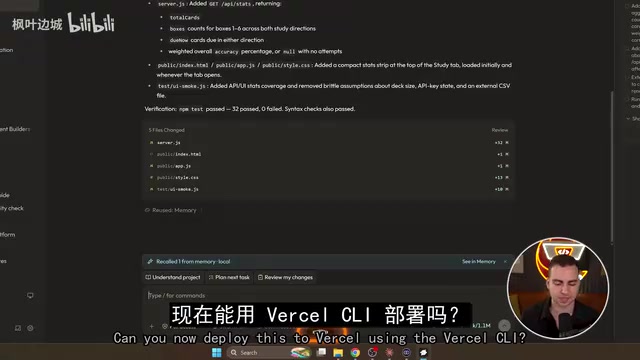
Code mode directly edits code. The reviewer asked it to add a stats bar to the top of the study tab showing total card count, per-box counts, and overall accuracy — and it passed the tests. They then asked the agent to deploy the changes via Vercel CLI, and after refreshing the page, the new analytics bar appeared correctly.
Self-evolving Skills: Accumulating Experience Like a Science Experiment
Clicking "self evolution" in the bottom-left corner reveals a full dashboard showing everything the agent has learned and all the skills it has built. The evolution follows five steps: observe, discover, reuse/improve, validate, and solidify.
The core concepts are worth unpacking:
- Gene: The smallest, tested strategy — something like "read a specific file" or "run a SQL query and handle the result." A gene only exists after the agent has successfully executed it, and it's stored in a local library.
- Capsule: An entire task and its solution packaged together. Once the agent has solved a complex problem, the full execution path is saved and can be replayed directly next time rather than re-discovered from scratch.
- Event: Every change to a gene or capsule is logged in an uneditable audit trail.
EvoMap claims that once the agent has learned common patterns from a codebase or conversation, token consumption drops by approximately 31%. The reviewer admitted they couldn't verify that figure on the spot, but based on their testing found it credible — and described the mechanism as feeling "more like a scientific approach than randomly generating skill files."
There's also an optional global network: you can inherit high-scoring genes or capsules learned by other agents, publish your own for others to reuse, and even earn additional credits through contributions. The reviewer called this "something I've barely seen in other software."
An important backdrop for understanding self-evolving skills is the limitation of traditional prompt engineering. Conventional AI coding assistants rely on developers manually providing sufficient context and instructions in each conversation — once you switch tasks or start a new session, any accumulated "know-how" vanishes. EvoX's gene and capsule mechanism is essentially an attempt to solve this stateless problem: serializing successful execution paths into persistent, structured objects rather than relying on the LLM's parametric memory. This aligns with recent research directions around "tool memory" and "experience replay." The validation step is especially critical: only strategies that have been verified through actual execution get solidified into genes, which helps prevent the agent from "learning" and preserving incorrect approaches.
A Survival Game with 100 Agents
To demonstrate swarm capabilities more vividly, the reviewer designed a survival game experiment called "arena" — spinning up roughly 100 agents, each responsible for designing one species for the game (one file, one primary task).
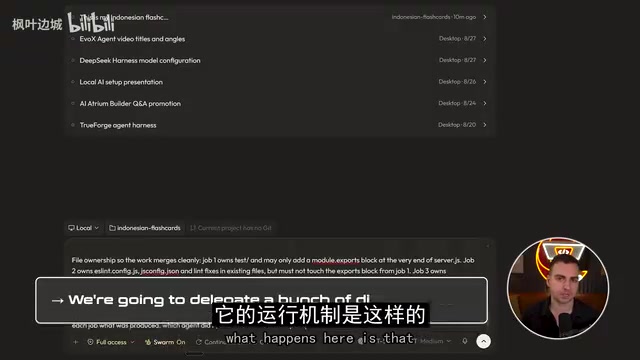
The swarm split the task into 100 parallel sub-tasks. Each agent received the same ruleset, wrote its own species, tested it, and iterated — with no visibility into what any other agent was doing, since each operated in its own independent context window. Everything finished in about 20 minutes; sequential execution would have taken several hours.
The experiment ran for two generations. In the first, agents explored strategies randomly. The reviewer then selected the best performers and prompted the model to "not copy them directly, but design new strategies based on what worked before." In the second generation, the model discovered stronger approaches — like staying put and avoiding over-aggression — and surviving species jumped from 64 out of 100 in the first generation to 99 out of 100.
In a more realistic token comparison, the swarm completed the Indonesian flashcard app task using approximately 84,000 tokens in seven to eight minutes. Running the same tasks sequentially without swarm mode took about 2.5 times longer and consumed 129,000 tokens. Even for relatively simple operations, swarm mode delivered a noticeable advantage in both token efficiency and speed.
Connections and Extensions
In the Connections settings page, you can hook the agent into Discord, LINE, Messenger, Slack, and other channels, and even scan a QR code to connect a mobile phone — meaning triggers can come from almost any integration. Like other agent harnesses, it also supports plugins, skills, apps, sub-agents, and hooks, and can import from other agents.
Final Thoughts
This walkthrough was sponsored by EvoMap, though the reviewer emphasized that everything demonstrated is available to try for free. Sponsorship aside, the swarm's core idea — merging results with code rather than asking a model to summarize — directly addresses one of the most persistent pain points in multi-agent systems: information loss caused by context bloat. The jump from 26% to 71% comes from a vendor benchmark, but the underlying logic is transparent and traceable. Self-evolving skills and the global network also offer a different kind of value compared to mainstream coding assistants. For developers already using Claude Code or Codex, EvoX feels more like a new option worth running in parallel than an immediate reason to switch.
Related articles

Chain of Thought Isn't Just for AI: How Humans Can Use CoT to Improve Thinking Quality
Chain of Thought isn't just a prompt trick for large models. Starting from a Hacker News discussion, this article analyzes why CoT works for human thinking too, breaks down actionable ways to transfer it, and highlights the key differences between human CoT and machine CoT.
Cloudflare Teams Up with OpenAI: Closi…
Cloudflare Teams Up with OpenAI: Closing the Loop from Vulnerability Discovery to Defense with AI
Cloudflare uses OpenAI Daybreak to investigate security vulnerabilities and generate reviewable remediation plans, while developers use Codex to boost coding efficiency and quality.

Orca Multi-Agent Orchestration in Practice: A Guide to Parallel Collaboration with Claude and Codex
Orca is Stable AI's free open-source agent workbench supporting 34 agents like Claude Code and Codex in parallel. Learn its Git worktree isolation, multi-model orchestration, and mobile management.