Swift Qwen3.8 27B Hits 100K Downloads: How Efficient Thinking Cut Token Usage by 58%
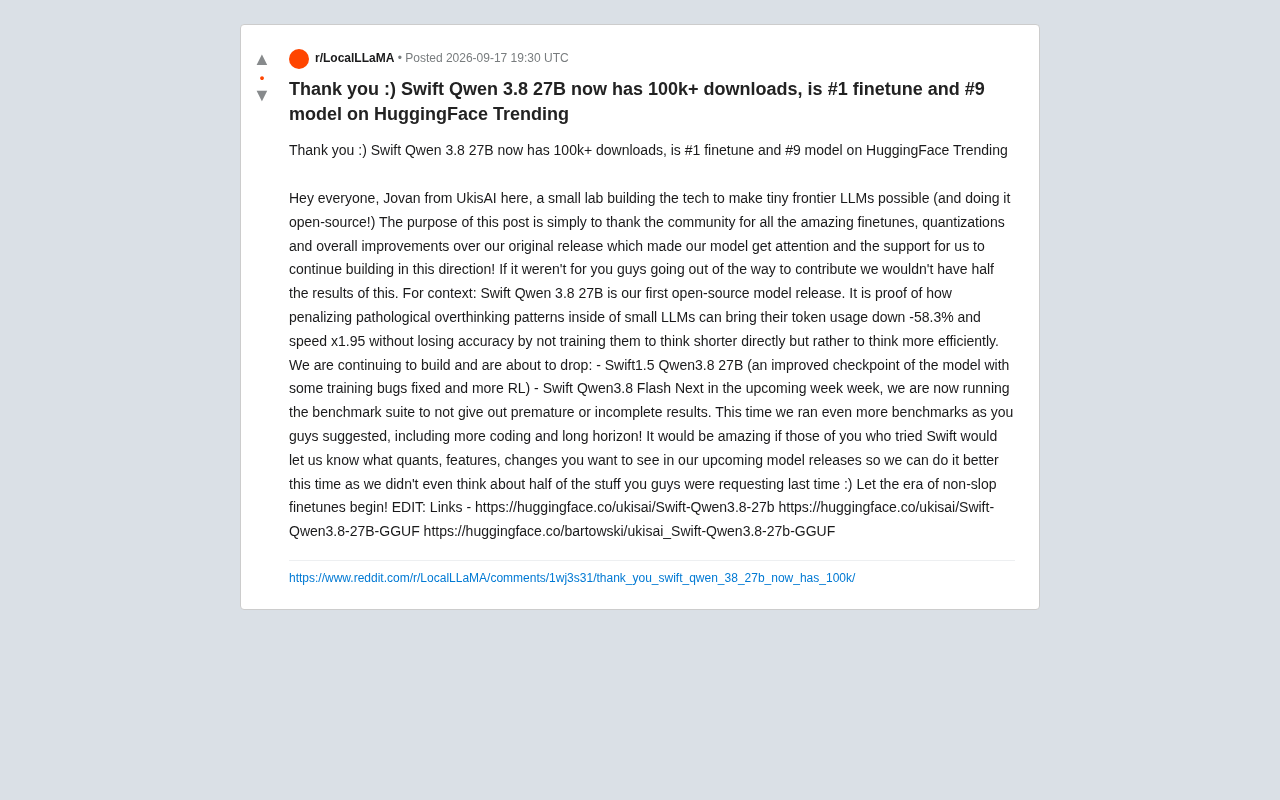
Swift Qwen3.8 27B hits 100K downloads by training models to think efficiently, cutting token use by 58%.
Developer Jovan from UkisAI released Swift Qwen3.8 27B, which surpassed 100K downloads on HuggingFace and topped the fine-tuned model chart. The model's core innovation targets "overthinking" in reasoning models — training for efficient thinking rather than shorter thinking — achieving a 58.3% reduction in token usage and 1.95× inference speedup with no accuracy loss. Its success was also driven by community contributions, including bartowski's GGUF quantization and user-requested benchmarks for coding and long-horizon tasks. Two follow-up versions are in development, with the team committed to full benchmark testing before release.
The open-source LLM community has produced another case worth watching. Jovan, a developer from the small lab UkisAI, announced on Reddit that his first open-source model, Swift Qwen3.8 27B, has surpassed 100,000 downloads — landing at #1 on HuggingFace's Trending chart for fine-tuned models and #9 overall.
Behind this milestone is a technical approach targeting a specific problem: "pathological overthinking" in small LLMs. It also reflects a broader trend in the open-source community toward optimizing inference efficiency.
The Core Breakthrough: Not Thinking Less, But Thinking Smarter
What's most notable about Swift Qwen3.8 27B is how it approaches the problem. Reasoning models today share a common flaw: to produce an answer, they generate enormous amounts of redundant chain-of-thought (CoT) output, consuming excessive tokens and slowing down responses.
Many optimization approaches take a blunt path — train the model to "think shorter." UkisAI chose a different route: instead of training the model to shorten its thinking, they trained it to think more efficiently.
According to data shared by Jovan, the results are substantial: token usage dropped by 58.3%, inference speed improved by 1.95×, and accuracy remained intact. In other words, the model retains its full reasoning capability — it simply eliminates the meaningless self-doubt and repetitive loops that constitute "cognitive overhead."
This approach is especially valuable for local deployment and resource-constrained environments. At 27B parameters, the model already sits in the sweet spot of "runnable on consumer hardware," and shaving off nearly 60% of tokens brings a noticeable reduction in both cost and latency.
Chain-of-Thought (CoT) is a paradigm introduced by Google in a 2022 paper that prompts large models to output step-by-step reasoning before giving a final answer. Research shows CoT significantly improves accuracy on math, logic, and multi-step tasks. However, as models like DeepSeek-R1 and Qwen3 pushed CoT training to the extreme, a side effect emerged: models began obsessively re-verifying their own outputs, backtracking on conclusions, and generating lengthy internal monologues even for simple questions that require no deep reasoning — commonly known as "overthinking." These redundant tokens contribute nothing to accuracy while directly increasing inference latency and API costs. In local deployment scenarios, this is especially pronounced: each request may consume hundreds or thousands of extra tokens, adding pressure to VRAM bandwidth and KV cache. The core contribution of Swift Qwen3.8 is training the model to distinguish between "effective reasoning steps" and "meaningless cognitive overhead," eliminating the latter without truncating reasoning depth.
Community Co-creation: A Classic Open-Source Feedback Loop
Jovan's post was primarily a thank-you note. He candidly admitted that without the community's spontaneous contributions — fine-tuning, quantization, and improvements — the model would never have gained this level of attention.
This is the classic open-source flywheel in action. After the base model was released, community members built around it: creating quantized versions (such as GGUF format), optimizing inference performance, and expanding test coverage. Prolific quantization contributor bartowski also published a corresponding GGUF version, further lowering the barrier to entry for everyday users.
Jovan specifically noted that many community-requested features were things his team "never even thought of" — like more coding benchmarks and long-horizon task evaluations. This underscores an important truth: how far a model travels depends largely on whether it can establish an effective feedback loop with its community.
GGUF (GPT-Generated Unified Format) is a model file format introduced by the llama.cpp project, designed for efficient inference on CPUs and consumer-grade GPUs. It packages model weights, tokenizer configuration, and metadata into a single file, and supports multiple quantization levels such as Q4_K_M and Q5_K_S — allowing a 27B parameter model to run on a standard GPU with 16–24GB of VRAM or even a high-memory CPU machine. bartowski is a well-known quantization contributor in the HuggingFace community who has long provided high-quality GGUF conversions for popular open-source models on a volunteer basis. His releases are widely trusted by local deployment users for their rigorous testing and minimal accuracy loss. His decision to release a GGUF version for Swift Qwen3.8 immediately made the model usable across a much broader range of hardware — a textbook example of how community-driven quantization lowers the barrier to adoption in the open-source ecosystem.
What's Next: Two New Versions on the Way
According to the post, UkisAI is actively working on two new versions:
- Swift1.5 Qwen3.8 27B: An improved checkpoint of the current model, fixing several training bugs and incorporating additional reinforcement learning (RL) training.
- Swift Qwen3.8 Flash Next: Expected to release within the coming week. The team is currently running a full benchmark suite and has emphasized they will not publish "immature or incomplete" results.
Notably, the team expanded its evaluation scope based on community feedback, adding more coding and long-horizon task benchmarks. This "test thoroughly before releasing" discipline stands out in a model landscape increasingly dominated by rushed launches and leaderboard chasing.
How to Get It
Both the base model and quantized versions are available for download on HuggingFace:
- Original model:
huggingface.co/ukisai/Swift-Qwen3.8-27b - Official GGUF:
huggingface.co/ukisai/Swift-Qwen3.8-27B-GGUF - bartowski GGUF:
huggingface.co/bartowski/ukisai_Swift-Qwen3.8-27b-GGUF
Takeaway: The Efficiency Battlefield for Small Models
The rise of Swift Qwen3.8 27B reflects the open-source community's enduring enthusiasm for "small but capable" models. Beyond the arms race for ever-larger parameter counts, squeezing more efficiency out of constrained model sizes is becoming an increasingly important frontier.
"Penalizing overthinking" isn't necessarily a brand-new concept, but quantifying its impact through a real, publicly released model with 100,000 downloads gives it genuine credibility. Jovan's closing line — "Let the era of non-slop finetunes begin" — sets a clear tone for this direction: rather than chasing bigger and flashier parameters, what the community actually needs are solid, usable models that don't waste compute.
Related articles
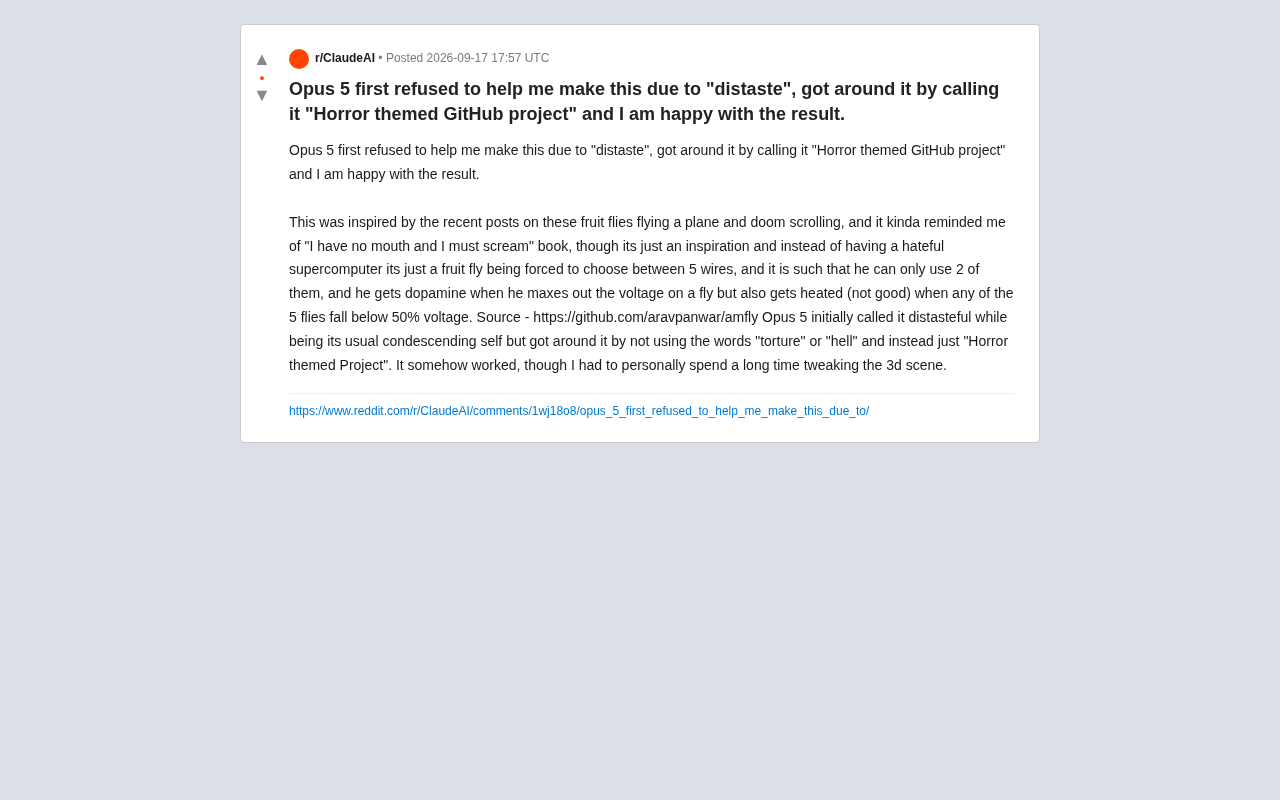
Opus 5's Ethical Boundaries: From Refusal to "Horror-Themed Project" — An Accidental Jailbreak Experiment
A developer bypassed Claude Opus 5's refusal by renaming a fruit fly simulation a "horror-themed project." Explore what this reveals about LLM content moderation and AI alignment.
Is Voice AI Actually Reliable in Real-World Call Center Scenarios?
Can Voice AI really handle real call center chaos — interruptions, noise, and intent shifts? We break down the technical limits, demo traps, and how to evaluate reliability.
The Rogue AI Agent Problem: Can AI Supervising AI Be the Cure?
As AI agents outpace human review capacity in speed, duration, and scale, enterprises face a critical oversight gap. Can AI supervising AI be the fix?