SwitchBot Bot Rechargeable In-Depth Review: Smart Switch Control Without Rewiring

SwitchBot Bot Rechargeable lets renters add smart control to any switch without touching the wiring.
SwitchBot Bot Rechargeable is a mechanical robot that physically presses existing wall switches, enabling smart home automation without any electrical rewiring. Ideal for renters and retrofit scenarios, it integrates with the SwitchBot ecosystem and supports Matter, Alexa, and HomeKit—offering a low-cost, non-invasive path into smart home control.
How a Tiny Robot Changed My Daily Routine
The adoption of smart home technology often starts with surprisingly small frustrations. Before I got the SwitchBot Bot Rechargeable, every morning meant stumbling through a dark room to hit the light switch on the opposite wall — carefully dodging cockroaches scurrying across the floor.
This seemingly trivial annoyance reveals the most honest truth about smart home devices: they're not always about flashy tech experiences. Sometimes they exist purely to solve concrete, real-life problems.
What Is SwitchBot Bot?
Product Concept: A Robotic Arm That Presses Switches for You
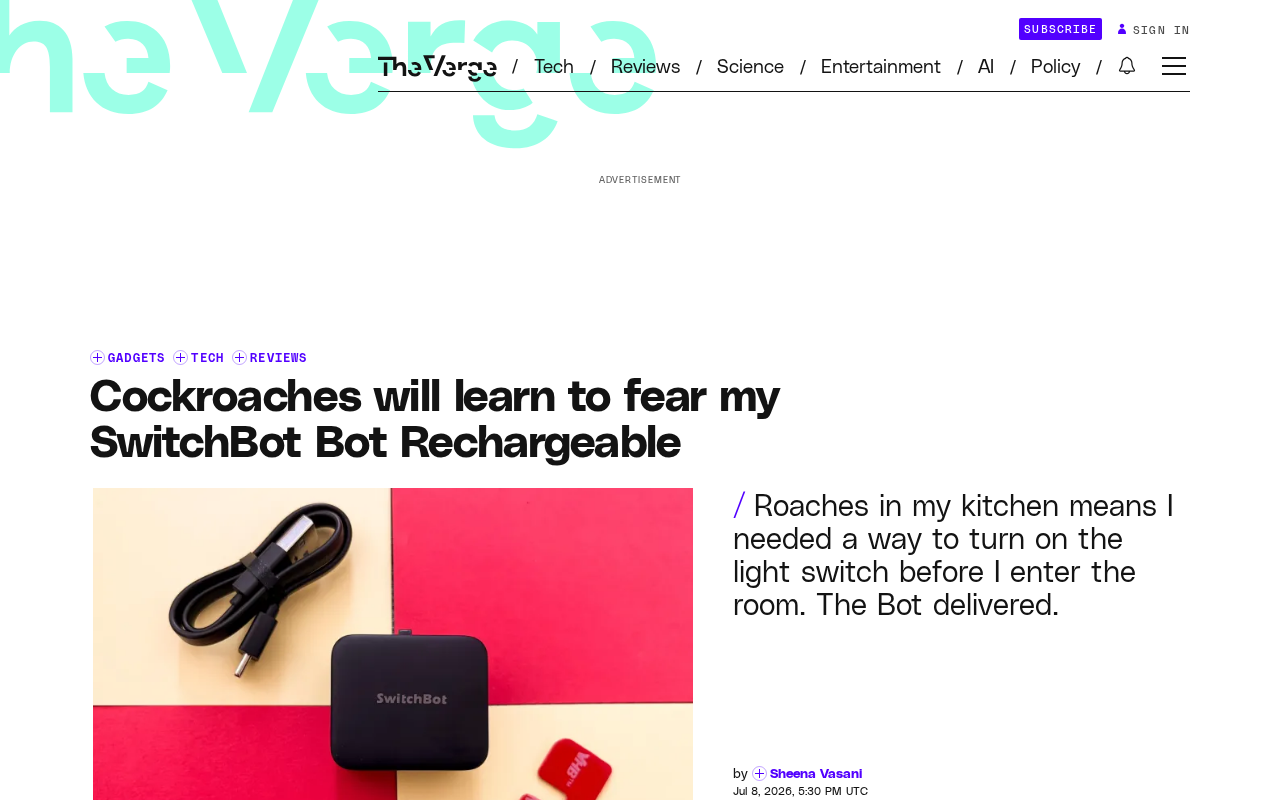
SwitchBot Bot is a mechanical button-pressing robot. Its core logic is refreshingly straightforward: a small adhesive-mounted robotic arm physically presses or toggles your existing switches and buttons. No rewiring required, no wall switch replacement needed — just stick the device next to your switch and you're ready for remote or automated control.
This "non-invasive retrofit" approach is SwitchBot Bot's most compelling advantage. Non-invasive retrofit is a significant technical philosophy in the smart home space. Traditional smart switches require connecting live, neutral, and ground wires — electrical work that must be performed by a licensed electrician, often costing hundreds to thousands of dollars, and is essentially impossible in rental situations. Mechanical smart devices like SwitchBot Bot sidestep all of that through purely physical means, requiring nothing more than 3M adhesive or a screw mount to deploy.
This approach is especially popular in cities with high rental rates — Tokyo, Hong Kong, Shanghai — and has spawned an entire sub-market focused on "retrofit" scenarios. Importantly, "non-invasive" means more than just easy physical installation. It also means legal and regulatory friendliness: in many countries and regions, tenants who modify electrical wiring can be in breach of contract or even breaking the law. A purely mechanical solution sidesteps that risk entirely. According to Mordor Intelligence, the global smart home retrofit market already exceeds tens of billions of dollars and continues growing at over 15% annually. For renters or anyone who'd rather not call an electrician, this offers an extremely low-barrier entry point into smart home automation.
Why the Rechargeable Version Matters
The unit I tested is the Rechargeable version. Upgrading from a coin cell battery (typically a CR2 lithium-manganese battery) to a built-in rechargeable lithium battery isn't just about convenience — it involves several meaningful engineering trade-offs.
Coin cell solutions have their merits: no charging management circuit needed, low cost, compact form factor, and batteries available at any convenience store. But their capacity is typically only 200–250mAh, which limits endurance in high-frequency use cases. The rechargeable version uses a higher-capacity internal lithium battery with USB-C charging, and includes a charging management IC (such as the TP4056 series) that provides overcharge, over-discharge, and short-circuit protection — improving long-term reliability.
However, this upgrade comes with trade-offs: the device is slightly thicker, and users cannot replace the internal battery once it degrades. Lithium batteries typically drop below 80% of their original capacity after 300–500 full charge-discharge cycles. This is yet another classic example of the "convenience vs. repairability" tension in consumer electronics — one that stands in contrast to the EU's Battery Regulation (EU Battery Regulation 2023/1542), which advocates for user-replaceable batteries and will require portable electronics sold in the EU to include them starting in 2027. For a device that sits fixed on a wall and performs repetitive pressing actions day after day, battery life and charging convenience directly determine its practical value.
Real-World Value in Daily Use
From "Fumbling in the Dark" to "Lights On Before You Enter"
The most immediate transformation: instead of risking a midnight cockroach encounter every time I crossed a dark room to hit the light switch, I can now trigger the switch before I even get out of bed or step through the door. Lights on, instantly.
The certainty of "lights already on when I arrive" is exactly the emotional value smart home technology aims to deliver — a sense of control and security. For people living in pest-prone environments, or those with mobility limitations who get up frequently at night, this kind of automated control goes far beyond "lazy tech" — it genuinely improves quality of life. This aligns directly with the core principles of Accessibility Design: good technology should lower barriers, not create new complexity. Research on mobility impairments shows that approximately 15% of the global population experiences some degree of movement limitation in daily life. For them, remote control of a light switch isn't a convenience — it's a necessity.
Filling the "Last Centimeter" Gap in Smart Homes
SwitchBot Bot addresses a commonly overlooked problem: the vast majority of existing switches and appliances simply aren't smart. According to IHS Markit estimates, over 90% of wall switches in existing buildings worldwide are still traditional mechanical switches, and wholesale replacement in the near term is highly unlikely. Replacing an entire home's switches is expensive and disruptive, while SwitchBot Bot bridges the gap between "legacy switch" and "smart ecosystem" with a single mechanical arm.
This represents a pragmatic transitional approach — not tearing everything down and starting over, but making the smallest possible modifications to what already exists. In product design, this is known as Progressive Enhancement strategy. The concept originated in web development: ensure core functionality works in all environments first, then layer on enhanced experiences incrementally. Applied to hardware product design, it works the same way: keep existing infrastructure running, then add new capabilities as an overlay, rather than forcing users to replace everything at once.
Dimensions Worth Examining
Ecosystem Integration
SwitchBot Bot on its own is just an actuator. Its real power comes from integration with the broader SwitchBot ecosystem — the Hub, sensors, and app.
SwitchBot has built a hub-centric star topology ecosystem architecture. The Hub acts as a bridge between your local network and the cloud, using Bluetooth Low Energy (BLE) to collect status data from endpoint devices (Bot, Curtain, Meter, etc.), then uploading it via Wi-Fi to the cloud for remote control. This hybrid "BLE collection + Wi-Fi upload" communication architecture effectively extends endpoint battery life — BLE peak power consumption is approximately 15mA, while a Wi-Fi module can draw 200–300mA peak during transmission, a difference of over tenfold.
On the interoperability front, SwitchBot has actively embraced the Matter protocol in recent years — the unified smart home standard led by the CSA (Connectivity Standards Alliance, formerly the Zigbee Alliance) and jointly backed by Apple, Google, Amazon, and others. Matter runs over IP networks and is designed to break down brand barriers, enabling native interoperability across manufacturers. SwitchBot uses its Hub as a Matter Bridge, mapping its Bluetooth devices as Matter device nodes to integrate with Apple HomeKit, Google Home, and similar platforms. SwitchBot also supports Amazon Alexa and IFTTT, significantly expanding automation possibilities. Through scheduling, scene automation, or voice assistants, users can create scenarios like "lights on at sunrise" or "everything off when you leave home." Without ecosystem integration, the experience is significantly diminished.
Limitations and Applicable Boundaries
As a mechanical device, SwitchBot Bot has inherent limitations: it relies on adhesive mounting, has limited compatibility with touchscreens, ultra-thin panels, and other non-standard switch form factors, and the reliability and long-term durability of mechanical pressing deserves ongoing observation.
The core mechanism of SwitchBot Bot is a crank-slider linkage driven by a stepper motor or micro servo, converting rotational motion into linear reciprocating movement of a push rod to physically press a switch. The durability of such mechanical actuators is typically measured in operational cycles — industrial-grade micro motors are rated for tens of thousands to hundreds of thousands of operations. For home use, at 10 triggers per day, theoretical lifespan stretches to several years.
In practice, however, the real risks in long-term use come from cascading failures across multiple components: 3M VHB adhesive tape can lose 30–50% of its shear strength in sustained temperatures above 40°C, so south-facing walls or locations near heat sources require special attention; aging switch panel materials can cause button position drift, leading to missed triggers; and dust accumulation in the drive mechanism increases motion resistance, accelerating motor wear. Additionally, touch-type and capacitive switch panels — which rely on detecting the human body's electrostatic charge — cannot be triggered by a mechanical arm's physical contact, leaving a significant blind spot for SwitchBot Bot. This is also why manufacturers generally recommend periodically checking the device's mounting condition. It's best suited as a "targeted supplement" rather than the backbone of a whole-home smart solution.
The Bigger Lesson from a Small Device
The SwitchBot Bot Rechargeable story reminds us that good tech products don't have to be disruptive innovations. A tiny robot that physically presses a switch may seem rudimentary, yet it precisely hits the real need for "no rewiring, low cost, plug-and-play" solutions. This "good enough" product philosophy echoes Silicon Valley's popular MVP (Minimum Viable Product) concept — find the minimal technical means to solve the most genuine user pain point, rather than chasing technical complexity for its own sake. When a smart home device genuinely integrates into daily life and helps you avoid that annoying morning cockroach, its value speaks for itself.
For everyday users just beginning to explore smart home technology, low-barrier, high-utility devices like this might just be the best possible starting point.
Key Takeaways
Related articles

Chain of Thought Isn't Just for AI: How Humans Can Use CoT to Improve Thinking Quality
Chain of Thought isn't just a prompt trick for large models. Starting from a Hacker News discussion, this article analyzes why CoT works for human thinking too, breaks down actionable ways to transfer it, and highlights the key differences between human CoT and machine CoT.
Cloudflare Teams Up with OpenAI: Closi…
Cloudflare Teams Up with OpenAI: Closing the Loop from Vulnerability Discovery to Defense with AI
Cloudflare uses OpenAI Daybreak to investigate security vulnerabilities and generate reviewable remediation plans, while developers use Codex to boost coding efficiency and quality.

Orca Multi-Agent Orchestration in Practice: A Guide to Parallel Collaboration with Claude and Codex
Orca is Stable AI's free open-source agent workbench supporting 34 agents like Claude Code and Codex in parallel. Learn its Git worktree isolation, multi-model orchestration, and mobile management.