Switching from LLM APIs to Self-Hosting: Does the Math Actually Work Out?

An engineer's Reddit post reveals the hidden costs of self-hosting LLMs that go far beyond GPU rental fees.
This article examines a Reddit thread in which an infrastructure engineer publicly asks when API bills justify switching to self-hosted LLMs. It systematically covers the key decision dimensions: true self-hosting costs extend well beyond GPU rental to include idle time, engineering labor, and 24/7 on-call responsibility; cold start latency, autoscaling complexity, OOM errors, and 2 AM pages are the most common operational pain points; and some teams that tried self-hosting eventually switched back due to unexpected operational burden and open-source models' inability to keep pace with API vendors' continuous model updates. The article concludes with a practical decision framework: self-hosting only makes sense when volume is high, traffic is stable, the team has MLOps capacity, open-source model quality is acceptable, and full TCO is lower than API costs.
One Infrastructure Engineer's Hard Question
On Reddit, a developer identifying as an infrastructure engineer posed a question that countless teams wrestle with: When does self-hosting a large language model (LLM) actually make financial sense compared to paying for API access? His frustration was palpable — nearly every blog post he'd found gave the same non-answer: "it depends." That's hardly useful guidance for making a real decision.
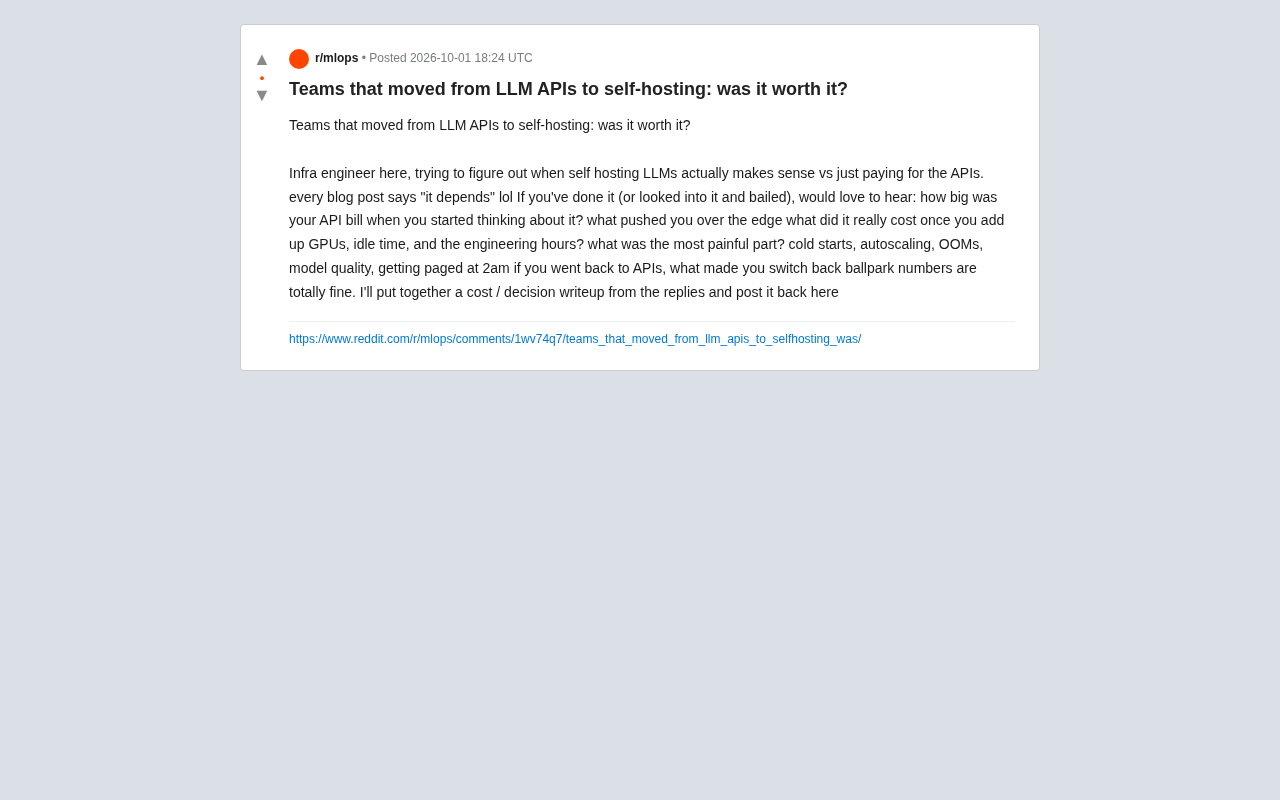
The question resonated widely because it cuts to the heart of one of the most practical cost trade-offs in modern AI engineering. As API bills from OpenAI, Anthropic, and others continue to compound, more and more teams are asking themselves: does building your own GPU cluster and maintaining an inference service actually save money, or does it just create a new set of headaches?
The Trigger Point: How Big Does Your API Bill Have to Get?
The first core question the poster raised was blunt — what was your API bill when you first started considering self-hosting? This is really where the entire decision chain begins.
For most teams, API costs are nearly negligible in the early stages. The real inflection point typically arrives after usage scales up: when monthly bills jump from a few hundred dollars to tens of thousands, the fixed-cost model of self-hosting starts to look attractive. Per-token pricing compounds quickly under high-concurrency, high-frequency workloads, while the marginal cost of self-hosting stabilizes once you've purchased or committed to GPU hardware.
But there's a trap that's easy to miss: API bills are visible costs, while self-hosting costs are hidden and distributed. Simply comparing "monthly API spend" to "monthly GPU rental" is a dangerously oversimplified analysis.
The Real Costs Go Far Beyond GPU Rental
The original post made a point of emphasizing that when calculating the full picture, you can't just look at GPU pricing — you also need to account for idle time and engineering hours.
This is precisely where self-hosting is most commonly underestimated:
- GPU utilization: If your traffic has significant peaks and valleys, the GPUs you provisioned for peak load sit idle during off-peak hours — but you're still paying for them. This idle cost often erodes the theoretical savings.
- Engineering labor: The time spent building and maintaining inference services, monitoring, and tuning translates into salary costs that can be substantial. For small teams, this can easily exceed the API bill itself.
- Opportunity cost: Engineering resources devoted to infrastructure maintenance are resources not spent building core product features.
In other words, self-hosting converts "variable cash expenditure" into "fixed assets plus labor investment." Whether that conversion is worthwhile depends heavily on your specific usage patterns.
The Real Pain Points: Cold Starts, Autoscaling, and 2 AM Pages
The poster called out several of the most maddening aspects of running self-hosted inference — the kind of details only someone who's been burned by them in production would immediately think of:
Cold Starts
Loading a large model into GPU memory takes time. The first request can face delays of tens of seconds. For applications requiring immediate responses, this is a fatal user experience problem — but keeping the model resident at all times circles right back to the idle cost problem.
Autoscaling
Scaling GPU instances up and down is far more complex than scaling ordinary web services. Slow model loading, combined with scarce and expensive GPU resources, makes it extremely difficult to scale both responsively and economically.
OOMs and Model Quality
Long contexts and high concurrency can both trigger OOM (Out of Memory) errors. On top of that, whether open-source self-hosted models can match the quality of flagship API models is a variable that requires repeated validation.
Getting Paged at 2 AM
The poster half-jokingly mentioned "getting paged at 2am" — and this is perhaps the most invisible cost of self-hosting: 24/7 operational responsibility. API service availability is guaranteed by the vendor; self-hosting means your team becomes its own SRE.
OOM (Out of Memory) is a stability threat unique to LLM inference services, fundamentally different from memory issues in ordinary applications. GPU VRAM is a physically isolated, fixed resource — unlike CPU memory, it cannot be temporarily extended through virtual memory or swap. Loading a 70B-parameter model onto an 80GB A100 leaves very limited room for the KV Cache (the buffer storing intermediate inference states). As concurrent requests increase and context windows grow, the KV Cache rapidly exhausts available VRAM, triggering an OOM that crashes the entire inference process rather than degrading gracefully. This means self-hosting teams must carefully manage concurrency limits, maximum context lengths, and capacity planning for different scenarios — a specialized operational discipline that cannot be resolved through simple configuration.
Going Back to the API: Why Do Some Teams Switch Back?
The post also specifically asked teams that tried self-hosting and returned to APIs what drove their decision to revert.
The value of this question lies in surfacing a reality that marketing narratives tend to obscure: self-hosting isn't a one-way technical upgrade — it's a reversible trade-off. Common reasons for switching back typically include: operational burden exceeding the team's capacity, actual cost savings falling short of projections, and model quality or iteration speed failing to keep pace with API vendors' release cadence.
API vendors continuously ship stronger and cheaper models — this "free upgrade" is an advantage that self-hosting simply cannot match. While your self-hosted model sits at a fixed version, the API may have iterated through several generations.
A Decision Framework for Teams on the Fence
Drawing on the threads of this discussion, here's a more practical way to think through the decision — rather than the useless "it depends":
- Evaluate scale and stability: Self-hosting's cost advantages only materialize when call volume is high, traffic patterns are stable and predictable, and GPU utilization can be maintained at a high level.
- Assess team capability: Do you have dedicated infrastructure or MLOps engineers to take on operational ownership? Without them, labor costs will quietly erase any savings on paper.
- Consider quality tolerance: Can your use case accept the quality level of open-source models, and the cost of not being able to adopt frontier model updates in real time?
- Calculate full TCO: GPU costs + idle costs + engineering labor + operational risk, compared against your API bill — that's the only fair comparison.
This crowdsourced investigation, sparked by a single engineer's post, is essentially a process of using frontline production experience to push back against vague theoretical advice. For any team evaluating this path, the checklist of questions it surfaces is itself the most valuable starting point for making the decision.
TCO (Total Cost of Ownership) is the core financial framework for evaluating self-hosting versus API solutions, but in practice, several categories of hidden costs are easy to miss. First, network and storage costs: model weight files can run from tens to hundreds of gigabytes, and the costs of downloading models during node restarts or scale-out events, plus distributed storage fees, are non-trivial. Second, compliance and security investment: self-hosting means your team bears full responsibility for data security audits, access controls, and vulnerability remediation — this is especially significant in regulated industries like finance and healthcare. Third, experimentation and iteration costs: switching models under an API model is nearly zero-cost, while every model upgrade in a self-hosted environment requires re-running performance tests, VRAM assessments, and load tests. Factoring these costs into the TCO calculation typically raises the break-even point for self-hosting significantly.
Related articles

Chain of Thought Isn't Just for AI: How Humans Can Use CoT to Improve Thinking Quality
Chain of Thought isn't just a prompt trick for large models. Starting from a Hacker News discussion, this article analyzes why CoT works for human thinking too, breaks down actionable ways to transfer it, and highlights the key differences between human CoT and machine CoT.
Cloudflare Teams Up with OpenAI: Closi…
Cloudflare Teams Up with OpenAI: Closing the Loop from Vulnerability Discovery to Defense with AI
Cloudflare uses OpenAI Daybreak to investigate security vulnerabilities and generate reviewable remediation plans, while developers use Codex to boost coding efficiency and quality.

Orca Multi-Agent Orchestration in Practice: A Guide to Parallel Collaboration with Claude and Codex
Orca is Stable AI's free open-source agent workbench supporting 34 agents like Claude Code and Codex in parallel. Learn its Git worktree isolation, multi-model orchestration, and mobile management.