Synter Canvas: How an AI Agent Manages 30+ Ad Platforms with Guardrails
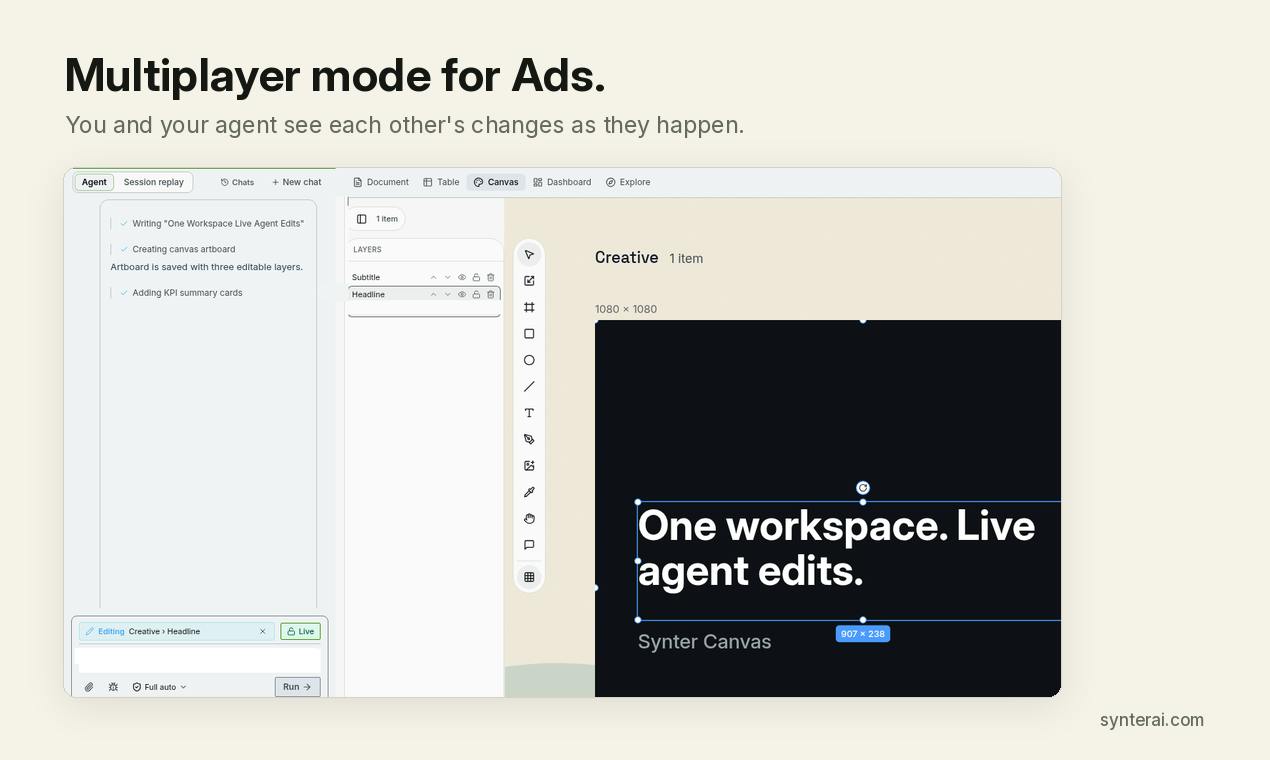
Synter Canvas uses a guardrailed AI Agent to take over ad delivery across 30+ platforms, billed per verified write.
Synter Canvas is the #5-ranked AI ad delivery tool on Product Hunt. It uses an autonomous Agent to build, launch, and optimize campaigns across 30+ ad platforms, with safety gates and guardrails on every change to reduce the risk of AI mishandling budgets. Pricing is $0.25 per verified write with a 0% cut of ad spend. Platform coverage is only a starting point—per-platform depth and guardrail granularity are what really determine the experience.
Ad management has long been a "manual grind": copying creatives across platforms, adjusting budgets by hand, and watching data late into the night. Synter Canvas, ranked #5 on Product Hunt, offers another approach—letting an AI Agent take over the entire workflow from building campaigns to optimizing delivery, covering 30+ ad platforms, with safety guardrails on every change.
Core mechanism: Agent execution + guardrail audits
Synter Canvas's positioning is clear: "Your AI agent builds, launches and optimizes campaigns across 30+ ad platforms." It's not a simple bulk-upload tool, but an Agent capable of autonomous decisions—building campaigns, launching, and optimizing are all within its scope.
What's truly worth noting is how it handles risk. Once ad budgets are mishandled by AI, the losses are real money, so the product sets safety gates and guardrails on every change. This means each Agent action isn't "executed directly"—it only takes effect after constraints and checks. For marketing teams handing their accounts over to AI, this layer of design does more to allay concerns than "how many platforms it covers."
AI Agent is fundamentally different from traditional automation scripts. Scripts execute mechanically according to preset rules, while an Agent has goal-oriented autonomous decision-making: it can judge what to do next based on account data, platform feedback, and target metrics—for example, proactively pausing and replacing a creative set when it detects declining conversion rates. Synter Canvas's claimed end-to-end "build, launch, optimize" workflow is precisely a manifestation of this closed-loop decision-making. But the higher the autonomy, the greater the risk of errors, which is why "guardrails" have become an indispensable companion design for Agent products—they insert a layer of policy validation between the Agent's decisions and real operations.
Safety gates are an approval mechanism triggered manually or by rules. Unlike guardrails that allow everything automatically, safety gates are typically used for high-risk actions—such as a single budget adjustment exceeding a set threshold or batch-pausing a large number of ad groups—in which case the Agent's action is suspended pending human confirmation or secondary validation before actually being submitted. This layered design lets teams allocate control by risk level: low-risk operations fully automated, high-risk operations requiring review, achieving a balance between efficiency and controllability.
Billing logic: pay per verified write, no cut of ad budget
Synter Canvas adopts a notably restrained pricing model: $0.25 per verified write, and a 0% cut of ad spend.
The "$0.25 per verified write" pricing is directly tied to how the Agent works—the AI is charged each time it completes an operation confirmed by the system, pay-as-you-go. The 0% ad spend cut directly addresses many ad teams' frustration with third-party tools skimming off the top: a tool shouldn't take a slice of your media budget.
The subtext of this combination is that the product hopes to create value through the Agent's automation capabilities themselves, rather than relying on a share of ad spend. For teams with large ad budgets, the cost-structure difference from a 0% cut will be very tangible.
A "verified write" can be understood as a change operation that the Agent submits to an ad platform and that the system confirms as successful—such as creating a new ad group, modifying a bid, or adjusting a budget. The emphasis on "verified" is because API calls can fail due to platform rate limits, parameter errors, or permission issues; only writes confirmed as effective are billed, preventing users from paying for invalid operations. This usage-based pricing model is becoming increasingly popular among AI Agent products—it ties costs to actual value-producing actions rather than charging per seat or subscription period.
What does 30+ platform coverage mean?
Multi-platform coverage is an old topic for ad tools, but 30+ platform coverage executed by an Agent is another matter. Manually moving creatives between platforms and aligning bidding strategies is inherently slowed down by differences in platform rules; the Agent's value lies in consistently implementing "the same set of delivery intent" across platforms and automatically optimizing under guardrail constraints.
However, the claimed number of platforms is only a starting point, not the end. What really determines the experience is the depth of adaptation for each platform—which platforms can be fully automated, which can only be semi-automated, and whether guardrail judgments are equally reliable across different platforms. These details have not yet been elaborated in the current product description.
How much control should be left to AI?
Synter Canvas's design actually raises a question the industry is facing: where is the boundary of ad automation?
Its answer is "autonomy with guardrails"—the Agent has execution authority, but major or sensitive changes must pass through safety gates. This is a pragmatic compromise: it preserves the efficiency of the Agent's cross-platform batch operations while avoiding the uncontrollable risks of fully letting go. For teams considering introducing an AI Agent to manage advertising, the specific granularity of this guardrail mechanism—which operations are intercepted and which are allowed through—may be more worth focusing on during the trial phase than the number of platforms.
Looking at Product Hunt data, the product received 89 votes and 10 comments, ranking #5, indicating that the direction of "AI Agent managing ads" indeed has market attention. But whether it can deliver on the promise of "secure automation across 30+ platforms" ultimately depends on the reliability of the guardrails and the Agent's performance in real accounts.
One-line Summary
Synter Canvas uses a guardrailed AI Agent to take over ad delivery across 30+ platforms, billed per verified write.
Paragraph Summary
Synter Canvas is the #5-ranked AI ad delivery tool on Product Hunt, centered on using an autonomous Agent to complete the full workflow of building, launching, and optimizing campaigns across 30+ ad platforms. Its key design is that every change is constrained by safety gates and guardrails, reducing the risk of AI mishandling budgets. The pricing model is restrained: $0.25 per verified write and a 0% cut of ad spend, creating value through automation capabilities rather than a share of spend. The article notes that 30+ platform coverage is only a starting point; the depth of adaptation per platform and the granularity of guardrail judgments are the real determinants of the experience. The product's proposed "autonomy with guardrails" is a pragmatic compromise on the boundary of ad automation, but whether the promise can be delivered still requires trial validation.
Related articles

ApexW Optimizer Benchmark: Matches 8-bit AdamW in Unsloth with Lower Memory Usage
Developer shares benchmark of ApexW optimizer in Unsloth: ApexW 8bit has lower optimizer state memory (47.101 MB) and slightly better final loss than 8-bit AdamW, but similar speed. Needs independent reproduction.

US Computer Science Enrollment Drops 12.4% — Is CS Still Worth Studying?
CS enrollment fell 12.4% while health majors grew 6.2%. A CS master's grad explains why the degree's real value isn't coding but systems thinking.
Training 15+ Models on Your Own Data to Predict Blood Glucose: A Personal Health Data Modeling Case Study
A Reddit user trained 15+ machine learning models on personal blood glucose and metabolic data, revealing the technical challenges, overfitting risks, and implications for personal AI health apps.